
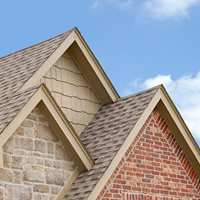
The roof forms a big part of your property’s character and its design is influenced by various factors. This would include: the nature of your building, its construction and proposed use; available materials; your budget; and, any local or national laws covered by building regulations and planning permission.
Such considerations mean that roof design is complex – it also involves making important safety calculations about the size and strength of materials needed to support a structure – so is often best left to experts with relevant experience.
A roof will be one of two basic styles, pitched or flat. But whichever you choose, its main purpose is to provide protection from the elements, making regular inspection and maintenance essential.
Pitched roofs
Pitched roofs have two or more slopes that rise to a peak, with at least one slope at an angle of more than 10 degrees from the horizontal.
A roof’s pitch is the angle at which it rises from its lowest to highest point.

Traditionally produced pitched roofs are made on site by skilled joiners using load-bearing cross walls to support substantial timber beams. As a result, the structure is strong with plenty of open space in the loft area; this allows complicated and tailored roof designs – including living areas – to be created, and the floor joists used for light storage. The craftsmanship, materials and time involved make this option more expensive than the ‘trussed roof’ modern alternative.
Construction of a trussed roof is quick, thanks to the use of lightweight, pre-made, rigid supporting frames that are delivered on site, ready to be lifted into place by a crane and fixed on top of load-bearing walls. Unless attic trusses are specified on ordering, loft space is limited, meaning there is little room for storage and lots of extra work would be needed to create a living area.
Both types of roof are normally covered with overlapping slates or tiles made from clay or concrete, which are secured to evenly spaced battens.
A layer of felt underneath the battens helps to stop warm air from inside the roof forming condensation on the cold underside of the covering, which could cause timbers to rot. The felt also acts as a barrier to dirt and pollution entering the building.
In the UK, pitched roofs often have a gable roof – which is relatively cheap to install – or are hipped roof requiring a more complex internal framework that makes this the more expensive option. Sometimes, a mixture of both styles is used to meet the owner’s needs and to add individuality to the property’s design.
Flat roofs

Flat roofs are common in Britain, particularly for comparatively small structures like extensions and garages.
This horizontal form of roofing – essentially a waterproof covering on top of a base attached to ceiling joists – allows water to drain away via a very slight slope of a few degrees.
While relatively inexpensive compared with a pitched roof, your choice of covering material – eg felt, fibreglass, metal, rubber or synthetic polymer – will influence the cost.