
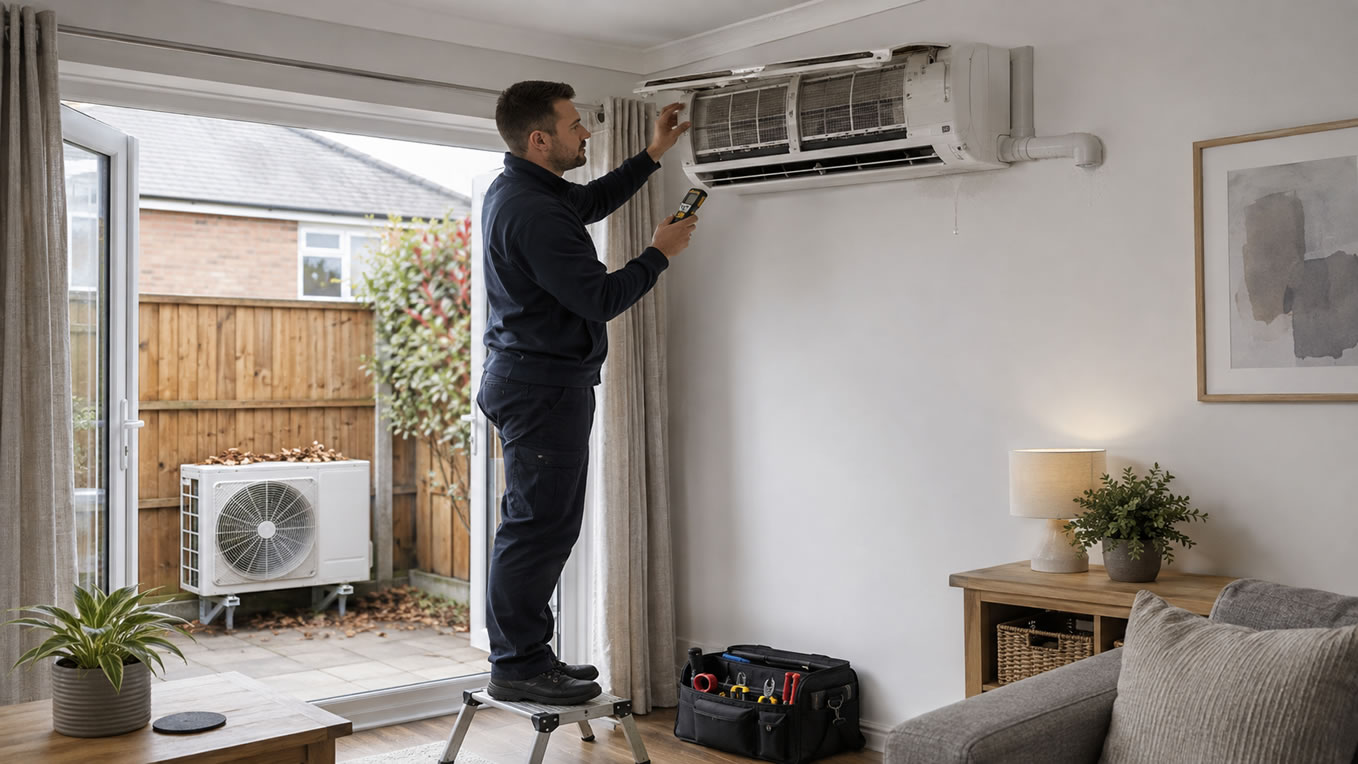
Home air conditioning can be easy to forget about when it appears to be working normally.
However, just like a boiler, car or heat pump, an air conditioning system benefits from regular inspection and servicing. Filters become dirty, coils collect dust, condensate drains can block and components gradually wear.
Often, the first sign of a problem is not a complete breakdown.
Instead, homeowners may notice that the system:
- Takes longer to cool the room
- Sounds different
- Smells unusual
- Uses more electricity
- Drips water
- Blows less air than before
These warning signs do not always mean the air conditioning needs an expensive repair. In many cases, a service may identify a relatively minor issue before it develops into something more serious.
Here are six common clues that your air conditioning system may be due for attention.
What Does an Air Conditioning Service Include?
A typical domestic air conditioning service may involve checks such as:
- Cleaning or inspecting filters
- Inspecting indoor unit coils
- Checking outdoor condenser condition
- Checking airflow
- Cleaning condensate drains
- Checking refrigerant pressures where appropriate
- Inspecting electrical connections
- Checking fan operation
- Looking for unusual vibration
- Testing operating temperatures
- Checking the remote or controls
- Looking for signs of refrigerant leakage
- Confirming heating and cooling modes operate correctly
Exactly what is included depends on the type of system and service package.
How Often Should Home Air Conditioning Be Serviced?
For many residential systems, an annual professional service is a sensible starting point.
However, more frequent attention may be useful where the system:
- Runs every day
- Operates in a dusty room
- Serves a home office
- Runs in heating mode throughout winter
- Is installed in a conservatory
- Contains several indoor units
- Serves commercial premises
Filters may need cleaning much more regularly than the full system requires professional servicing.
Clue 1: The Room Is Taking Longer to Cool
One of the clearest warning signs is reduced cooling performance.
You may notice that the unit:
- Runs for longer
- Struggles on warm days
- Never reaches the selected temperature
- Takes much longer than it used to
- Cools one side of the room better than another
A decline in performance can have several causes.
Dirty Air Filters
A dirty filter restricts airflow through the indoor unit.
This can reduce:
- Cooling performance
- Heating performance
- Air circulation
Fortunately, this is often one of the easiest problems to address.
Many modern wall-mounted air conditioners have washable filters behind the front panel.
Always follow the manufacturer’s instructions before removing or cleaning them.
Dirty Indoor Coil
Dust can gradually collect on the heat exchanger.
If airflow through the coil becomes restricted, the system may have to work harder to deliver the same cooling.
This is one reason professional servicing goes beyond simply wiping the exterior of the unit.
Dirty Outdoor Unit
The outdoor condenser needs airflow too.
Performance can suffer if the unit becomes obstructed by:
- Leaves
- Dirt
- Vegetation
- Debris
The area around the outdoor unit should remain reasonably clear.
Low Refrigerant or Refrigerant Leak
An air conditioner is designed to operate with a specific refrigerant charge.
If refrigerant has escaped from the system, cooling performance may fall.
Refrigerant should not normally need routine “topping up” without a reason.
If charge is low, the installer should investigate whether a leak exists.
Is Reduced Cooling Always a Fault?
No.
Performance can also appear worse because:
- Weather is unusually hot
- Doors and windows are open
- Room use has changed
- New electrical equipment generates more heat
- The unit is undersized for the space
A service can help determine whether the system itself is responsible.
Clue 2: Airflow Feels Weaker Than Before
Stand a reasonable distance from the indoor unit and compare the airflow with how you remember it operating previously.
A noticeable reduction can indicate that servicing is overdue.
Possible causes include:
- Dirty filters
- Dirty coil
- Fan problem
- Obstructed air path
- Fault with internal components
Weak Airflow From One Side of the Unit
Uneven airflow can sometimes occur where:
- Filters are heavily contaminated
- Louvres are obstructed
- Fan wheel is dirty
- Internal components need attention
Do not poke objects into the unit or attempt to dismantle the fan assembly.
Why Airflow Matters
An air conditioner needs to move a substantial volume of air across the heat exchanger.
Restricted airflow can cause:
- Longer running times
- Reduced comfort
- Higher electricity use
- Poor temperature control
Servicing helps maintain the airflow the system was designed to deliver.
Clue 3: Your Air Conditioner Has Started Smelling
An air conditioning system should not normally produce strong unpleasant smells.
If it does, arrange an inspection.
Common descriptions include:
- Musty
- Damp
- Sour
- Stale
- Burning
- Electrical
Different smells can suggest very different problems.
Musty Smells
Musty odours can be associated with:
- Moisture
- Dust
- Dirty filters
- Contamination within the indoor unit
- Condensate drainage issues
Air conditioners naturally create condensation while cooling, so keeping the drainage system clean is important.
Damp or Stale Smell
This may become particularly noticeable:
- When unit first starts
- After system has not been used for months
- During humid weather
Cleaning filters and servicing internal components may improve the problem.
Burning Smell
A burning or strongly electrical smell requires more caution.
Switch the system off and arrange professional inspection.
Possible causes could include:
- Electrical component issue
- Overheating motor
- Wiring problem
Do not continue running the air conditioner simply to see whether the smell disappears.
Does Air Conditioning Cause Mould?
A properly installed and maintained air conditioner should manage condensation through its drainage system.
However, contamination can develop where moisture and dirt accumulate.
Regular cleaning and servicing can reduce this risk.
Clue 4: The Indoor Unit Is Dripping Water
Water dripping from the indoor unit deserves attention.
During normal cooling, moisture from the air condenses on the cold indoor coil.
That water should normally flow:
- Into the condensate tray.
- Through a drain pipe.
- Away from the unit.
If something goes wrong, water may appear inside the room.
Common Reasons an Air Conditioner Leaks Water
Possible causes include:
- Blocked condensate drain
- Dirty drain tray
- Damaged drain pipe
- Incorrect fall on drainage pipe
- Frozen indoor coil
- Poor installation
Why Condensate Drains Block
Drainage pipes can gradually accumulate:
- Slime
- Dust
- Algae
- Debris
A service can include checking and cleaning the condensate system.
Do Not Ignore Small Drips
A small leak may seem harmless.
However, repeated moisture can damage:
- Plaster
- Paint
- Wallpaper
- Flooring
- Furniture
It can also encourage damp staining.
Water From the Outdoor Unit
Water outside is not necessarily a fault.
When operating in heating mode, air conditioning systems can produce water at the outdoor unit during defrost cycles.
The key distinction is between normal drainage and water appearing somewhere it should not.
Clue 5: The Air Conditioner Has Become Noisy
Air conditioning units make some noise during normal operation.
However, a change in sound can indicate that something needs checking.
Listen for:
- Rattling
- Buzzing
- Clicking
- Grinding
- Whistling
- Humming
- Vibration
Rattling
Possible causes include:
- Loose cover
- Loose fixing
- Debris
- Fan issue
- Vibration against wall
A simple loose panel may be straightforward to correct.
Buzzing
Buzzing could relate to:
- Electrical components
- Fan motor
- Outdoor unit
- Vibration
Persistent unusual buzzing is worth investigating.
Grinding or Scraping
This may suggest a mechanical issue.
Turn the system off if the sound is severe.
Continuing to run it could potentially make the fault worse.
Outdoor Unit Noise
The outdoor condenser contains:
- Compressor
- Fan
- Electrical components
Therefore, some operating noise is normal.
However, a significant change in volume or vibration may justify a service.
Vibration Through the Wall
Wall-mounted outdoor units can sometimes transmit vibration through the building.
Possible issues include:
- Worn vibration mounts
- Loose brackets
- Pipework touching structure
An installer may be able to reduce it.
Clue 6: Your Electricity Use Has Increased
An air conditioner that is working harder than necessary can use more electricity.
If usage rises without an obvious reason, the system may benefit from servicing.
Potential causes include:
- Restricted filters
- Dirty coils
- Reduced airflow
- Incorrect settings
- Refrigerant issue
- Faulty sensor
- Worn components
Compare Like With Like
Energy use naturally changes with:
- Outdoor temperature
- Number of hours used
- Thermostat setting
- Number of rooms cooled
Therefore, a higher bill does not automatically prove the air conditioning has developed a fault.
Compare similar periods where possible.
Lower Temperature Settings Do Not Cool the Room Faster
Setting the air conditioner to an extremely low temperature does not necessarily make the room cool dramatically faster.
Instead, it can cause the system to run for longer.
A sensible set temperature is usually more efficient.
Bonus Clue: The System Is Frequently Turning On and Off
Frequent short cycles can indicate an issue.
Possible causes include:
- Temperature sensor problem
- Incorrect sizing
- Dirty filters
- Control fault
- Installation issue
However, inverter systems naturally vary their output, so not every change in compressor operation is abnormal.
A technician can determine whether the behaviour is expected.
Bonus Clue: Ice Is Forming on the Indoor Unit
Ice on:
- Coil
- Pipework
- Indoor unit
can indicate a problem.
Possible causes include:
- Restricted airflow
- Dirty filters
- Refrigerant issue
- Fan problem
Turn the system off and allow the ice to melt naturally.
Do not chip it off.
Bonus Clue: Your Air Conditioner Keeps Showing an Error Code
Modern systems can display diagnostic codes through:
- Indoor unit lights
- Controller
- Remote
- App
If an error repeatedly returns, note the exact code.
Do not repeatedly reset the system without investigating the underlying problem.
Bonus Clue: The System Is Several Years Old and Has Never Been Serviced
Even if everything appears normal, a system that has operated for years without inspection may benefit from a service.
Preventative maintenance can identify:
- Dirty components
- Loose electrical terminals
- Drainage issues
- Deteriorating insulation
- Early leaks
before they become obvious faults.
Air Conditioning Service vs Repair
These terms are sometimes confused.
Air Conditioning Service
Generally preventative.
It may include:
- Cleaning
- Inspection
- Testing
- Minor adjustments
Air Conditioning Repair
Addresses a specific fault.
Examples include:
- Failed fan motor
- Broken control board
- Refrigerant leak
- Failed sensor
- Damaged condensate pump
A service may identify a repair that then needs separate work.
Air Conditioning Service vs Maintenance
Maintenance is the broader term.
It can include:
- Regular servicing
- Filter cleaning
- Repairs
- Replacement components
- Refrigerant checks
For larger systems, planned maintenance may involve scheduled visits throughout the year.
Typical Air Conditioning Service Costs
Broad UK budgeting figures might include:
| Service | Typical Cost |
|---|---|
| Single home AC unit service | £80–£150 |
| Two-unit service | £120–£220 |
| Multi-split system | £150–£300+ |
| Basic fault diagnosis | £80–£180 |
| Condensate drain cleaning | £80–£180 |
| Minor repair alongside service | £100–£300+ |
| Commercial maintenance visit | £150–£500+ |
Costs vary according to:
- Location
- System size
- Number of units
- Access
- Faults
- Manufacturer
London and the South East may cost more. Same as types and models set air conditioning repairs prices.
Is Air Conditioning Servicing Worth It?
For a regularly used system, generally yes.
A service can help:
- Maintain performance
- Reduce avoidable faults
- Keep drainage clear
- Maintain airflow
- Spot problems early
- Keep the system cleaner
It does not guarantee the unit will never fail, but preventative maintenance can reduce the chance of small problems becoming expensive ones.
Can Servicing Reduce Electricity Use?
Potentially.
A system with:
- Clean filters
- Good airflow
- Clean heat exchangers
- Correct controls
can operate more effectively than one that is heavily restricted by dirt.
However, servicing cannot overcome:
- Poor insulation
- Oversized windows
- Open doors
- Incorrectly sized system
Can You Service an Air Conditioner Yourself?
Some basic homeowner maintenance is normally possible.
This may include:
- Cleaning washable filters
- Wiping exterior surfaces
- Keeping outdoor unit clear
- Checking for obvious drainage problems
Follow the manufacturer’s instructions.
Work Best Left to a Professional
Professional attention is recommended for:
- Refrigerant circuits
- Electrical faults
- Internal dismantling
- Deep coil cleaning
- Compressor problems
- Leak detection
- Refrigerant recovery or charging
How to Clean an Air Conditioning Filter
Although designs differ, the general process may be:
- Switch unit off.
- Open front cover according to instructions.
- Carefully remove washable filters.
- Vacuum loose dust.
- Wash if manufacturer allows.
- Let filters dry fully.
- Reinstall them correctly.
Never reinstall wet filters unless the manufacturer’s instructions specifically permit it.
How Often Should Filters Be Cleaned?
This depends heavily on use.
A unit running daily may need attention every few weeks.
A lightly used bedroom unit may need less frequent cleaning.
Check filters more often where:
- Pets live in home
- Room is dusty
- Windows remain open
- Building work is taking place nearby
Keep the Outdoor Unit Clear
Avoid allowing:
- Leaves
- Plants
- Storage
- Wheelie bins
to obstruct airflow around the condenser.
Do not tightly box the outdoor unit in just to hide it.
Air Conditioning in Bedrooms
Bedroom units often run quietly overnight.
Service clues may include:
- Increasing noise
- Reduced cooling
- Smells when starting
- Weak airflow
Because noise matters more during sleep, small mechanical changes may become noticeable earlier.
Air Conditioning in Home Offices
Home-office systems may operate for many hours each weekday.
This means:
- Filters can become dirty more quickly
- Electricity consumption matters more
- Regular servicing becomes more valuable
Computers and monitors also generate additional heat.
Conservatory Air Conditioning
Conservatories place heavy demands on air conditioning because of:
- Large glass areas
- Solar gain
- Rapid temperature changes
A system may work much harder than one serving an ordinary bedroom.
Servicing becomes particularly important where the unit operates heavily throughout summer.
Multi-Split Air Conditioning
A multi-split system uses one outdoor unit connected to several indoor units.
A service may need to check:
- Each indoor unit
- Shared outdoor condenser
- Drainage
- Refrigerant circuit
- Individual controls
The cost is usually higher than servicing a single split.
Air Conditioning Used for Heating
Many modern systems can operate as air-to-air heat pumps.
That means they may be used:
- For cooling in summer
- For heating in winter
Systems operating throughout the year generally justify more regular checks than units used only during occasional summer heat.
Signs the Air Conditioner May Need Repair Rather Than Just Servicing
Servicing may not be enough where:
- Unit will not start
- Circuit breaker repeatedly trips
- Strong burning smell appears
- Fan has stopped
- Refrigerant leak is confirmed
- Compressor will not operate
- Error code remains
- Water leak is severe
In these situations, request fault diagnosis.
When Replacement May Be Better Than Repair
Consider replacement if:
- System is very old
- Major components have failed
- Repairs are becoming frequent
- Replacement parts are difficult to obtain
- Performance is poor
- You want a more efficient modern system
- Existing system is badly sized
A technician should be able to discuss repair and replacement options.
What Should an Air Conditioning Service Quote Include?
| Item | Included? |
| Indoor unit inspection | |
| Filter cleaning | |
| Coil inspection | |
| Outdoor unit inspection | |
| Drainage check | |
| Electrical inspection | |
| Temperature test | |
| Airflow check | |
| Refrigerant check where needed | |
| Leak inspection | |
| Heating mode test | |
| Cooling mode test | |
| Cleaning materials | |
| VAT | |
| Service report |
Questions to Ask an Air Conditioning Engineer
- What is included in the service?
- Will you clean the filters?
- Will the indoor coil be inspected?
- Will you check the condensate drain?
- Will the outdoor unit be cleaned?
- Will refrigerant pressures be checked if necessary?
- Will you look for signs of leaks?
- Will both heating and cooling be tested?
- Are minor adjustments included?
- Is VAT included?
- Will I receive a service report?
- How often would you recommend servicing this system?
- What does an air conditioning quote includes?
Six Signs Summarised
| Warning Sign | Possible Cause |
| Poor cooling | Filter, coil, airflow or refrigerant issue |
| Weak airflow | Dirty filter or fan problem |
| Bad smell | Dirt, moisture or electrical issue |
| Water leaking | Blocked or damaged condensate drain |
| New noises | Fan, vibration or component issue |
| Higher electricity use | Reduced efficiency or system fault |
Air Conditioning Service Checklist
Consider booking a service if:
- Cooling is noticeably weaker
- Airflow has reduced
- Unit smells unpleasant
- Water is leaking indoors
- New noises have appeared
- Energy consumption seems unusually high
- Ice appears on pipework
- Error codes keep returning
- Filters are repeatedly very dirty
- Outdoor unit is heavily contaminated
- System has not been serviced for a long time
Frequently Asked Questions
How do I know if my air conditioning needs servicing?
Common clues include weaker cooling, reduced airflow, unpleasant smells, water leaks, unusual noises and higher electricity use.
How often should home air conditioning be serviced?
An annual professional service is a sensible starting point for many domestic systems, particularly those used regularly.
Can dirty filters stop an air conditioner cooling properly?
Yes. Dirty filters restrict airflow and can noticeably reduce heating and cooling performance.
Why does my air conditioner smell musty?
Dust, moisture, dirty filters or contamination within the indoor unit can cause musty smells.
Why is water dripping from my indoor air conditioning unit?
Possible causes include a blocked condensate drain, damaged drain pipe, dirty drain tray or frozen indoor coil.
Is water from an outdoor air conditioning unit normal?
Sometimes. Systems used for heating can produce water outdoors during normal defrost operation.
Why has my air conditioner become noisy?
New rattling, buzzing, scraping or vibration can result from loose components, fan problems, debris or electrical faults.
Can servicing reduce air conditioning electricity costs?
A clean, properly operating system can run more efficiently than one with restricted filters or dirty heat exchangers, although energy use also depends on weather and thermostat settings.
Can I clean air conditioning filters myself?
Many domestic systems have washable filters that homeowners can clean according to the manufacturer’s instructions.
Can I refill air conditioning refrigerant myself?
No. Refrigerant work requires appropriate equipment, knowledge and applicable qualifications. Low refrigerant should also prompt investigation for leaks.
Does an air conditioner need refrigerant every year?
No. A correctly sealed system should not normally require routine annual refrigerant top-ups simply as part of servicing.
Why is ice forming on my air conditioner?
Restricted airflow, dirty filters, fan problems or refrigerant issues can cause ice to form.
Should I turn off an air conditioner that smells burnt?
Yes. Switch it off and arrange professional inspection because a burning smell may indicate an electrical or overheating problem.
Is air conditioning servicing worth paying for?
For regularly used systems, servicing can help maintain performance, keep drainage and filters clean and identify developing faults before they become more expensive.
How much does an air conditioning service cost?
A basic service for one domestic split unit might broadly cost around £80–£150, with multi-unit systems generally costing more.