
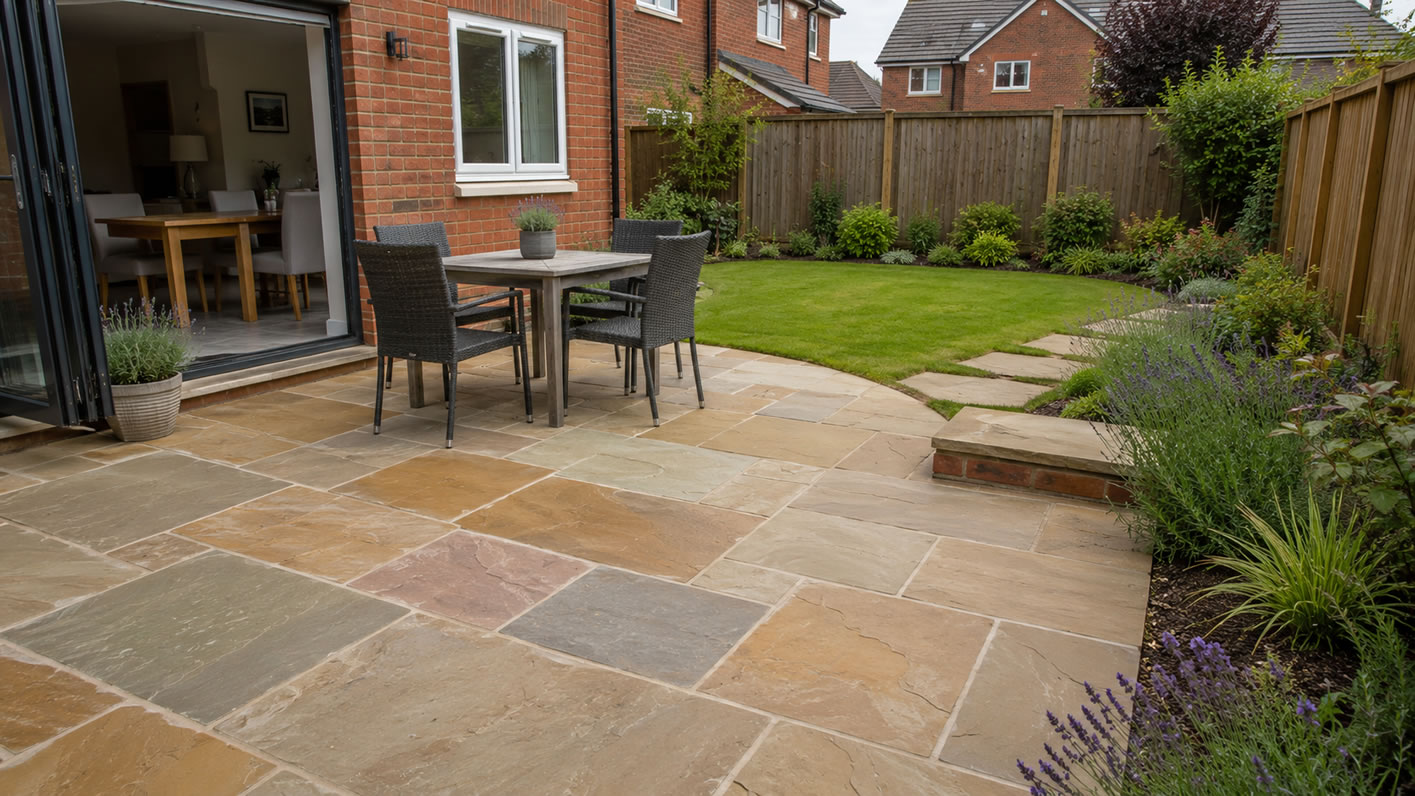
Natural stone remains one of the most popular choices for garden patios in the UK, and it is easy to see why.
Unlike manufactured paving, every piece of natural stone has its own variation in colour, texture and markings. That can help a patio feel more established and less uniform, particularly around older homes, cottages and traditional gardens.
It is also a practical material.
Good-quality sandstone, limestone, slate and granite can all provide long service lives when they are suitable for outdoor use and installed correctly. Natural stone can also be used for paths, steps, raised beds and garden features, helping the patio fit naturally into the wider landscaping.
However, natural stone is not one single product.
Different stones vary considerably in:
- Appearance
- Porosity
- Slip resistance
- Strength
- Colour stability
- Maintenance
That means choosing the right type is just as important as choosing natural stone in the first place.
Here are five of the strongest reasons to consider it for a new patio.
Natural Stone Patio Options at a Glance
| Stone Type | Appearance | Maintenance | Typical Style |
|---|---|---|---|
| Indian sandstone | Warm, varied and natural | Moderate | Traditional and mixed |
| Sawn sandstone | Cleaner and more uniform | Moderate | Modern/traditional |
| Limestone | Smooth and elegant | Moderate | Contemporary |
| Slate | Dark and distinctive | Moderate | Modern |
| Granite | Crisp and hard-wearing | Low to moderate | Contemporary/premium |
| Yorkstone | Traditional and characterful | Moderate | Period properties |
Reason 1: Natural Stone Has Genuine Character
The biggest attraction is appearance.
Natural stone is quarried rather than manufactured to look identical.
Individual slabs may contain differences in:
- Colour
- Fossil markings
- Veining
- Texture
- Surface tone
As a result, the finished patio often looks more natural and less repetitive than a surface made entirely from identical paving units.
Why Variation Can Be an Advantage
A pack of sandstone might contain shades of:
- Buff
- Brown
- Grey
- Gold
- Pink
Rather than seeing these variations as flaws, many homeowners choose natural stone specifically because of them.
They can help the patio blend with:
- Brickwork
- Stone walls
- Timber fencing
- Planting
- Existing garden features
Natural Stone Works Particularly Well With Older Homes
Period properties can sometimes look slightly awkward with very uniform modern paving.
Natural stone often works well around:
- Victorian houses
- Edwardian homes
- Cottages
- Barn conversions
- Traditional brick semis
Riven sandstone or reclaimed-looking stone can provide a softer appearance than smooth porcelain.
It Can Work With Modern Homes Too
Natural stone is not limited to traditional gardens.
Sawn stone can create a much cleaner finish.
For example:
- Grey sawn sandstone
- Smooth limestone
- Granite paving
can suit:
- Contemporary extensions
- Bifold doors
- Rendered houses
- Modern garden designs
The finish makes a large difference.
Riven vs Sawn Natural Stone
Riven Stone
Has a naturally split surface.
It tends to look:
- Rustic
- Textured
- Traditional
Sawn Stone
Has been cut to create a flatter surface.
It usually looks:
- Cleaner
- More contemporary
- More uniform
Both are still genuine natural stone.
Reason 2: Natural Stone Can Be Very Durable
A properly installed natural-stone patio can provide many years of service.
Stone has already existed naturally for an extremely long time before being quarried.
Once installed properly, many paving stones cope well with:
- Rain
- Frost
- Foot traffic
- Garden furniture
- Barbecues
- General outdoor use
However, durability varies between materials.
Granite
Granite is one of the hardest natural paving materials.
It offers excellent resistance to:
- Wear
- Scratching
- Frost
- Heavy use
This can make it particularly suitable for busy patios and paths.
Sandstone
Good-quality sandstone is a very common patio material.
It provides a good balance between:
- Patio installation price
- Appearance
- Durability
It is softer than granite but is still perfectly suitable for ordinary garden use where the stone is appropriate for UK conditions.
Limestone
Limestone can also provide a durable patio.
However, it may change appearance with age and needs a little more consideration regarding:
- Staining
- Cleaning
- Weathering
Dark limestone can gradually lighten or fade outdoors.
Slate
Slate has a distinctive layered appearance.
Good paving-grade slate can be durable, but quality varies.
Some products cope with repeated freeze-thaw cycles better than others.
Thickness Matters
A stone patio is only as reliable as the complete installation.
The slabs need enough strength for their intended use.
Typical patio slabs may commonly fall around:
- 18–25mm
- 20–30mm
- 25–35mm
depending on stone type and product.
Do not assume thicker always means better, but very thin stone needs the correct installation method.
Installation Quality Matters More Than Stone Alone
An expensive natural-stone patio can still fail if the groundwork is poor.
Problems can include:
- Loose slabs
- Rocking
- Cracks
- Settlement
- Water pooling
A suitable base and full bedding layer are essential.
Reason 3: Natural Stone Ages Well
Some paving materials look their best only when newly installed.
Natural stone often becomes more attractive as it weathers.
Slight changes in:
- Colour
- Surface texture
- Jointing
- Patina
can help the patio settle into the garden.
Weathering Can Make Stone Look More Natural
A newly laid patio may initially look very sharp.
After a few seasons, the stone can blend more naturally with:
- Plants
- Walls
- Timber
- Surrounding garden
This is particularly appealing in established gardens.
But Weathering Is Not the Same as Neglect
Natural stone still needs basic maintenance.
Without cleaning, surfaces may develop:
- Algae
- Moss
- Dirt
- Organic staining
Regular sweeping and occasional suitable cleaning are normally enough for most patios.
Colour Change Varies by Stone
Some materials maintain colour better than others.
Granite generally stays relatively consistent.
Sandstone can mellow over time.
Limestone may become lighter, particularly darker varieties.
Slate can also change depending on weather exposure and quality.
Ask the supplier how the exact paving normally weathers.
Reason 4: Natural Stone Offers a Wide Range of Styles
One of the biggest misconceptions is that natural stone always means rustic brown sandstone.
There are many different looks available.
Indian Sandstone
Perhaps the most familiar natural patio stone.
Common colours include:
- Buff
- Grey
- Brown
- Multi-colour
- Raj-style mixed tones
It works particularly well in:
- Cottage gardens
- Traditional patios
- Mixed planting schemes
Grey Sandstone
A popular choice for more contemporary designs.
It can provide a similar colour palette to modern porcelain while keeping the variation of natural stone.
Limestone
Limestone tends to have a smoother, more understated appearance.
Popular tones include:
- Grey
- Black
- Cream
- Beige
It can work very well with minimalist gardens.
Granite
Granite provides a crisp premium appearance.
Common colours include:
- Silver grey
- Dark grey
- Black
It suits modern properties particularly well.
Slate
Slate provides strong natural character.
It is often chosen in:
- Grey
- Blue-grey
- Black
It works particularly well with planting and timber.
Mixed-Size Patio Packs
Many natural stone products are sold in mixed-size project packs.
These may contain several slab dimensions.
A typical patio might use:
- Large rectangles
- Medium rectangles
- Small squares
- Small rectangles
This creates a less repetitive appearance.
Single-Size Natural Stone
Single-size slabs produce a cleaner design.
For example:
- 600 × 600mm
- 600 × 900mm
can suit more modern gardens.
Natural Stone Borders
Stone also works well with contrasting borders.
Possible combinations include:
- Sandstone + granite setts
- Limestone + clay pavers
- Granite + gravel
A small border can make the patio feel more intentional.
Reason 5: Natural Stone Works Well With the Rest of the Garden
A patio rarely exists by itself.
It usually connects with:
- Lawn
- Borders
- Steps
- Paths
- Raised beds
- Garden walls
- Pergolas
- Garden rooms
Natural stone is particularly good at linking these elements together.
Natural Stone Paths
The same material can continue into a garden path.
This creates visual continuity.
Alternatively, the paving can be combined with:
- Gravel
- Stepping stones
- Setts
Natural Stone Steps
Matching stone can be used for:
- Garden steps
- Raised patios
- Door thresholds
This is useful where the garden changes level.
Raised Beds and Walls
Matching or complementary stone can be used around:
- Raised borders
- Retaining walls
- Planters
This makes the hard landscaping feel coordinated.
Natural Stone and Planting
Stone works particularly well beside planting.
The natural colour variation can complement:
- Lavender
- Ornamental grasses
- Roses
- Ferns
- Evergreen shrubs
This can soften a hard patio surface.
Which Natural Stone Is Best for a Patio?
There is no single winner.
The right choice depends on your priorities.
| Priority | Good Starting Choice |
| Traditional appearance | Sandstone |
| Modern grey patio | Sawn sandstone/granite |
| Premium durability | Granite |
| Smooth elegant finish | Limestone |
| Dark dramatic appearance | Slate |
| Period property | Sandstone/Yorkstone |
| Lower-maintenance natural stone | Granite |
Natural Stone vs Porcelain
These are now two of the most commonly compared premium patio materials.
| Feature | Natural Stone | Porcelain |
| Appearance | Naturally varied | Consistent |
| Water absorption | Varies | Very low |
| Maintenance | Moderate | Low |
| Colour consistency | Variable | High |
| Traditional properties | Excellent | Good |
| Modern properties | Excellent | Excellent |
| Surface character | Natural | Manufactured |
| Stain resistance | Varies | Usually excellent |
Why Choose Stone Instead of Porcelain?
Natural stone may be better if you want:
- Genuine variation
- Traditional character
- Natural weathering
- A patio that blends with planting
Why Choose Porcelain Instead?
Porcelain may be better if you want:
- Very consistent colour
- Low porosity
- Minimal staining
- Sharp contemporary lines
Neither material is automatically better.
Natural Stone vs Concrete Paving
Concrete paving is manufactured to imitate natural materials.
Advantages of concrete include:
- Consistency
- Wide design choice
- Often lower cost
Natural stone provides:
- Genuine variation
- Natural ageing
- More individual character
Natural Stone vs Resin
Resin-bound surfacing creates a continuous aggregate finish.
Natural stone slabs provide:
- Defined paving units
- More traditional construction
- Easier individual slab replacement
Resin can be better for:
- Curves
- Seamless modern areas
- Some permeable installations
Does Natural Stone Get Slippery?
It can.
Any outdoor paving can become slippery when covered in:
- Algae
- Moss
- Ice
Surface texture matters.
Riven stone generally provides more texture than very smooth stone.
For shaded or wet locations, check the paving’s slip characteristics before buying.
Natural Stone Around Bifold Doors
Stone can look excellent beside a modern extension.
However, finished patio levels need to be designed carefully around:
- Door thresholds
- Damp-proof course
- Drainage
Do not simply raise the patio to make it flush without considering moisture protection.
Natural Stone Around a Conservatory
Stone can work particularly well around conservatories because its natural tones complement:
- Brick
- Glass
- Garden planting
Lighter stones can also help prevent the area appearing overly dark.
Does Natural Stone Need Sealing?
Not always.
Some homeowners seal natural stone to improve resistance to:
- Staining
- Oil
- Food spills
However, sealers can alter:
- Colour
- Sheen
- Breathability
Always use a product suitable for the exact stone.
Test it on an inconspicuous area first.
Should Sandstone Be Sealed?
It is optional in many situations.
Sealing may make maintenance easier, particularly around:
- Barbecues
- Dining areas
- Outdoor kitchens
However, good-quality sandstone does not automatically require sealing simply because it is outdoors.
Should Limestone Be Sealed?
Many homeowners choose to seal limestone because it can be more susceptible to staining.
Again, the exact product and desired appearance matter.
Cleaning Natural Stone
Routine maintenance is generally simple.
Try:
- Sweeping regularly
- Removing leaves
- Washing with water
- Using suitable stone cleaner when needed
Avoid using strong acidic products unless specifically approved for the material.
Pressure Washing Natural Stone
Pressure washing can be used cautiously on some paving.
However, excessive pressure can:
- Damage joints
- Etch softer stone
- Make the surface rougher
Keep the nozzle at a sensible distance and avoid concentrating high pressure into joints.
Algae and Moss
Shaded patios may develop green growth.
This is particularly common:
- Beneath trees
- North-facing gardens
- Damp corners
Good drainage and regular sweeping help reduce it.
Jointing Natural Stone
Traditional patio jointing might use:
- Cement mortar
- Specialist brush-in compounds
- Resin jointing products
The correct method depends on:
- Slab type
- Joint width
- Installation method
Poor jointing can crack or wash out.
Full Mortar Bed
Natural stone paving should generally be laid on a full, consistent bedding layer rather than small isolated spots.
This provides better support across the entire slab.
Why Dot-and-Dab Is a Poor Patio Method
Using small mortar spots can leave unsupported voids beneath the stone.
This may contribute to:
- Rocking
- Cracking
- Moisture staining
- Hollow areas
A proper full bed is far more reliable.
Slurry Primer
Some natural paving benefits from a slurry bonding primer on the underside.
This improves adhesion between:
- Stone
- Mortar bed
Dense materials may particularly benefit.
The installer should follow product guidance.
Patio Sub-Base
The stone is only the top layer.
A typical patio construction might include:
- Excavation
- Compacted sub-base
- Bedding mortar
- Natural stone
- Jointing
Poor groundwork can cause even premium stone to move.
Patio Falls
A patio should have a gentle fall to shed water.
It should not normally be perfectly flat.
Water should move away from:
- House
- Doors
- Walls
and towards an appropriate drainage area.
Typical Natural Stone Patio Costs
Broad UK budgeting figures might include:
| Patio Type | Typical Installed Cost |
| Basic sandstone | £80–£120 per m² |
| Better-quality sandstone | £90–£140 per m² |
| Limestone | £90–£150 per m² |
| Slate | £100–£160 per m² |
| Granite | £120–£200+ per m² |
| Premium Yorkstone | £150–£300+ per m² |
These are broad estimates.
Cost depends on:
- Stone
- Patio size
- Access
- Excavation
- Drainage
- Steps
- Cutting
- Location
Example 20m² Patio Budget
A 20m² sandstone patio might broadly cost:
- Excavation and preparation: £800–£1,500
- Sub-base and bedding: £500–£900
- Paving: £600–£1,200
- Labour and cutting: £900–£1,500
- Jointing and finishing: £200–£400
Possible overall range:
Around £3,000–£5,500
Complex sites can cost more.
Why Natural Stone Patio Prices Vary
Two sandstone patios can differ greatly in price.
Differences may include:
- Stone thickness
- Stone grade
- Country of origin
- Finish
- Calibration
- Sizes
- Colour
- Supplier
Do not compare products by colour alone.
Calibrated Natural Stone
Calibrated paving has been processed so the slabs are more consistent in thickness.
This can make installation easier.
Uncalibrated stone may vary more and require extra bedding adjustment.
Does Natural Stone Add Value to a Garden?
A well-designed patio can improve:
- Appearance
- Usability
- Outdoor entertaining
Whether it increases property value by a specific amount is impossible to guarantee.
However, good landscaping can certainly improve first impressions and make the garden more appealing to buyers.
Is Natural Stone Good for Outdoor Dining?
Yes.
A properly laid stone patio provides a stable base for:
- Dining tables
- Chairs
- Barbecues
For dining areas, consider:
- Smooth enough surface
- Stain protection
- Adequate size
Very heavily riven stone can make some furniture slightly less stable.
Natural Stone and Outdoor Kitchens
Stone can work very well around an outdoor kitchen.
Consider sealing more porous materials where:
- Oil
- Grease
- Wine
- Food
may regularly spill.
Natural Stone and Fire Pits
Natural stone can be used around fire-pit areas, but heat resistance varies by stone and construction.
Do not assume every paving slab is suitable for direct exposure to intense heat.
Follow the fire-pit manufacturer’s clearance requirements.
Buying Extra Stone
Order more than the exact measured patio area.
An allowance of roughly:
- 5–10%
is common.
Complex patterns and numerous cuts may need more.
Keep a few spare slabs afterwards.
Natural stone batches can vary, so matching the exact colour years later may be difficult.
Inspect Stone Before Installation
Because natural variation is expected, installers often open several packs and mix slabs.
This helps avoid creating one area dominated by a single shade.
Do not lay every slab from one pallet before opening the next.
Common Natural Stone Patio Mistakes
Choosing by Colour Alone
Check durability and surface finish too.
Expecting Every Slab to Match
Natural variation is part of the material.
Poor Base Preparation
This causes movement regardless of stone quality.
Dot-and-Dab Installation
Creates unsupported areas.
No Drainage Fall
Encourages standing water.
Installing Too Close to the DPC
Finished levels should be planned properly.
Wrong Cleaning Chemicals
Acids can damage some stone.
Not Buying Spare Slabs
Future colour matching may be difficult.
Choosing Very Smooth Stone in a Shaded Garden
Consider wet slip performance.
What Should a Natural Stone Patio Quote Include?
| Quote Item | Why It Matters |
| Stone type | Confirms material |
| Stone thickness | Helps assess specification |
| Finish | Riven, sawn, textured |
| Excavation | Important groundwork |
| Waste removal | Can add cost |
| Sub-base | Supports patio |
| Bedding | Should be full bed |
| Primer | May be required |
| Jointing | Affects durability |
| Drainage | Prevents water problems |
| Steps | Often additional |
| Cutting | Important around edges |
| VAT | Confirms total |
| Guarantee | Clarifies workmanship cover |
Questions to Ask a Patio Installer
- Which natural stone would suit this garden?
- Is the stone suitable for UK winters?
- What thickness is it?
- Is it calibrated?
- What finish does it have?
- Is it slippery when wet?
- Does it need sealing?
- How deep will you excavate?
- What sub-base will you use?
- Will the slabs be laid on a full mortar bed?
- Will you use slurry primer?
- How will the patio drain?
- What jointing material will be used?
- Is waste removal included?
- Is VAT included?
- What guarantee is provided?
Natural Stone Patio Checklist
| Check | Completed? |
| Stone selected | |
| Finish selected | |
| Colour variation accepted | |
| Slip resistance considered | |
| Stone suitable for outdoors | |
| Patio size confirmed | |
| Drainage planned | |
| Sub-base specified | |
| Full mortar bed included | |
| Primer considered | |
| Jointing selected | |
| Extra slabs ordered | |
| Maintenance understood | |
| Several quotes compared |
Frequently Asked Questions
Is natural stone good for patios?
Yes. Natural stone is attractive, durable and available in a wide range of colours and finishes, making it suitable for both traditional and contemporary gardens.
What is the best natural stone for a patio?
Sandstone is one of the most versatile choices, granite is particularly durable, limestone offers a smoother finish and slate provides a distinctive darker appearance.
Is natural stone better than porcelain?
Neither is automatically better. Natural stone provides genuine variation and character, while porcelain offers greater colour consistency and lower water absorption.
How long does a natural stone patio last?
A correctly installed natural-stone patio can last for several decades, depending on the stone, groundwork and maintenance.
Does natural stone need sealing?
Not always. Sealing can help with staining on some stones but should be chosen according to the exact material and desired finish.
Is Indian sandstone good for UK patios?
Yes. Good-quality Indian sandstone is widely used for UK patios because it offers natural colour variation and good durability when installed correctly.
Does natural stone get slippery?
It can become slippery when wet or covered in algae. Surface texture and maintenance make a significant difference.
Is granite good for patios?
Yes. Granite is hard-wearing, frost resistant and well suited to premium modern patios.
Does limestone fade?
Some darker limestone can lighten noticeably with prolonged outdoor weathering and UV exposure.
Can natural stone be pressure washed?
Some stone can be pressure washed carefully, but excessive pressure can damage softer surfaces and patio joints.
Should natural stone be laid on a full mortar bed?
Yes. A consistent full bedding layer normally provides better support than isolated mortar spots.
What is calibrated paving?
Calibrated paving has been processed to create a more consistent slab thickness, making installation easier.
Is natural stone expensive?
Natural stone is usually more expensive than basic concrete paving but can be comparable with premium block paving and often costs less than high-end porcelain or granite systems.
How much does a natural stone patio cost?
Installed prices might broadly range from around £80–£200+ per square metre depending on the stone, site preparation, location and design.
Should I order spare paving slabs?
Yes. Ordering around 5–10% extra is sensible, particularly because future batches of natural stone may vary in colour.