
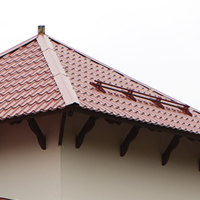
All sides of a hipped roof slope downwards towards the property’s walls, often at a gentle angle – there are no vertical sides, so they are commonly seen on bungalows and cottages.
A ‘hip’ is the external angle at which a roof’s adjacent sloping sides meet; the degree of this angle is known as the ‘hip bevel’. The triangular sloping surface that is formed by hips meeting at a roof’s ridge is called a ‘hip end’.
Where the property has an internal corner, the join between the two slopes is a known as ‘a valley’.
Hipped roofs are built around a complex system of trusses so can be designed to fit many different shaped structures but, whatever the layout, their ridges will always be central to the rectangular building below and the roof’s four faces will always have the same pitch.

An advantage of this style of construction, compared with a gable design, is that the bottom edges of the roof, ie the eaves, appear on all sides of the building, giving the walls and windows protection from the weather and sun.
And, because a hipped roof is self-bracing, it is better able to cope with high winds. But, because of its shape, a hipped roof is more difficult to maintain and has less roof space.
There are plenty of options when it comes to covering your roof. But don’t forget that there could be restrictions relating to the types of materials you are allowed to use, so it’s wise to contact your local council before placing an order for slates or clay or concrete tiles, or instructing a builder.
But whatever’s on your shopping list, it makes sense to get several quotes to find the best advice, service and price available.