
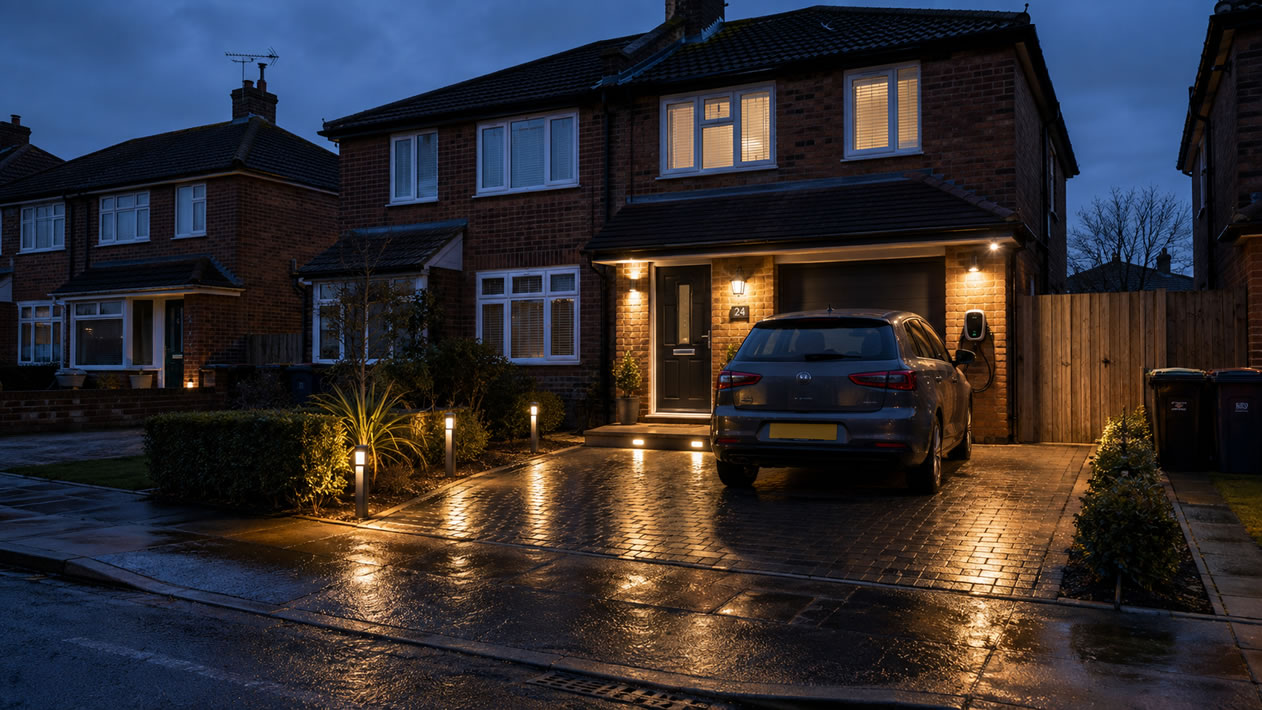
Winter can make even a familiar driveway more awkward to use.
Shorter days, darker mornings, wet surfaces, frost and poor visibility can all make parking and walking around the front of your home less convenient. Good driveway lighting helps by making edges, steps, paths, gates and obstacles easier to see.
It can also improve the appearance of the property.
However, effective driveway lighting is not simply a case of installing the brightest possible floodlight. Too much glare can be unpleasant for neighbours, create harsh shadows and even make it harder to see clearly.
The best approach is usually to combine practical lighting with a few well-positioned low-level fittings.
This guide looks at the main driveway lighting options, where to install them, what works best in winter and how to avoid common mistakes.
Why Driveway Lighting Matters More in Winter
Winter changes how a driveway is used.
You may leave home before sunrise and return after dark.
Wet weather also makes it harder to see:
- Kerbs
- Steps
- Puddles
- Drainage channels
- Changes in level
- Ice
- Low walls
- Planting edges
A properly lit driveway can make these features much easier to identify.
Driveway Lighting at a Glance
| Lighting Type | Best Use | Main Advantage |
|---|---|---|
| Wall lights | General driveway lighting | Simple and effective |
| Motion floodlights | Security and arrivals | Bright when needed |
| Bollard lights | Paths and edges | Good low-level guidance |
| Ground lights | Borders and entrances | Discreet appearance |
| Step lights | Steps and level changes | Improves safety |
| Gate lights | Driveway entrance | Helps identify access |
| Solar lights | Decorative or secondary lighting | Easy installation |
| Smart lights | Flexible control | Timers, apps and automation |
| PIR lighting | Automatic use | Energy efficient |
| Dusk-to-dawn lights | Continuous low-level lighting | Convenient in winter |
Start by Looking at How You Actually Use the Driveway
Before choosing fittings, think about how people move through the space.
Ask yourself:
- Where does the car stop?
- Which door do you normally use?
- Is there a separate path?
- Are there steps?
- Is the driveway narrow?
- Is the entrance difficult to see?
- Do you reverse into the drive?
- Are bins stored beside it?
- Is there an EV charger?
- Are there dark side passages?
Lighting should follow these movements.
Light the Route, Not Just the Driveway
A common mistake is to focus only on the parking surface.
Instead, consider the whole route from:
street → driveway → car → path → front door
This often produces a better result than one very bright light.
Wall-Mounted Driveway Lights
Wall lights are one of the simplest options.
They can be installed on:
- House wall
- Garage
- Porch
- Side wall
They work particularly well where the driveway sits beside the house.
Advantages of Wall Lights
- Do not take up driveway space
- Easy to position
- Wide choice of styles
- Can include PIR sensors
- Good for small driveways
- Useful around garage doors
They are especially practical for narrow UK driveways where bollards could become obstacles.
Where to Position Wall Lights
Useful locations include:
- Beside front door
- Above garage door
- Beside side gate
- Along side passage
- Near EV charger
Avoid placing a powerful light directly at eye level.
PIR Motion-Sensor Lighting
PIR lights switch on when movement is detected.
They are popular because they provide light only when needed.
This can help reduce:
- Electricity use
- Light pollution
- Unnecessary all-night illumination
Best Places for PIR Lights
Consider:
- Garage wall
- House corner
- Driveway entrance
- Side access
- Near front door
Position the sensor so it detects genuine movement rather than every passing pedestrian or vehicle.
Avoid Oversensitive PIR Settings
A badly adjusted sensor may activate because of:
- Cars on road
- Cats
- Trees moving in wind
- Pedestrians
- Neighbours
If possible, choose fittings with adjustable:
- Sensitivity
- Detection range
- Duration
- Light level
Floodlights
LED floodlights can illuminate a large area very effectively.
They work well for:
- Wide driveways
- Rear parking areas
- Garages
- Security lighting
However, brighter is not always better.
Problems With Overly Bright Floodlights
A badly positioned floodlight can:
- Shine into neighbouring windows
- Cause glare
- Create deep shadows
- Make cameras less effective
- Make the house frontage look harsh
Aim the light down towards your property rather than outward towards the road.
Bollard Lights
Bollards create low-level lighting along:
- Paths
- Driveway edges
- Planting
- Entrances
They are particularly useful on wider driveways.
Advantages of Bollards
- Attractive
- Good directional lighting
- Helps define driveway edges
- Works well with landscaping
Disadvantages of Bollards
They take up physical space.
This matters on a narrow driveway.
A badly positioned bollard can also be damaged by:
- Car doors
- Bumpers
- Delivery vans
Recessed Ground Lights
Ground lights can create a clean contemporary appearance.
They may be installed:
- Along borders
- Beside walls
- Near entrances
- Around planting
Some fittings are suitable for areas where vehicles pass, but not all are.
If installed in a driveway, make sure the exact fitting is rated for the intended load.
Do Not Assume Every Ground Light Can Be Driven Over
This is important.
Some recessed lights are designed only for:
- Gardens
- Paths
- Pedestrian areas
A fitting positioned in a tyre path must be specifically suitable for vehicle loading.
Otherwise, it may crack or fail.
Step Lights
If your driveway includes steps, these should be treated as a priority.
Winter makes steps more difficult to see because:
- Surfaces are wet
- Shadows are stronger
- Frost can hide edges
Low-level lighting at each step can improve visibility considerably.
Lighting Changes in Level
Also consider lighting:
- Raised paths
- Retaining walls
- Kerbs
- Ramps
- Drainage channels
The aim is to make the change in level obvious without creating glare.
Gate and Entrance Lighting
A driveway entrance can be difficult to see at night, particularly on rural roads or poorly lit streets.
Possible solutions include:
- Pillar lights
- Wall lights
- Low-level markers
- Reflective house number
- Gate-mounted lighting
This can also make the property easier for:
- Visitors
- Delivery drivers
- Taxis
to identify.
Solar Driveway Lights
Solar lighting is attractive because it does not require mains wiring.
Common options include:
- Stake lights
- Solar wall lights
- Solar bollards
- Solar marker lights
Are Solar Driveway Lights Any Good in Winter?
They can be useful, but winter performance is often weaker.
Reasons include:
- Short daylight hours
- Low sun angle
- Cloud
- Shading
- Dirty panels
A solar fitting that works well in June may operate for far fewer hours in December.
Best Use for Solar Lighting
Solar lights are generally better for:
- Decorative borders
- Secondary paths
- Marker lighting
rather than essential driveway safety lighting.
For key areas such as steps and entrances, mains-powered lighting is usually more reliable.
LED Lighting
LED fittings are now the obvious choice for most new driveway installations.
Advantages include:
- Low energy consumption
- Long service life
- Instant brightness
- Wide range of fittings
- Good smart-control options
They are particularly suitable for lights that operate every evening.
Warm White or Cool White?
Colour temperature affects how the driveway feels.
Warm White
Typically around 2700K–3000K.
It creates a softer residential appearance.
Best for:
- Traditional homes
- Porches
- Paths
- Decorative lighting
Neutral White
Around 3500K–4000K.
Gives a clearer, more functional appearance.
Useful for:
- Driveways
- Garages
- Working areas
Very Cool White
Can appear harsh in a domestic setting.
Use carefully.
What Brightness Do You Need?
There is no reason to flood a small driveway with extremely high-output lights.
A better strategy is to use several lower-output fittings positioned where needed.
For example:
- Porch light
- Wall light near parking bay
- Low-level path lights
This often gives better visibility than one huge floodlight.
Lighting a Small Driveway
Small driveways need particularly careful positioning.
Good options include:
- Wall-mounted PIR light
- Front-door light
- Low-profile path lights
Avoid:
- Large bollards
- Freestanding fittings in door-opening zones
- Very bright floodlights
Lighting a Narrow Driveway
For narrow side driveways, wall lighting is usually best.
Possible layout:
- Downlights along side wall
- Sensor light near garage
- Front-door lighting
This keeps the entire ground area free for vehicles and pedestrians.
Lighting a Large Driveway
Larger driveways can support:
- Bollards
- Ground lights
- Multiple wall lights
- Entrance lighting
The key is to create overlapping pools of light rather than one bright central source.
Lighting a Tarmac Driveway
Dark asphalt absorbs light and can appear almost black in winter.
Therefore, edge lighting can be particularly helpful for tarmac driveways.
Good options include:
- Wall lights
- Border bollards
- Entrance lights
A bright horizontal beam close to the ground is usually unnecessary.
Lighting Block-Paved Driveways
Block paving often benefits from warm architectural lighting.
You can highlight:
- Borders
- Paths
- Steps
- Planting
Avoid installing too many recessed lights into the paving itself.
Fewer well-positioned fittings often look better.
Lighting Resin Driveways
Resin surfaces can reflect more light than dark asphalt.
Low-level lighting can create a clean contemporary look.
Popular combinations include:
- Grey resin
- Anthracite bollards
- Warm-white LEDs
Lighting Gravel Driveways
Gravel is generally easy to see under directional lighting because of its texture.
Useful options include:
- Bollards
- Pillar lights
- Low-level wall lights
Avoid very low fittings where loose gravel can cover them.
Driveway Lighting and Security
Lighting can help occupants and visitors feel more comfortable, but it is not a substitute for proper security.
Combine lighting with:
- Good locks
- CCTV
- Doorbell cameras
- Secure gates
- Clear sightlines
Does Leaving Lights on All Night Improve Security?
Not necessarily.
Constant very bright lighting can create glare and deep shadows.
A combination of:
- Low-level dusk-to-dawn light
- PIR brighter lighting
can often work better.
Smart Driveway Lighting
Smart lighting gives more control.
Features may include:
- App control
- Timers
- Schedules
- Dimming
- Motion activation
- Integration with smart home systems
You could set the lights to:
- Come on at dusk
- Dim after 10pm
- Increase brightness when motion is detected
- Switch off later overnight
Dusk-to-Dawn Sensors
Photocell-controlled lights automatically switch on when it becomes dark.
This is useful during winter because sunset times change significantly.
You do not need to keep adjusting a timer.
Timer-Controlled Lighting
Timers can still work well.
However, update them as the seasons change unless they have astronomical sunset functions.
Driveway Lighting for EV Chargers
If you charge an electric car at night, install useful lighting around the charging point.
It should make it easy to see:
- Charging socket
- Cable
- Charger controls
Try to avoid creating shadows exactly where the connector needs to be handled.
Avoid Lighting That Creates Trip Hazards
Cables should not trail across:
- Driveway
- Path
- Steps
Permanent lighting should have properly planned wiring.
The same applies to EV charging cables.
Waterproof and Weather-Resistant Fittings
Outdoor fittings need to be designed for outdoor conditions.
They may be exposed to:
- Rain
- Frost
- Snow
- Pressure from cleaning
- Dust
- Road spray
Choose fittings with an appropriate ingress-protection rating for their location.
What Does an IP Rating Mean?
IP ratings describe resistance to:
- Solid particles
- Water
For example, outdoor lights commonly carry ratings such as IP44, IP65 or higher depending on where they are installed.
A fitting in an exposed driveway position may need more protection than one beneath a sheltered porch.
Frost and Winter Weather
Fittings close to the ground face particularly harsh conditions.
Look for products suitable for:
- Outdoor temperatures
- Frost
- Rain
- Wet ground
Poor-quality fittings may fail after repeated winter exposure.
Lighting and Drainage
Avoid positioning recessed fittings where water naturally collects.
Even weather-rated equipment performs better when not sitting in standing water.
Check:
- Driveway falls
- Channel drains
- Low spots
before choosing ground-light positions.
Electrical Safety
Permanent outdoor lighting connected to the mains should be installed correctly for the environment.
Outdoor electrical work may involve:
- Buried cables
- RCD protection
- Junction boxes
- Earthing
- Weatherproof equipment
For new circuits or significant alterations, using a competent electrician is the safest approach.
Can You Install Driveway Lights Yourself?
Simple solar lights are normally straightforward.
Low-voltage plug-in lighting may also be relatively simple where designed for DIY installation.
Mains-powered outdoor lighting is different.
If new wiring, circuits or outdoor connections are required, professional installation is usually the better option.
Buried Cables
Never simply bury ordinary indoor electrical cable beneath a driveway.
A permanent installation needs wiring appropriate for:
- Ground conditions
- Mechanical protection
- Vehicle areas
The exact solution should be specified by an electrician.
Plan Lighting Before Installing a New Driveway
If you are replacing the driveway anyway, plan lighting at the same time.
This allows contractors to install:
- Cable ducts
- Junction points
- Bases for bollards
- Future EV ducts
before the final surface is completed.
It is far cheaper and neater than cutting into a brand-new driveway later.
Installing Spare Ducting
Even if you are not installing every light immediately, spare ducting can be useful.
It may later carry:
- Lighting cable
- EV charger cable
- Gate power
- CCTV wiring
A little forward planning can save considerable disruption.
Avoid Light Pollution
Good driveway lighting should remain primarily within your own property.
Avoid directing strong lights:
- Into neighbours’ bedrooms
- Across road
- Into sky
Downward-facing fittings are often the best option.
Wildlife-Friendly Lighting
Excessive outdoor lighting can affect wildlife.
You can reduce unnecessary impact by:
- Switching lights off when not needed
- Using motion sensors
- Choosing warmer colour temperatures
- Directing light downward
- Avoiding illumination of hedges unnecessarily
Driveway Lighting With CCTV
Lighting and cameras should be planned together.
Too much light can cause:
- Glare
- Overexposure
- Reflections
Check camera footage after dark.
A moderate, evenly illuminated scene is often more useful than one extremely bright spot.
Lighting House Numbers
Winter deliveries become much easier if your house number is clearly visible.
Options include:
- Backlit number
- Small wall light
- Gate light
- Illuminated plaque
Keep it simple and readable from the road.
Typical Driveway Lighting Costs
Broad UK budgeting figures might be:
| Work | Typical Cost |
| Basic exterior wall light | £40–£120 |
| Quality PIR wall light | £60–£180 |
| LED floodlight | £40–£150 |
| Bollard light | £50–£200 each |
| Recessed ground light | £40–£150 each |
| Smart outdoor light | £60–£200+ |
| Electrician fitting existing point | £80–£180 |
| New outdoor lighting circuit | £300–£800+ |
| Multiple driveway lighting installation | £500–£2,000+ |
Complex landscaping or long cable runs can increase costs.
Where the Money Goes
Installation cost depends on:
- Number of fittings
- Cable routes
- Driveway surface
- Consumer unit
- Access
- Ground excavation
- Smart controls
- Electrical upgrades
Installing lighting before a new driveway is laid can reduce labour considerably.
Cheap Lights vs Better-Quality Fittings
Outdoor lights operate in a difficult environment.
Very cheap fittings may suffer from:
- Water ingress
- Corrosion
- Failed seals
- Poor sensors
- Discolouration
Spending slightly more on durable outdoor-rated fittings can provide better long-term value.
Best Driveway Lighting Combinations
Small Driveway
- PIR wall light
- Front-door light
Modern Driveway
- Downward wall lights
- Low bollards
- Subtle entrance lighting
Traditional Home
- Warm-white wall lanterns
- Low path lighting
Long Driveway
- Entrance lights
- Spaced bollards
- Garage light
Gravel Driveway
- Gate lights
- Bollards
- House-mounted floodlight
Common Driveway Lighting Mistakes
One Extremely Bright Floodlight
Creates glare and harsh shadows.
Lights at Eye Level
Can dazzle drivers and pedestrians.
Too Many Ground Lights
Often looks cluttered and adds unnecessary maintenance.
Poor PIR Positioning
Causes constant activation.
Ignoring Neighbours
Bright light entering another home can create disputes.
Installing Solar Lights in Deep Shade
Winter performance may be disappointing.
Forgetting Driveway Construction
Do not install lights where tyres will hit them.
No Lighting Around Steps
Changes in level should be a priority.
Installing Wiring After the Driveway
This often means unnecessary cutting and patching.
Winter Driveway Lighting Checklist
| Check | Completed? |
| Parking area visible | |
| Pedestrian route visible | |
| Steps illuminated | |
| Driveway edges visible | |
| Entrance easy to identify | |
| Front door lit | |
| Garage entrance lit | |
| EV charger visible | |
| PIR settings adjusted | |
| Lights angled downward | |
| Neighbours not affected | |
| Outdoor fittings weather rated | |
| Cables protected | |
| Drainage checked | |
| House number visible |
Questions to Ask an Electrician
- Which driveway areas need lighting most?
- Would wall lights or bollards work better?
- What IP rating should the fittings have?
- Do I need a new circuit?
- Is RCD protection already suitable?
- How will cables be routed?
- Will cables need burying?
- Can spare ducting be installed?
- Can lights use PIR sensors?
- Can they use dusk-to-dawn controls?
- Can the system be smart controlled?
- Is the driveway surface likely to need cutting?
- Are all fittings included?
- Is VAT included?
- What guarantee applies?
Frequently Asked Questions
What is the best lighting for a driveway?
A combination of wall-mounted lights, PIR lighting and low-level path or edge lighting works well for many homes.
Are PIR lights good for driveways?
Yes. They provide light when movement is detected and can reduce unnecessary electricity use.
Should driveway lights stay on all night?
Not necessarily. Motion sensors, timers or dusk-to-dawn dimming can reduce unnecessary lighting while maintaining convenience.
Are solar lights suitable for a driveway?
They can work well for decorative or secondary lighting, but winter performance may be limited by shorter daylight hours and cloudy conditions.
What colour light is best outside a house?
Warm white around 2700K–3000K usually gives a comfortable residential appearance, while slightly cooler neutral white can suit practical working areas.
Do driveway lights need to be waterproof?
They should be properly rated for outdoor use and suitable for the amount of weather exposure they will experience.
Can recessed ground lights be driven over?
Only if the exact fitting is specifically designed and rated for vehicle loading.
Is it better to use one large floodlight or several smaller lights?
Several carefully positioned lower-output lights often provide better visibility with less glare.
Should driveway lighting be installed before a new driveway?
Ideally, yes. Cable ducts and foundations can then be installed before the final driveway surface is laid.
Can driveway lighting help security?
It can improve visibility and complement CCTV and other security measures, but it should not be treated as the only security measure.
Are LED lights good for driveways?
Yes. LEDs are energy efficient, provide instant light and are available in a wide range of outdoor fittings.
Where should a driveway PIR sensor point?
It should cover the driveway and access route without unnecessarily detecting pedestrians, traffic or neighbouring properties.
Should I light my EV charger?
Good local lighting makes plugging and unplugging easier during dark winter evenings.
Can I install driveway lights myself?
Solar and some low-voltage systems can be suitable for DIY installation, while permanent mains electrical work is generally better handled by a competent electrician.
How much does driveway lighting cost?
A simple wall light installation can cost under a few hundred pounds, while a larger system involving several fittings, buried wiring and controls may cost £500–£2,000 or more.