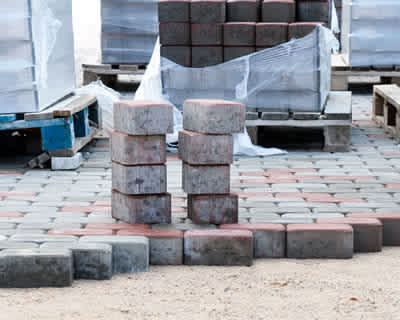
- Prepare the sub-base The driveway company will excavate, or dig, the existing surface down to a depth of around 200mm. They will remove any debris from the area may place it in a skip or arrange for it to be removed in another way. When they dig down to the sub-base of your previous driveway, they will assess how much hardcore they need and arrange for that to be delivered to the site. They will then spread the hardcore across the sub-base to create a level surface to pour the concrete on. Most good contractors will apply a gel to any walls and doors to protect them from concrete splashes. They will also add any gulley tops, manhole covers or shuttering that’s required.
- Installation and imprinting Next, the tradespeople will have the concrete either poured from a large mixer vehicle or barrow it in from a mixer and pour onto the surface. They level it with rakes, then add a colour surface hardener in a colour of your choice. This will give the driveway its permanent colour. They will then wait until the concrete has hardened to the correct consistency for imprinting the pattern, then will use special tools and stencils to make the pattern that you asked for. They will then spread a colour powder called a release agent over the surface, and leave to dry for 1 to 2 days depending on the weather conditions.
- Cleaning When the contractors return, they will add crack control cuts into the concrete. This is important because concrete expands and contracts in the heat, so there needs to be some give to stop any larger cracks from forming. Then everything is power washed clean, and a chemical wash is also used on the concrete to ensure it’s completely dust-free. The installers will ensure all your walls and doors are clean, which will hopefully be an easy job if they used wall gel.
- Sealing The final step is to seal the driveway. There needs to have been at least two dry days before the tradespeople can do it, so you might find it’s best to have your pattern imprinted driveway installed in the summer. The contractors will blow any debris away from the surface and dry any damp areas where necessary. They will then add an anti-slip agent to the sealant and brush it on. It’s best to not walk or drive onto your new concrete driveway for about 4 days after sealing to allow everything to set. But after that, you’re ready to use your new driveway!
Bellingham
Bellingham is a district in south east London, in the London Borough of Lewisham. Its neighbouring districts are Catford, Downham and Sydenham. The Ravensbourne River runs through the centre of Bellingham, also to the west and east it is bordered by railway lines running south from Catford.
The name Bellingham means ‘the water-meadow owned by Beora’s people’, and was the true name of the medieval manor in the area. The name was preserved by the farm in the region, Bellingham Railway Station and the Bellingham Estate. Various other historical names have been preserved by the street brands of the estate, which are connected with King Alfred, who was thought to have already been god, the father of the manor of Lewisham, and were extracted from the brands of mills, houses and fields in the certain area.
Bellingham was farmland before Bellingham Estate was built, between 1920 and 1923. London City Council built about 2600 homes and flats during this time. Bellingham Estate was among the many large estates built by London City Council after the First World War to aid with slum clearance and reduce overcrowding. As there is plenty of land available the majority of the dwellings built were two-story homes, and there was lots of green, open space.
Today, Bellingham is a localised city centre. Its high street is Randlesdown Road, which includes a supermarket, a gym, hairdressers and multiple restaurants and food outlets. It also has a sixth form college, and a church and a library. Bellingham boasts many popular recent and present residents, like the singer/song-writer Kate Bush, the former Labour Prime Minister James Callaghan, and the footballer Ian Wright.