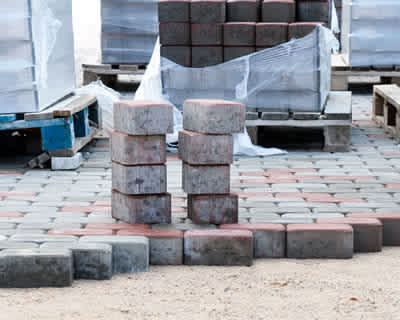
- Prepare the sub-base The driveway company will excavate, or dig, the existing surface down to a depth of around 200mm. They will remove any debris from the area may place it in a skip or arrange for it to be removed in another way. When they dig down to the sub-base of your previous driveway, they will assess how much hardcore they need and arrange for that to be delivered to the site. They will then spread the hardcore across the sub-base to create a level surface to pour the concrete on. Most good contractors will apply a gel to any walls and doors to protect them from concrete splashes. They will also add any gulley tops, manhole covers or shuttering that’s required.
- Installation and imprinting Next, the tradespeople will have the concrete either poured from a large mixer vehicle or barrow it in from a mixer and pour onto the surface. They level it with rakes, then add a colour surface hardener in a colour of your choice. This will give the driveway its permanent colour. They will then wait until the concrete has hardened to the correct consistency for imprinting the pattern, then will use special tools and stencils to make the pattern that you asked for. They will then spread a colour powder called a release agent over the surface, and leave to dry for 1 to 2 days depending on the weather conditions.
- Cleaning When the contractors return, they will add crack control cuts into the concrete. This is important because concrete expands and contracts in the heat, so there needs to be some give to stop any larger cracks from forming. Then everything is power washed clean, and a chemical wash is also used on the concrete to ensure it’s completely dust-free. The installers will ensure all your walls and doors are clean, which will hopefully be an easy job if they used wall gel.
- Sealing The final step is to seal the driveway. There needs to have been at least two dry days before the tradespeople can do it, so you might find it’s best to have your pattern imprinted driveway installed in the summer. The contractors will blow any debris away from the surface and dry any damp areas where necessary. They will then add an anti-slip agent to the sealant and brush it on. It’s best to not walk or drive onto your new concrete driveway for about 4 days after sealing to allow everything to set. But after that, you’re ready to use your new driveway!
Bridge Of Orchy
Bridge of Orchy (Drochaid Urchaidh in Gaelic) is a village nestled in Argyll and Bute in Scotland. It sits at the head of Glen Orchy. While generally described as a hamlet, Bridge of Orchy meets the definition of a village as it features a church. Access to the village is made possible by the village's location on the A82 dual carriageway, and also being served by a railway station. The eponymous bridge in the town was built by Government forces as a part of a programme of reparations to the Highland Clans which included the construction of military roads from the Lowlands in to the much wilder upland parts of Scotland. It crosses the River Orchy, one of the fastest white water rivers in the UK. Dating back to 1751, the village boasts a unique tourist hotel. Orchy is also located on the West Highland Way long distance path, which is a linear long distance footpath in Scotland, with the official status of Long Distance Route. It's 154 km (96 miles) long, running from Milngavie north of Glasgow to Fort William in the Scottish Highlands, with a hill walking section in the route. The path comes under the stewardship by the West Highland Way Management Group (WHWMG) comprising West Dunbartonshire Council, Stirling Council, Argyll & Bute Council, Highland Council and Loch Lomond and The Trossachs National Park Authority. About 80,000 people make use of the path every year, of whom over 15,000 walk the whole route. Close by prominent peaks are the Munros Beinn Dorain and Beinn an D'thaidh. The village itself is inside the central highlands. For all of your property upgrades, be sure that you employ trusted experts in Bridge of Orchy to ensure that you get the top quality service.