
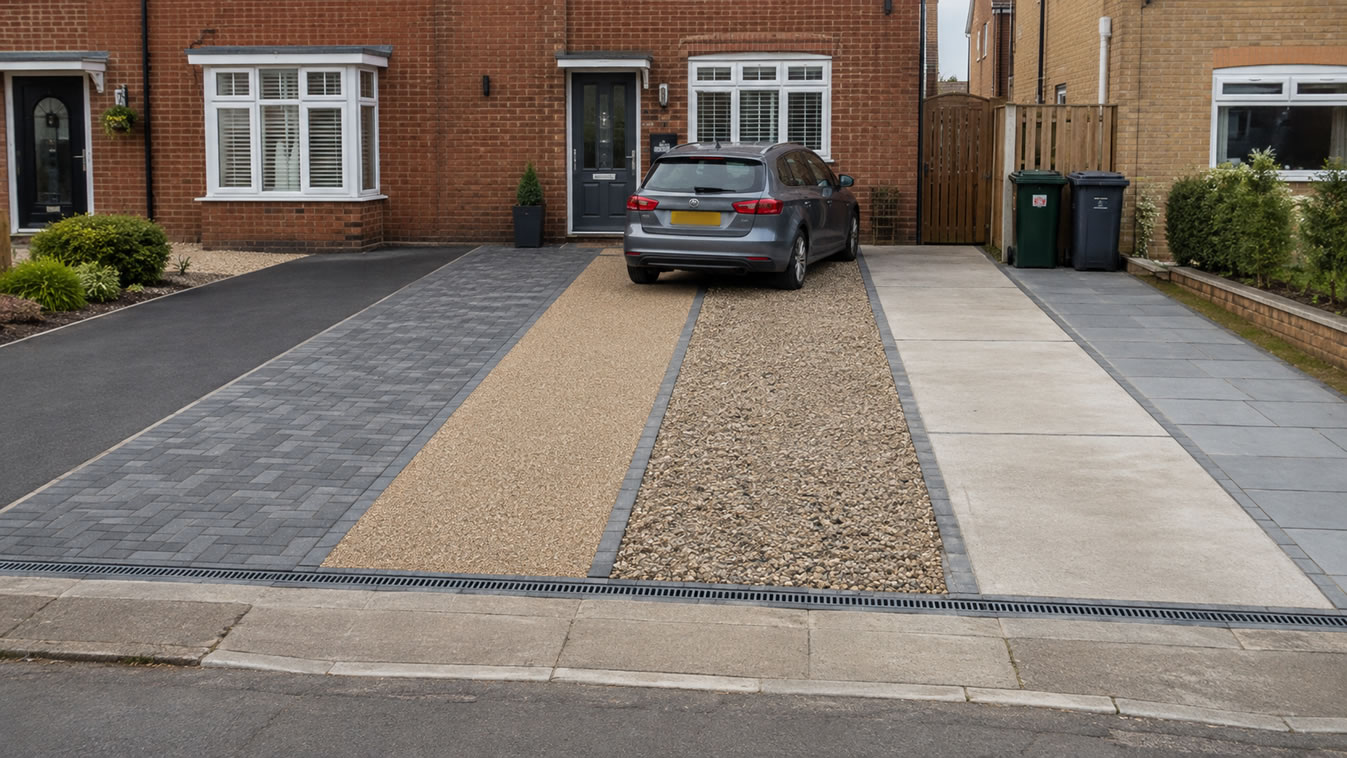
Choosing a driveway surface is not just about picking the one that looks best.
The right material depends on how the driveway will be used, how much maintenance you are prepared to do, the style of your property, drainage, budget and the type of vehicles that will park on it.
For example, tarmac can be an excellent option if you want a practical, relatively low-maintenance driveway at a sensible price. Block paving gives far more choice in colours and patterns. Resin can create a clean modern finish, while gravel remains one of the most economical and naturally permeable choices.
Concrete, porcelain and natural stone can also work well, particularly where appearance and long-term durability matter more than keeping the initial cost as low as possible.
There is therefore no single “best driveway material”.
The better question is:
Which driveway surface best matches your property, budget and priorities?
This guide compares the main driveway materials used in the UK and gives you a simple way to narrow down the options.
Driveway Materials at a Glance
| Driveway Surface | Cost | Maintenance | Appearance | Drainage | Best For |
|---|---|---|---|---|---|
| Tarmac/asphalt | ££ | Low | Simple | Standard or porous options | Practical driveways |
| Block paving | £££ | Moderate | Very flexible | Permeable versions available | Decorative driveways |
| Resin bound | £££ | Low to moderate | Modern | Can be permeable | Contemporary homes |
| Gravel | £ | Moderate | Traditional | Excellent | Budget and rural properties |
| Concrete | £££ | Low | Simple or decorative | Usually impermeable | Heavy-use driveways |
| Driveway slabs | £££–££££ | Low to moderate | Premium | Depends on system | Designer driveways |
| Granite | ££££ | Low | Premium natural stone | Depends on system | High-end durable driveways |
| Permeable paving | £££ | Moderate | Wide choice | Excellent | Drainage-sensitive sites |
Start With How You Will Use the Driveway
Before looking at paving colours or photographs, think about the practical requirements.
Ask yourself:
- How many cars will use it?
- Are the vehicles small cars, SUVs or vans?
- Will commercial vehicles regularly park there?
- Is the driveway steep?
- Is it narrow?
- Is it curved?
- Will children cycle or play on it?
- Do you need easy access for wheelchairs or pushchairs?
- Will you install an EV charger?
- Do you need space for wheelie bins?
- How much maintenance are you prepared to do?
Your answers can quickly rule certain options in or out.
Step 1: Set a Realistic Budget
Cost is usually the easiest place to start.
A driveway has several costs beyond the visible surface.
These can include:
- Excavation
- Waste disposal
- Sub-base
- Drainage
- Edging
- Labour
- Manhole adjustments
- Dropped kerb
- Surface material
Therefore, comparing material prices alone can be misleading.
Broad UK Driveway Cost Comparison
These are useful budgeting ranges rather than fixed prices.
| Surface | Typical Installed Cost |
| Gravel | £40–£80 per m² |
| Tarmac/asphalt | £60–£100 per m² |
| Standard block paving | £80–£130 per m² |
| Concrete | £80–£140 per m² |
| Resin bound | £90–£150 per m² |
| Decorative block paving | £100–£160 per m² |
| Driveway slabs | £100–£180 per m² |
| Driveway porcelain | £130–£220+ per m² |
| Granite/natural stone | £140–£250+ per m² |
Ground conditions can significantly change these figures.
If Your Main Priority Is Low Cost
Start by considering:
- Gravel
- Tarmac/asphalt
- Basic concrete
Gravel generally has the lowest initial cost.
However, it needs more ongoing tidying than tarmac.
Tarmac provides a firmer surface and usually requires relatively little maintenance.
If Your Main Priority Is Appearance
Look more closely at:
- Block paving
- Resin bound
- Driveway porcelain
- Natural stone
- Granite
These surfaces provide more design choice than ordinary asphalt.
If Your Main Priority Is Low Maintenance
Good starting options include:
- Tarmac
- Driveway porcelain
- Concrete
- Resin bound
No driveway is completely maintenance-free, but these generally require less routine attention than loose gravel or paving with large numbers of joints.
Step 2: Decide How Important Appearance Is
The driveway occupies a large proportion of the front of many UK homes.
It can therefore have a significant effect on kerb appeal.
Think about the property itself.
Traditional Brick House
Suitable materials might include:
- Block paving
- Gravel
- Tarmac with brick edging
- Sandstone-style paving
- Granite setts
Modern Rendered House
Consider:
- Resin
- Grey porcelain
- Large-format concrete
- Tarmac with charcoal edging
- Granite
Cottage or Rural Home
Possible options include:
- Gravel
- Natural stone
- Traditional blocks
- Tumbled paving
New-Build Property
Simple contemporary surfaces often work well:
- Grey blocks
- Resin
- Asphalt
- Porcelain
Tarmac or Asphalt Driveways
Tarmac is one of the most practical choices.
Technically, modern domestic driveways are generally surfaced using asphalt or other bitumen-bound materials, although “tarmac” remains the common everyday term.
Advantages of Tarmac
- Relatively affordable
- Fast installation
- Smooth surface
- Good for narrow driveways
- Works well on curves
- Few joints
- Low maintenance
- Suitable for cars and vans
- Easy to resurface later
Disadvantages of Tarmac
- Limited colour choice
- Repairs may remain visible
- Can soften slightly in very hot weather
- Ordinary asphalt is not permeable
- Unsupported edges can crumble
Who Should Choose Tarmac?
Tarmac is especially suitable if you want:
- Practical parking
- Lower costs
- Fast installation
- Simple appearance
- Minimal maintenance
It is often one of the strongest choices for small driveway or awkwardly shaped driveways.
Block Paving
Block paving is one of the most versatile driveway materials.
Blocks are available in:
- Different sizes
- Colours
- Shapes
- Textures
Common patterns include:
- Herringbone
- Basket weave
- Stretcher bond
Advantages of Block Paving
- Huge design choice
- Individual blocks can be replaced
- Permeable options available
- Good kerb appeal
- Works with traditional and modern houses
- Easy to create borders and paths
Disadvantages of Block Paving
- More expensive than basic tarmac
- Joints need maintenance
- Weeds can establish in joints
- Poorly installed blocks can sink
- Can look busy in very small spaces
Who Should Choose Block Paving?
Consider it if you value:
- Appearance
- Colour choice
- Patterns
- Easy individual repairs
It works particularly well where the driveway is an important visual part of the front garden.
Resin-Bound Driveways
Resin-bound surfacing combines decorative aggregate with resin.
The mixture is laid as a continuous layer.
It creates a smooth appearance while retaining visible natural stone.
Advantages of Resin
- Attractive modern finish
- Wide colour range
- Smooth surface
- Few joints
- Low weed growth
- Can form part of a permeable system
- Suitable for irregular shapes
Disadvantages of Resin
- Higher installation cost
- Installation quality varies
- Base preparation is critical
- Repairs can show
- Poor-quality resin can discolour or deteriorate
Who Should Choose Resin?
Resin can work particularly well if you want:
- Contemporary appearance
- Decorative colour
- Smooth surface
- Relatively low maintenance
Choose an experienced installer because the final quality depends heavily on preparation and mixing.
Gravel Driveways
Gravel remains one of the simplest driveway materials.
It is especially common around:
- Rural homes
- Period properties
- Larger driveways
Advantages of Gravel
- Low initial cost
- Naturally permeable
- Traditional appearance
- Wide stone choice
- Easy to extend
- Straightforward local repairs
Disadvantages of Gravel
- Stones move
- Requires occasional raking
- May spread onto pavement
- Can develop wheel ruts
- Less comfortable for wheelchairs or pushchairs
- Weeds may establish
Gravel Stabilisation Grids
Modern driveway grids can reduce gravel movement.
They can help:
- Keep gravel level
- Reduce rutting
- Improve walking
- Prevent stones migrating
The grids still require a suitable driveway sub-base beneath them.
Who Should Choose Gravel?
Gravel works particularly well if:
- Budget is limited
- Drainage is important
- You like a traditional appearance
- You do not mind occasional maintenance
Concrete Driveways
Concrete provides a solid and hard-wearing surface.
It can be installed as:
- Plain concrete
- Brushed concrete
- Coloured concrete
- Pattern-imprinted concrete
Advantages of Concrete
- Strong
- Durable
- Suitable for heavy vehicles
- Low routine maintenance
- Smooth surface
Disadvantages of Concrete
- Can crack
- Repairs can look obvious
- Usually impermeable
- Needs curing before use
- Decorative versions can become expensive
Pattern-Imprinted Concrete
Pattern-imprinted concrete is poured as one slab and stamped to imitate:
- Blocks
- Stone
- Setts
- Paving
It provides a decorative appearance without individual paving joints.
However, cracking and repairs can be more difficult to disguise.
Who Should Choose Concrete?
Concrete can suit homeowners looking for:
- Strength
- Low maintenance
- Firm surface
- Regular heavier vehicle use
Driveway Slabs
Large-format driveway slabs have become increasingly popular.
Options include:
- Concrete slabs
- Porcelain
- Granite
- Natural stone
However, the slabs must be specifically designed for vehicles.
Do not assume standard patio slabs are suitable.
Advantages of Driveway Slabs
- Premium appearance
- Fewer joints than block paving
- Modern large-format designs
- Individual slabs may be replaceable
- Wide material choice
Disadvantages of Driveway Slabs
- Expensive
- Heavy
- Installation requires accuracy
- Poor bedding can cause rocking or cracking
- Replacement slabs may be difficult to match later
Who Should Choose Driveway Slabs?
Consider them if:
- Appearance matters greatly
- Budget allows
- You want a premium modern design
- The driveway is reasonably straightforward in shape
Porcelain Driveway Paving
Porcelain can provide one of the cleanest contemporary driveway finishes.
However, only use a system specifically designed for vehicle traffic.
Ordinary thin patio porcelain should not automatically be installed on a driveway.
Advantages of Porcelain
- Low water absorption
- Excellent colour consistency
- Low maintenance
- Resistant to many stains
- Contemporary appearance
Disadvantages of Porcelain
- Expensive
- Requires specialist cutting
- Installation must follow the manufacturer’s system
- Replacement patterns may differ between batches
Granite Driveways
Granite is one of the strongest natural paving materials.
It can be used as:
- Large slabs
- Setts
- Paving units
Advantages of Granite
- Very durable
- Premium appearance
- Excellent wear resistance
- Good frost resistance
- Long potential lifespan
Disadvantages of Granite
- High cost
- Heavy
- Difficult to cut
- Labour-intensive
Which Driveway Is Best for Heavy SUVs?
A heavy SUV can use most professionally constructed driveway surfaces.
However, the base becomes particularly important.
Good choices include:
- Asphalt
- Heavy-duty block paving
- Concrete
- Granite
- Properly rated driveway slabs
Tell contractors which vehicles will normally use the driveway.
Best Driveway for Vans
For frequent van parking, practical options include:
- Asphalt
- Concrete
- Heavy-duty block paving
Decorative surfaces can also work, but they need to be properly rated.
Best Driveway for a Small Front Garden
Good options include:
Tarmac
Makes excellent use of limited space.
Resin
Provides a smooth decorative finish without many joints.
Large-Format Paving
Can make small spaces look more modern.
Avoid excessive borders and colours.
Best Driveway for a Large Frontage
Larger areas give more options.
You might combine:
- Asphalt with block border
- Gravel with paved entrance
- Blocks with planting
- Resin with stone edging
Mixing materials can reduce cost while improving appearance.
Best Surface for a Narrow Driveway
Tarmac is particularly strong here.
It fits easily between:
- Walls
- Fences
- Houses
without requiring numerous paving cuts.
Resin can also work well.
Best Driveway for a Curved Entrance
Consider:
- Tarmac
- Resin
- Small block paving
- Gravel
Large paving slabs generally create more cutting and waste on curves.
Best Driveway for a Sloping Site
Tarmac often performs particularly well because it creates one continuous textured surface.
Suitable block paving can also work.
With resin or smooth slabs, pay extra attention to wet slip resistance.
Step 3: Think About Maintenance
Different surfaces need different levels of attention.
| Surface | Maintenance Level |
| Tarmac | Low |
| Resin | Low |
| Porcelain | Low |
| Concrete | Low |
| Block paving | Moderate |
| Natural stone | Moderate |
| Gravel | Moderate |
Typical Tarmac Maintenance
Usually:
- Sweep debris
- Keep drains clear
- Repair cracks
- Repair damaged edges
Typical Block Paving Maintenance
May involve:
- Sweeping
- Weed removal
- Moss cleaning
- Re-sanding joints
- Resetting sunken blocks
Typical Resin Maintenance
Usually:
- Sweep
- Occasional wash
- Keep drains clear
- Remove organic growth
Typical Gravel Maintenance
Includes:
- Raking
- Replacing lost stone
- Filling ruts
- Weed control
Natural Stone Maintenance
Depending on material:
- Cleaning
- Joint repairs
- Optional sealing
- Stain treatment
Step 4: Consider Drainage Before Choosing the Surface
Drainage should influence your decision from the start.
For houses in England, current Planning Portal guidance says that a new or replacement front driveway does not normally require planning permission where the surface is permeable, such as gravel, permeable concrete block paving or porous asphalt, or where water is directed into a lawn or border.
If more than 5m² of front garden is covered with a traditional impermeable surface and water is not directed to a permeable area, planning permission is normally required.
Additional local restrictions can apply, and different planning systems operate elsewhere in the UK.
Which Driveway Materials Can Be Permeable?
Gravel
Naturally permeable when correctly constructed.
Permeable Block Paving
Uses wider joints and an open-graded base.
Porous Asphalt
Allows water through the surface.
Resin Bound
Can be permeable when laid as part of a suitable system.
Permeable Paving Systems
Some specialist slabs and paving systems allow water through joints.
Surface Material Alone Does Not Determine Drainage
This is important.
A “permeable” surface needs compatible layers beneath it.
For example, porous asphalt laid onto impermeable concrete does not suddenly create a fully permeable driveway.
The complete construction needs to manage water.
Drainage for Impermeable Driveways
Options include directing water towards:
- Lawn
- Flower bed
- Rain garden
- Gravel infiltration area
- Suitable soakaway
- Drainage channel
A contractor should explain where the water will actually go.
Step 5: Decide How Much Weed Maintenance You Want
If weeds annoy you, avoid choosing solely on initial appearance.
Lowest Joint Maintenance
- Asphalt
- Resin
- Concrete
More Joint Maintenance
- Block paving
- Slab paving
- Setts
Gravel
Weeds can establish in soil and debris collecting within the stone.
Good groundwork helps, but no surface permanently prevents every weed.
Which Driveway Gets the Most Moss?
Moss depends more on:
- Shade
- Moisture
- Drainage
- Nearby vegetation
than the material itself.
However, block joints and porous natural stone can provide more places for organic growth than smooth asphalt driveway.
Step 6: Consider Repairs
Every driveway eventually needs some maintenance.
Asphalt Repairs
Advantages:
- Easy to patch
- Can often be resurfaced
Disadvantage:
- New repairs usually remain visible
Block Paving Repairs
Advantages:
- Individual blocks can be lifted
- Utility trenches can often be reinstated neatly
Disadvantages:
- Old blocks may have faded
- Settlement may affect larger areas
Resin Repairs
Damaged sections can be repaired, but matching:
- Aggregate
- Colour
- Weathering
may be difficult.
Concrete Repairs
Cracks can be filled, but colour matching is often poor.
Gravel Repairs
Probably the simplest.
New stone can be:
- Added
- Raked
- Levelled
Slab Repairs
Individual slabs can sometimes be replaced.
Keep several spare units after the driveway is installed.
Step 7: Think About Future Work
Do you expect to install:
- EV charger
- New drainage
- Water main
- Fibre cable
- Garden lighting
later?
If so, consider installing ducts before surfacing.
Some surfaces are easier to lift later than others.
Block paving and slabs can often be carefully removed.
Tarmac or concrete usually needs cutting.
EV Charging and Driveway Choice
All major driveway surfaces can work with an EV charger.
The more important issue is planning the cable route before installation.
Consider:
- Charger position
- Which side of car has charging socket
- Future second car
- Spare electrical duct
Step 8: Consider Access and Machinery
A material that looks affordable on paper may become expensive where access is poor.
For example, asphalt normally requires:
- Hot material delivery
- Compaction equipment
- Suitable access
A very small rear parking area with difficult access may be less practical for tarmac.
Block paving or gravel may be easier to transport manually.
Step 9: Think About the Property Style
A driveway should ideally complement rather than compete with the house.
Red-Brick Semi
Possible choices:
- Tarmac with red or charcoal edging
- Block paving
- Gravel
- Sandstone-effect paving
White Rendered House
Consider:
- Grey resin
- Charcoal blocks
- Black asphalt
- Grey porcelain
Victorian Terrace
Possible options:
- Clay-style blocks
- Granite setts
- Gravel
- Tarmac with brick border
Country Cottage
Often suits:
- Gravel
- Natural stone
- Tumbled blocks
Step 10: Decide Whether You Want the Driveway to Stand Out
There are two broad design approaches.
Make the Driveway a Feature
Use:
- Decorative blocks
- Porcelain
- Granite
- Contrasting borders
Make the Driveway Disappear Visually
Use:
- Simple tarmac
- Neutral resin
- Gravel
and concentrate attention on:
- Front door
- Planting
- House
Neither approach is wrong.
Combining Driveway Materials
You do not have to choose just one.
Useful combinations include:
Tarmac + Block Border
One of the most cost-effective combinations.
Gravel + Granite Entrance
Creates a stronger entrance and keeps gravel away from the pavement.
Resin + Block Border
Adds definition.
Tarmac + Porcelain Path
Allows a premium pedestrian area without paving the whole driveway.
Blocks + Gravel Planting Strip
Adds drainage and softens the frontage.
Driveway Material Decision Table
| Your Main Priority | Good Starting Choice |
| Lowest cost | Gravel |
| Low cost + firm surface | Tarmac |
| Lowest maintenance | Tarmac/porcelain |
| Most colour choice | Block paving |
| Modern appearance | Resin/porcelain |
| Traditional appearance | Gravel/block paving |
| Rural property | Gravel |
| Heavy vehicles | Asphalt/concrete |
| Curved driveway | Asphalt/resin |
| Narrow driveway | Asphalt |
| Easy future repairs | Block paving |
| Premium natural appearance | Granite |
| Drainage priority | Gravel/permeable paving |
| Small front garden | Asphalt/resin |
| High-end modern home | Porcelain/granite |
| DIY-friendly maintenance | Gravel/block paving |
A Simple Five-Question Test
If you are still unsure, answer these five questions.
1. Is Your Budget Tight?
Yes: Start with gravel or tarmac.
No: Consider blocks, resin, porcelain or stone.
2. Do You Want Very Low Maintenance?
Yes: Start with tarmac, concrete, resin or porcelain.
No: Blocks, stone and gravel remain good options.
3. Is Appearance More Important Than Cost?
Yes: Consider blocks, resin, porcelain or granite.
No: Tarmac is difficult to beat for practicality.
4. Is Drainage Difficult?
Yes: Look closely at gravel, permeable paving or porous asphalt.
5. Will Vans or Heavy Vehicles Use It?
Yes: Prioritise the construction specification and sub-base over decorative finish.
Driveway Material Scorecard
| Material | Budget | Appearance | Maintenance | Durability | Drainage |
| Gravel | 5/5 | 4/5 | 3/5 | 3/5 | 5/5 |
| Asphalt | 4/5 | 3/5 | 5/5 | 4/5 | 3/5 |
| Block paving | 3/5 | 5/5 | 3/5 | 4/5 | 4/5 |
| Resin | 3/5 | 5/5 | 4/5 | 4/5 | 4/5 |
| Concrete | 3/5 | 3/5 | 4/5 | 5/5 | 2/5 |
| Porcelain | 2/5 | 5/5 | 5/5 | 5/5 | 3/5 |
| Granite | 1/5 | 5/5 | 4/5 | 5/5 | 3/5 |
These ratings are only a general comparison. Installation quality can make a bigger difference than the surface itself.
How Important Is the Sub-Base?
Extremely important.
A driveway can have an expensive surface and still fail if it sits on weak groundwork.
The sub-base helps:
- Spread vehicle weight
- Resist settlement
- Maintain levels
- Support drainage
Possible signs of poor base construction include:
- Sunken tyre tracks
- Cracks
- Rocking paving
- Puddles
- Edge movement
Do not spend your entire budget on the visible finish.
Ask Contractors About What Is Underneath
A detailed driveway quotation should explain:
- Excavation depth
- Sub-base material
- Compacted depth
- Bedding
- Surface specification
- Edge restraints
- Drainage
This information is more useful than simply seeing “New driveway – £5,000”.
Do You Need a Dropped Kerb?
If you need to drive across a pavement to reach the new parking area, you normally need an approved vehicle crossover or dropped kerb.
GOV.UK directs homeowners in England and Wales to their relevant local authority for applications and requirements.
Check this before completing the driveway design because councils may have local requirements affecting the proposed access.
Should You Replace the Whole Front Garden?
Not necessarily.
Try to retain some:
- Planting
- Hedge
- Lawn
- Planter
- Gravel drainage
where space allows.
A small amount of greenery can prevent the front of the house looking like a car park.
Which Surface Is Best for a One-Car Driveway?
For practical value:
Tarmac is difficult to beat.
For appearance:
Block paving, resin or porcelain may be preferable.
For low budget and drainage:
Gravel remains an excellent option.
Which Surface Is Best for Two or Three Cars?
As the driveway gets larger, surface cost becomes increasingly important.
Tarmac often becomes very economical because installation is relatively fast.
Gravel can also be affordable.
Premium porcelain across a 100m² driveway can become extremely expensive.
Which Driveway Is Best for a £3,000 Budget?
Depending on size and groundwork, look first at:
- Gravel
- Tarmac
- Basic block paving for a small area
If major excavation and drainage are required, £3,000 may not cover a full medium-sized driveway regardless of material.
Which Driveway Is Best for a £5,000–£8,000 Budget?
You may have more options, including:
- Tarmac with decorative border
- Block paving
- Resin
- Better-quality concrete
depending on area.
Which Driveway Is Best for £10,000+?
Higher budgets open up:
- Porcelain
- Granite
- Premium block paving
- Natural stone
- Complex landscaping
However, spending more does not automatically produce a better driveway.
Design and installation quality still matter.
Common Driveway Material Mistakes
Choosing Only on Appearance
Think about maintenance and vehicle use too.
Choosing Only on Price
The cheapest surface may not provide the best long-term value.
Ignoring Drainage
This can create planning and practical problems.
Forgetting the Sub-Base
The visible material is only part of the driveway.
Using Patio Slabs for Cars
Only use slabs designed for vehicle traffic.
Choosing Gravel Without Edging
Loose stone may spread across paths and pavements.
Choosing Smooth Paving on a Steep Slope
Check wet slip resistance.
Using Too Many Materials
Small front gardens can look cluttered.
Forgetting Future EV Charging
Install ducts before surfacing.
Paying for the Driveway Before Checking the Dropped Kerb
Confirm vehicle access first.
How to Compare Driveway Quotes
Ask each contractor to quote for roughly the same specification.
Compare:
| Item | Quote A | Quote B | Quote C |
| Excavation depth | |||
| Waste removal | |||
| Sub-base material | |||
| Sub-base depth | |||
| Surface | |||
| Surface thickness | |||
| Drainage | |||
| Edging | |||
| Manhole work | |||
| VAT | |||
| Guarantee |
This often reveals why one contractor is cheaper than another.
Questions to Ask a Driveway Installer
- Which surface would you recommend for this property?
- Why?
- What are the alternatives?
- What maintenance does each surface need?
- Is the material suitable for my vehicles?
- Is it permeable?
- Where will rainwater go?
- How deep will you excavate?
- What sub-base will you use?
- What compacted depth will it have?
- What edging will be installed?
- Are drainage channels included?
- Will utility covers be adjusted?
- Does the price include waste removal?
- Is VAT included?
- How long before vehicles can use the driveway?
- What guarantee is provided?
Driveway Surface Checklist
| Question | Your Answer |
| How many cars? | |
| Largest vehicle? | |
| Approximate area? | |
| Maximum budget? | |
| Low maintenance important? | |
| Appearance very important? | |
| Permeability needed? | |
| Driveway sloping? | |
| Driveway curved? | |
| Heavy vehicles? | |
| EV charger planned? | |
| Dropped kerb needed? | |
| Planting to retain? | |
| Preferred property style? |
So, Which Driveway Material Is Best?
For most homeowners, the decision can be simplified considerably.
Choose tarmac or asphalt if you want a practical, relatively affordable and low-maintenance driveway.
Choose block paving if appearance, colour choice and easy individual repairs matter.
Choose resin bound if you want a smooth contemporary finish.
Choose gravel if budget, natural appearance and permeability are your biggest priorities.
Choose concrete if strength and low maintenance matter more than decorative flexibility.
Choose driveway porcelain or granite if you want a premium surface and are comfortable with the higher installation cost.
Most importantly, do not choose the surface in isolation.
A properly designed driveway needs the right:
- Sub-base
- Levels
- Edging
- Drainage
- Vehicle access
A modest tarmac driveway built properly will usually outperform expensive paving laid over weak groundwork.
Frequently Asked Questions
What is the best material for a driveway?
There is no single best material. Tarmac is excellent for practical low-maintenance driveways, block paving for decorative flexibility, resin for contemporary designs and gravel for affordable permeable driveways.
What is the cheapest driveway material?
Gravel is generally one of the cheapest driveway materials, followed by tarmac or asphalt for many straightforward installations.
What driveway surface needs the least maintenance?
Tarmac, porcelain, concrete and resin are generally among the lower-maintenance options.
Which driveway looks the best?
This depends on the property. Block paving, resin, granite and porcelain offer some of the greatest design flexibility.
Is tarmac better than block paving?
Tarmac is generally cheaper and requires less maintenance. Block paving offers more colours and patterns and allows individual blocks to be replaced.
Is resin better than tarmac?
Resin provides a more decorative finish and can form part of a permeable system. Tarmac is usually cheaper and simpler.
Is gravel a good driveway surface?
Yes. Gravel is affordable, naturally permeable and works particularly well with traditional or rural properties, although it requires occasional raking.
Is concrete good for a driveway?
Yes. Concrete is strong and durable but can crack, and conventional concrete is usually impermeable.
Can porcelain be used on a driveway?
Yes, but only use porcelain paving that is specifically designed and installed for vehicle traffic.
Which surface is best for a small driveway?
Tarmac is often an excellent choice because it makes efficient use of limited space. Resin and large-format driveway paving can also work well.
What is the best driveway for a van?
Asphalt, concrete and heavy-duty block paving are good starting choices when designed with a suitable base.
What driveway is best on a slope?
Tarmac often performs particularly well on sloping driveways. Textured block paving can also work well.
Which driveway material is most permeable?
Loose gravel is naturally permeable. Permeable block paving, porous asphalt and correctly installed resin-bound systems can also provide effective drainage.
Do I need planning permission for a new driveway?
For houses in England, permeable front driveways or those directing water to a lawn or border generally do not require permission solely because of the surfacing. If more than 5m² is covered with traditional impermeable surfacing and suitable on-site drainage is not provided, planning permission is normally required.
Do I need a dropped kerb?
If you need to cross a pavement to access the driveway, an approved dropped kerb or vehicle crossover is normally required through the relevant local authority.