
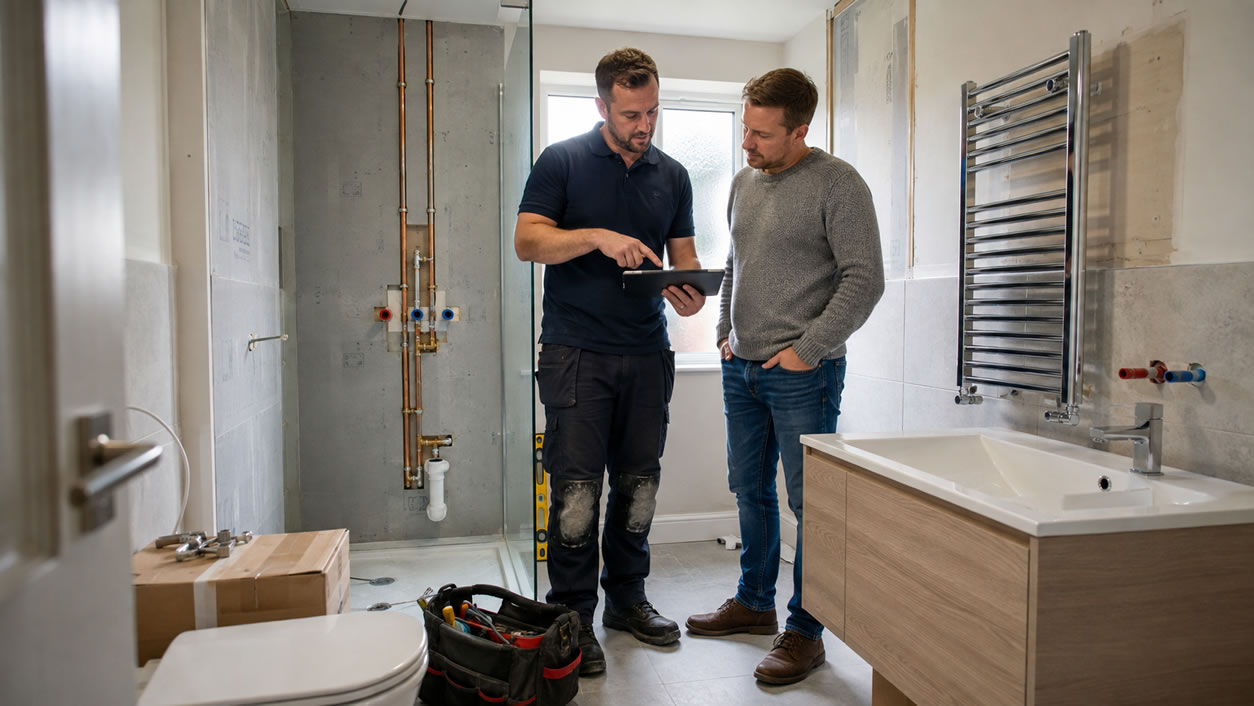
Hiring a plumber should be straightforward, but the right person for a dripping tap may not necessarily be the right choice for a complete bathroom renovation.
Plumbing covers a surprisingly wide range of work, from repairing leaking pipes and replacing taps to moving soil pipes, installing showers and completely replumbing a bathroom. Therefore, before comparing quotes, it helps to know what type of plumber you actually need.
For a small repair, speed and local availability may be the main priorities. However, for a bathroom refurbishment, you also need to think about experience with sanitaryware, drainage, concealed pipework, showers, heating and coordination with tilers, electricians and other trades.
The following five steps can help you find and compare local plumbers without making the process unnecessarily complicated.
Step 1: Decide Exactly What Plumbing Work You Need
Start by writing down what needs doing.
For a simple plumbing job, this might be:
- Repairing a leaking tap
- Replacing a toilet
- Fixing a leaking pipe
- Installing a new radiator
- Repairing a shower
- Replacing a kitchen tap
- Investigating low water pressure
- Unblocking waste pipework
For larger projects, the description needs to be more detailed.
Bathroom Renovation Plumbing
A bathroom renovation can involve considerably more plumbing work than homeowners initially expect.
Possible jobs include:
- Removing the old bath, basin and toilet
- Installing a new bathroom suite
- Moving the toilet
- Relocating the basin
- Converting a bath to a walk-in shower
- Installing a freestanding bath
- Moving hot and cold-water pipes
- Altering waste pipes
- Installing concealed shower valves
- Adding a heated towel rail
- Installing underfloor heating connections
- Changing radiator positions
- Installing new taps
- Connecting washing machines
- Fitting new shower pumps
- Improving water pressure
If you are planning a full renovation, tell plumbers this from the beginning rather than describing it simply as “a new bathroom”.
The more accurate the description, the easier it is to receive meaningful quotes and bathroom prices.
Think About Who Will Manage the Bathroom Project
There are several ways to arrange a bathroom refurbishment.
| Approach | How It Works |
|---|---|
| Plumber only | You organise tiler, electrician and decorator separately |
| Bathroom fitter | One contractor completes most installation work |
| Main contractor | Contractor organises several specialist trades |
| Supply-and-fit company | Bathroom supplier manages design and installation |
| DIY project management | You buy materials and coordinate individual trades |
A plumber may be perfectly capable of installing the sanitaryware but may not undertake:
- Tiling
- Plastering
- Electrical work
- Joinery
- Decorating
Ask what is included before accepting a quote.
Step 2: Find Local Plumbers Who Regularly Do That Type of Work
Once you know the scope, look for plumbers who regularly complete similar jobs.
A local plumber may specialise in:
- Emergency repairs
- General domestic plumbing
- Bathrooms
- Heating
- Boilers
- Commercial plumbing
- Drainage
For example, someone who spends most of the week repairing boilers may not be the best choice for a detailed bathroom redesign involving concealed pipework and high-end fittings.
Likewise, a bathroom installer may not provide a 24-hour emergency plumbing service.
Why Hiring Locally Can Help
A nearby plumber may offer several practical advantages.
They may:
- Reach you more quickly
- Have lower travelling costs
- Know local housing types
- Be familiar with common plumbing arrangements in the area
- Return more easily if adjustments are needed
- Have reviews from nearby customers
Local tradespeople may also already know where to obtain unusual fittings required for older properties.
Ask Friends and Neighbours
Personal recommendations can still be very useful.
Ask:
- What work was completed?
- Was the quote accurate?
- Did the plumber arrive when expected?
- Was the work tidy?
- Were there extra charges?
- Was the problem fixed first time?
- Would they use the plumber again?
A recommendation for a successful bathroom installation is more useful for another bathroom project than a recommendation based only on changing a tap washer.
Look at Previous Bathroom Work
For a substantial bathroom project, ask to see photographs of completed bathrooms.
Look for:
- Neat pipework
- Well-positioned sanitaryware
- Straight fittings
- Tidy silicone
- Good shower installation
- Sensible layout
- Clean finishing around pipes
If the plumber will also be responsible for tiling or other finishing work, inspect those details too.
Step 3: Compare at Least Two or Three Plumbing Quotes
For anything beyond a very small repair, compare several quotes.
Do not automatically choose the cheapest.
A low quote might exclude work another plumber has included.
For example, one bathroom quote might cover:
- Removal
- Plumbing
- Installation
- Waste disposal
while another covers only the plumbing labour.
The headline prices therefore cannot be compared directly.
What Should a Plumbing Quote Include?
A useful written quotation should explain:
| Quote Item | Why It Matters |
|---|---|
| Labour | Shows what work is included |
| Materials | Clarifies who supplies fittings |
| Call-out charge | Important for small jobs |
| Removal | Old fittings may need disposal |
| Plumbing alterations | Important during renovations |
| Waste pipe changes | Can significantly affect cost |
| Sanitaryware installation | Should list individual items |
| Tiling | May be separate |
| Electrical work | Usually requires another competent trade |
| Making good | Clarifies walls/floors after pipework |
| Waste disposal | Avoids unexpected costs |
| VAT | Confirms total payable price |
Bathroom Renovation Quotes Need More Detail
A full bathroom quote should ideally identify individual jobs.
For example:
- Remove existing suite
- Cap old services
- Relocate basin pipes
- Move shower waste
- Install new shower tray
- Install concealed shower valve
- Fit toilet
- Fit vanity basin
- Install bath
- Fit heated towel rail
- Test plumbing
- Dispose of old sanitaryware
This makes it much easier to compare one contractor with another.
Supply or Fit Only?
Ask whether the quote assumes the plumber will supply:
- Pipe
- Valves
- Waste fittings
- Traps
- Flexible connectors
- Sealants
You may still supply the visible items yourself, including:
- Bath
- Toilet
- Basin
- Shower
- Taps
- Vanity
- Towel rail
Clarifying this early prevents misunderstandings.
Do Not Compare Quotes on Price Alone
Suppose you receive:
- Quote A: £4,800
- Quote B: £5,500
- Quote C: £6,200
Quote A may initially appear best.
However, if Quote A excludes:
- Tiling
- Waste disposal
- Electrical work
- New pipework
it could eventually cost more than Quote B.
Compare scope rather than just totals.
Step 4: Check Experience, Insurance and Credentials
Before hiring a plumber, check that they are a genuine established tradesperson.
Useful checks include:
- Trading name
- Business address
- Telephone number
- Public liability insurance
- Written quotation
- Previous customer reviews
- Relevant experience
- Professional memberships where applicable
For ordinary domestic plumbing, there is no single universal licence that every UK plumber must hold.
However, particular types of work can require additional competence or registration.
Gas Work
If the project involves a gas appliance, such as moving or altering a gas boiler, the gas work must be carried out by an appropriately registered Gas Safe engineer.
Do not assume every general plumber is qualified to work on gas.
Electrical Work in Bathrooms
Bathrooms contain electrical safety zones and additional electrical requirements.
Work involving:
- New lighting
- Electric showers
- Extractor fans
- Underfloor heating
- New sockets outside relevant zones
- Electric towel rails
may require a suitably competent electrician.
A good bathroom contractor should explain who will undertake the electrical work.
Ask About Public Liability Insurance
Public liability insurance can provide protection if work causes accidental damage or injury.
For example:
- Pipe damages flooring
- Leak affects another room
- Tool damages kitchen fitting
- Water damages neighbouring property
Ask the contractor whether appropriate insurance is in place.
Reviews Are Useful, but Read Them Properly
Do not rely solely on the average star rating.
Read several recent reviews and look for recurring comments about:
- Reliability
- Communication
- Cleanliness
- Price
- Problem solving
- Returning to correct issues
For bathroom work, search specifically for reviews mentioning:
- Bathroom installation
- Shower installation
- Bathroom refurbishment
- Ensuite
- Wet room
Check Photographs Carefully
Professional-looking photographs are useful, but ask whether they genuinely show the contractor’s own projects.
For bathroom renovations, photographs should ideally show more than one completed job.
Step 5: Agree the Job, Price and Payment Terms Before Work Starts
Once you have selected a plumber, confirm the key details in writing.
This becomes especially important for larger bathroom renovations.
Agree:
- Start date
- Expected duration
- Total price
- Deposit
- Payment stages
- Materials
- Who purchases sanitaryware
- Waste removal
- Working hours
- Access arrangements
- Guarantee
- What happens if additional work is discovered
Avoid Paying the Entire Price Upfront
A contractor may reasonably ask for money towards:
- Special-order materials
- Bathroom suite
- Tiles
- Initial project costs
However, paying the entire labour cost before work begins removes a useful safeguard.
For larger projects, staged payments are often more practical.
For example:
- Deposit or materials.
- Payment after first-fix plumbing.
- Further payment as installation progresses.
- Final payment following completion.
The exact arrangement will vary.
What Is First-Fix Bathroom Plumbing?
Bathroom plumbing is often divided into first fix and second fix.
First Fix
This may include:
- Running water pipes
- Installing waste pipes
- Moving services
- Preparing shower plumbing
- Altering heating pipes
Much of this work becomes hidden behind:
- Walls
- Floors
- Boxing
- Tiles
Second Fix
Second fix involves connecting and installing the visible fittings.
These may include:
- Toilet
- Basin
- Taps
- Shower
- Bath
- Radiator
- Towel rail
Understanding this distinction helps homeowners follow progress.
Ask What Happens if Hidden Problems Are Found
Bathroom refurbishments frequently uncover unexpected issues.
These might include:
- Rotten floorboards
- Leaking old pipework
- Damaged joists
- Poor previous plumbing
- Inadequate waste pipes
- Damp
- Asbestos-containing materials
- Weak walls
Agree how additional work will be quoted before the project begins.
A good contractor should discuss extra costs before carrying out major unplanned work.
Typical Plumbing Costs
The following figures are broad UK budgeting estimates.
| Plumbing Job | Typical Cost |
|---|---|
| Call-out/small repair | £80–£180 |
| Replace tap | £100–£250 |
| Repair leaking pipe | £100–£300 |
| Replace toilet | £200–£500 |
| Replace basin | £200–£500 |
| Install radiator | £250–£600 |
| Replace shower | £250–£700 |
| Install bath | £300–£700 |
| Install heated towel rail | £250–£600 |
| Move basin plumbing | £300–£800 |
| Relocate toilet | £500–£1,500+ |
Accessibility, London and South East labour rates, and the complexity of the existing plumbing can increase costs.
How Much Does Bathroom Renovation Cost?
A bathroom involves much more than plumbing.
A typical project may include:
- Sanitaryware
- Plumbing
- Tiling
- Electrical work
- Flooring
- Plastering
- Decorating
- Waste removal
Broad UK budgets might look like:
| Bathroom Project | Typical Budget |
|---|---|
| Basic bathroom replacement | £4,000–£6,000 |
| Standard bathroom refurbishment | £6,000–£10,000 |
| Mid-range redesign | £8,000–£15,000 |
| Higher-spec bathroom | £12,000–£20,000+ |
Major layout changes can increase costs considerably.
Why Moving a Toilet Costs More
Toilets need a relatively large waste connection.
Moving one may involve changing:
- Soil pipe
- Floor
- Wall
- Boxing
- Drainage
Moving a basin is normally easier because the waste pipe is much smaller.
If you are trying to keep renovation costs under control, retaining the toilet in roughly the same location can help.
Shower Installation
A shower renovation may involve:
- Hot and cold supplies
- Waste pipe
- Shower tray
- Waterproofing
- Screen
- Valve
- Electric supply if electric shower
Concealed showers need additional planning because pipework and valves sit behind the finished wall.
Wet Room Plumbing
Wet rooms require particularly careful drainage.
The project may include:
- Floor former
- Tanking
- Drain
- Falls
- Waste pipe
- Waterproofing
A wet room is not simply a bathroom without a shower tray.
Poor drainage or waterproofing can cause expensive leaks.
Ensuite Bathroom Installation
Adding an ensuite may require new:
- Hot water supply
- Cold water supply
- Soil connection
- Waste pipes
- Ventilation
The location of existing drainage has a major influence on cost.
An ensuite positioned close to an existing bathroom may be much easier to install.
Questions to Ask a Plumber
Before accepting a quote, ask:
- Do you regularly do this type of plumbing?
- Have you completed bathroom renovations?
- Can I see examples?
- Is the quote fixed or estimated?
- What materials are included?
- Is VAT included?
- Who removes waste?
- Will you arrange other trades?
- Who completes electrical work?
- Who completes tiling?
- What happens if hidden problems are found?
- Are you insured?
- What guarantee do you provide?
- How long will the work take?
- What deposit is required?
- When are payments due?
Warning Signs When Hiring a Plumber
Be cautious where a contractor:
- Refuses to provide a written quote
- Demands full payment upfront
- Cannot explain the proposed work
- Has no contact details beyond a mobile number
- Pressures you into deciding immediately
- Quotes a major bathroom without inspecting it
- Cannot explain who will undertake electrical or gas work
- Offers to work on gas without appropriate registration
- Provides no clear payment terms
- Will not discuss a guarantee
One warning sign alone does not necessarily prove there is a problem, but several should make you reconsider.
Should You Buy the Bathroom Suite Yourself?
Both approaches can work.
Buying It Yourself
Advantages:
- Greater choice
- You control budget
- Easy price comparison
Potential disadvantages:
- You are responsible for incorrect sizes
- Missing fittings can delay installation
- Damaged goods become your problem to resolve
Plumber Supplies It
Advantages:
- Contractor checks compatibility
- Fewer ordering mistakes
- One point of responsibility
Disadvantages:
- Less control over purchasing
- Mark-up may be added
For complicated bathrooms, it can be useful to agree the exact products with the installer before ordering.
Measure Before Ordering Bathroom Fittings
Check:
- Bath length
- Shower tray dimensions
- Door swing
- Basin depth
- Toilet projection
- Vanity width
- Radiator position
A large freestanding bath may look attractive online but overwhelm a small UK bathroom.
Should You Hire One Bathroom Contractor?
For a full renovation, one main contractor can simplify the project.
They may coordinate:
- Plumbing
- Electrical work
- Tiling
- Plastering
- Joinery
This can reduce scheduling problems.
However, check exactly which work is completed by employees and which is subcontracted.
Should You Hire Trades Separately?
This can sometimes reduce costs and give you more control.
However, you become responsible for coordinating:
- Plumber
- Electrician
- Tiler
- Plasterer
- Decorator
If one trade runs late, everyone else’s schedule may change.
Do You Need a Plumber for a Bathroom Renovation?
Almost always, yes.
Even when sanitaryware stays in approximately the same place, a bathroom replacement commonly requires plumbing work involving:
- Isolation valves
- New taps
- Wastes
- Toilets
- Showers
- Heating
Major redesigns require even more plumbing input.
Local Plumber vs National Company
Both have advantages.
Local Plumber
Potential benefits:
- Lower overheads
- Faster local response
- Direct communication
- Flexible scheduling
Larger Company
Potential benefits:
- More staff
- Greater scheduling capacity
- Ability to cover several trades
- Established office support
For a bathroom project, experience and project management generally matter more than company size.
Small Plumbing Job or Full Renovation?
The hiring process should match the job.
| Job | Hiring Approach |
|---|---|
| Dripping tap | Local plumber, simple price |
| Leaking pipe | Fast availability and experience |
| Replacement toilet | Written price recommended |
| New shower | Check plumbing and electrical requirements |
| Bathroom replacement | Detailed quote |
| Bathroom redesign | Site survey and full specification |
| Wet room | Specialist experience important |
| New ensuite | Drainage and layout planning essential |
Five-Step Plumber Hiring Checklist
1. Define the Work
Write down exactly what needs doing.
2. Find Suitable Local Plumbers
Look for experience relevant to your project.
3. Compare Quotes
Compare scope, materials and exclusions rather than price alone.
4. Check the Contractor
Review experience, insurance, feedback and any relevant specialist qualifications.
5. Agree Everything in Writing
Confirm price, start date, payments and guarantees before work begins.
Frequently Asked Questions
How do I find a good local plumber?
Start by identifying the type of plumbing work you need, then compare local plumbers with relevant experience, recent reviews and clear written quotations.
How many plumber quotes should I get?
For larger jobs, two or three quotes provide a useful comparison. A simple emergency repair may not justify obtaining several quotations.
Should a plumber provide a written quote?
For bathroom renovations and other substantial work, a written quotation is strongly recommended.
Should I choose the cheapest plumber?
Not automatically. Compare what each quote includes, the plumber’s experience and the quality of the proposed materials.
Do plumbers install complete bathrooms?
Some do. Others only undertake the plumbing and leave tiling, electrical work and decorating to other trades.
How much does a bathroom renovation cost?
A standard UK bathroom refurbishment may broadly cost around £6,000–£10,000, while significant redesigns and premium bathrooms can cost considerably more.
Is moving a toilet expensive?
It can be. Relocating the toilet may require alterations to the large soil pipe, floors and boxing, making it more complicated than moving a basin.
Can a plumber install an electric shower?
The plumbing can be completed by an appropriate plumber, but electrical connections need to comply with applicable electrical safety requirements and may need a suitably competent electrician.
Does a plumber need to be Gas Safe registered?
Only plumbers carrying out gas work need the relevant Gas Safe registration. A plumber does not need Gas Safe registration simply to install ordinary water pipework or sanitaryware.
Should I pay a plumber upfront?
A reasonable deposit or payment for materials may be appropriate, particularly on a bathroom renovation. Paying the entire project price before work begins is generally best avoided.
Who should arrange the tiler for a bathroom renovation?
Some bathroom contractors arrange tiling as part of the project. Otherwise, the homeowner may need to employ a separate tiler.
Should I buy bathroom fittings before hiring a plumber?
It is usually better to discuss the proposed fittings with the installer first so sizes, connections and compatibility can be checked.
How long does a bathroom renovation take?
A straightforward bathroom replacement may take around one to two weeks, while complicated redesigns can take longer.
What insurance should a plumber have?
Public liability insurance is an important check for domestic plumbing contractors.
Is a local plumber better than a large plumbing company?
Not necessarily. A local plumber may offer more personal service, while a larger company may have more staff and broader availability. Relevant experience and a clear quotation matter more.