
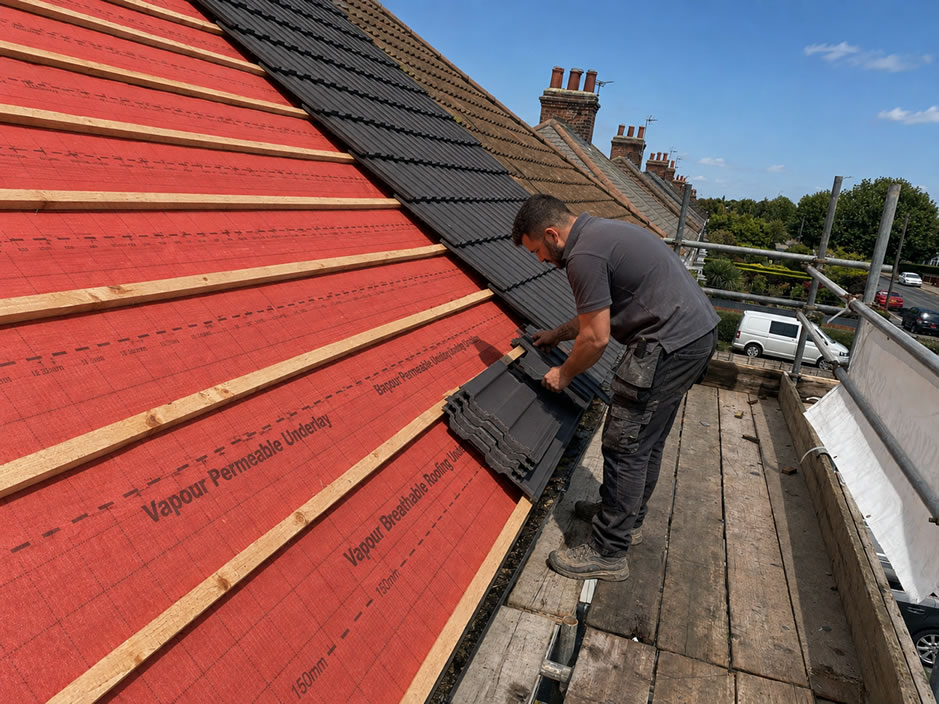
A leaking roof does not automatically need replacing.
Many roof problems come from a small, isolated fault such as a cracked tile, failed flashing or loose ridge tile. In these cases, a targeted repair may restore the roof without the cost and disruption of removing the entire covering.
However, repairs become less effective when deterioration affects large areas. An old roof with brittle underlay, rotten battens, repeated leaks and widespread tile damage may continue causing problems even after several local patches.
The difficult part for homeowners is deciding when another repair represents sensible maintenance and when it simply delays an unavoidable roof replacement.
This guide explains the signs that a roof can still be repaired, the warning signs that replacement may offer better value and the main factors that influence the decision.
Roof Repair vs Roof Replacement at a Glance
| Roof Condition | Repair May Be Suitable | Replacement May Be Better |
|---|---|---|
| One or two damaged tiles | Yes | Usually not |
| Local flashing leak | Yes | Only if wider roof is failing |
| Isolated storm damage | Often | If damage is widespread |
| One leaking valley | Possibly | If several roof areas are worn |
| Small underlay tear | Often | If underlay is brittle throughout |
| Several previous repairs | Less likely | Often |
| Widespread tile failure | No | Usually |
| Rotten battens across the roof | No | Usually |
| Significant roof sagging | Specialist assessment | Often |
| Roof near the end of its life | Short-term repair possible | Often better |
| Repeated leaks in different places | Less likely | Often |
| Major loft conversion planned | Repair may be poor value | Replacement may make sense |
What Counts as a Roof Repair?
A roof repair addresses a specific fault without replacing the full roof covering.
Common repairs include:
- Replacing broken tiles
- Refixing slipped slates
- Repairing lead flashing
- Re-bedding ridge tiles
- Replacing a short valley section
- Patching flat roofing
- Repairing a chimney junction
- Renewing damaged roof underlay locally
- Replacing rotten fascia boards
- Repairing guttering
- Fixing a leaking roof window
- Replacing individual battens
- Repairing storm damage
A repair should deal with the cause of the problem rather than simply covering the visible symptom.
What Does Roof Replacement Involve?
A roof replacement normally means removing most or all of the existing roof covering and rebuilding the weatherproof layers.
Depending on the roof, the work may include:
- Installing scaffolding.
- Removing tiles, slates or flat-roof covering.
- Removing old battens and underlay.
- Inspecting the roof structure.
- Repairing damaged rafters or decking.
- Upgrading insulation where required.
- Installing new roofing underlay.
- Fitting new battens.
- Installing new or reusable tiles and slates.
- Renewing valleys, flashing and roof edges.
- Reinstalling ridge and hip tiles.
- Clearing waste and inspecting the finished roof.
A replacement may cover one roof slope, one flat-roof section or the entire property.
Why Homeowners Often Prefer Repair First
Repair usually costs less and causes less disruption.
It may also:
- Preserve existing roof materials
- Avoid unnecessary waste
- Extend the roof’s useful life
- Take less time
- Require less scaffolding
- Avoid major internal disturbance
- Allow urgent work to be completed quickly
For a generally sound roof, replacement would often be excessive.
The problem arises when repairs become frequent, expensive and increasingly temporary.
When a Roof Repair Usually Makes Sense
The Fault Is Small and Clearly Identified
A repair is normally sensible when the contractor can point to a specific fault.
Examples include:
- One cracked tile
- A small flashing split
- A loose ridge tile
- One failed slate fixing
- A damaged vent
- A local felt tear
- One blocked valley
- A short section of failed guttering
The surrounding roof should remain in reasonable condition.
The Roof Still Has Useful Life Remaining
A roof that is not especially old and has sound underlay, battens and covering usually deserves repair rather than replacement.
For example, storm damage to an otherwise healthy 15-year-old tiled roof should not normally mean the whole roof needs renewing.
Damage Is Limited to One Area
A local leak around a chimney, roof window or valley may need detailed repair without disturbing the rest of the roof.
Matching Materials Are Available
Local repair becomes easier where replacement tiles, slates and accessories can be matched.
The Roof Structure Is Sound
If rafters, trusses and decking remain firm, the problem may only affect the outer covering.
The Repair Should Provide a Reasonable Lifespan
A repair should not merely delay failure for a few weeks unless it is clearly described as temporary emergency work.
Examples of Repairable Roof Problems
| Problem | Typical Repair |
| One broken concrete tile | Replace tile |
| Several slipped slates | Refix or replace slates |
| Cracked chimney flashing | Renew damaged leadwork |
| Loose ridge tile | Lift and refix properly |
| Blocked valley | Clear and inspect |
| Local valley split | Repair or replace affected section |
| Small flat-roof puncture | Compatible patch |
| Damaged roof vent | Replace vent and surrounding detail |
| One torn underlay section | Lift tiles and patch externally |
| Leaking skylight flashing | Renew flashing components |
| Storm-damaged verge | Repair or replace verge section |
| Small fascia rot | Replace affected timber |
Signs That Roof Replacement May Be Needed
A full replacement becomes more likely when several parts of the roof are failing at the same time.
Warning signs include:
- Leaks in several rooms
- Repeated repairs in different places
- Widespread broken or missing tiles
- Large areas of slipped slate
- Brittle roofing underlay
- Rotten battens
- Sagging roof slopes
- Extensive moss hiding damaged tiles
- Crumbling ridge and hip mortar
- Multiple failed valleys
- Widespread timber decay
- Daylight visible across the loft
- Frequent storm damage
- Flat roof covering cracking throughout
- Water pooling over large areas
- Repairs costing a large proportion of replacement
One sign alone may not prove that replacement is necessary. A proper roof survey should assess the complete condition.
Repeated Leaks in Different Locations
A leak that returns in exactly the same place may indicate a failed repair.
However, new leaks appearing around different parts of the property often suggest broader deterioration.
Possible causes include:
- Worn roof tiles
- Failed slate fixings
- Crumbling underlay
- Rotten battens
- Poor ventilation
- Several defective flashing details
- Ageing flat-roof membrane
- Movement in the roof structure
Repeated emergency call-outs can eventually cost more than planned replacement.
Widespread Tile Damage
Individual tiles can be replaced. However, replacement may be more practical when:
- Tiles crack during routine access
- Many tiles have frost damage
- Surfaces are flaking
- Fixing holes have enlarged
- Replacement tiles are difficult to match
- Tiles have become distorted
- Large numbers slip after wind
- Previous coatings have failed
- Water absorption has increased
A roofer should distinguish between cosmetic weathering and genuine material failure.
Widespread Slate Failure
Natural slate roofs can last for many decades, but the fixings may fail before the slates themselves.
Common problems include:
- Nail sickness
- Enlarged nail holes
- Frequent slipping slates
- Cracked or thin slates
- Rusted fixings
- Failed battens
- Widespread previous patching
If sound slates remain, they may be reused during a re-roof with new underlay, battens and fixings.
Failed Roof Underlay
Underlay sits beneath the tiles or slates.
A small tear can often be repaired externally by lifting the nearby roof covering. Full replacement becomes more likely where the underlay is:
- Brittle across the loft
- Hanging down between rafters
- Torn in many places
- Missing around junctions
- Sagging badly
- No longer reaching the gutter
- Damaged by long-term leaks
Replacing underlay properly requires removing the tiles and battens above it.
Rotten Roof Battens
Battens support tiles and slates.
Local replacement may be possible where one short section has become damaged. Widespread rot normally means the roof covering needs lifting.
Signs include:
- Tiles moving under light pressure
- Battens splitting around nails
- Dark or soft timber
- Rows of tiles sagging
- Fixings no longer holding
- Water stains across several roof slopes
Installing new tiles over weak battens is not a reliable solution.
Sagging Roof Slopes
A roof should generally appear straight and even.
Visible dips may indicate:
- Weak rafters
- Rotten timber
- Roof spread
- Failed supports
- Excessive weight
- Poor earlier alterations
- Long-term water damage
A small cosmetic irregularity on an old roof may not require replacement. A new or worsening sag needs structural assessment.
The solution may involve timber repair, partial rebuilding or complete roof replacement.
Flat Roof Warning Signs
Flat roofs often show different signs of failure.
Replacement may be needed where:
- Cracks cover large areas
- Felt has blistered extensively
- EPDM has separated around several edges
- GRP has widespread cracking
- Water remains in deep puddles
- Decking feels soft
- Several previous patches have failed
- The covering has shrunk
- Seams repeatedly reopen
- Water has damaged insulation below
A small puncture may accept a local patch, but a failing system should not be covered with repeated sealant repairs.
Pitched Roof Repair vs Replacement
| Pitched Roof Condition | Repair | Replacement |
| One or two missing tiles | Usually | No |
| Local flashing problem | Usually | Rarely |
| One damaged ridge section | Usually | Not necessarily |
| Several roof slopes leaking | Less likely | Often |
| Underlay brittle throughout | No | Usually |
| Battens rotten across roof | No | Usually |
| Repeated slipped slates | Possibly | Often |
| Roof structure sound | More likely | Depends on covering |
| Structural sagging | Limited repair may not be enough | Often part of solution |
| Tiles still reusable | Repair or re-cover | Tiles may be reused |
Flat Roof Repair vs Replacement
| Flat Roof Condition | Repair | Replacement |
| One small puncture | Usually | No |
| Local failed seam | Usually | Not necessarily |
| One edge lifting | Often | Depends on wider condition |
| Widespread blistering | Poor option | Usually |
| Soft roof deck | No | Usually |
| Several failed patches | Less likely | Often |
| Standing water in one small area | Possible | May need structural correction |
| Membrane shrinking throughout | No | Usually |
| Covering otherwise sound | Usually | No |
| Roof near end of life | Temporary repair possible | Often better |
Does Roof Age Decide Whether It Needs Replacing?
Age matters, but it should not be the only factor.
A well-built and maintained roof may last much longer than an average estimate. A poorly installed roof may fail early.
Broad material lifespans include:
| Roof Material | Broad Potential Lifespan |
| Concrete tiles | 40–60 years or more |
| Clay tiles | 50–100 years or more |
| Natural slate | 75–150 years or more |
| Artificial slate | 30–60 years |
| Basic mineral felt | 10–20 years |
| High-performance felt | 20–30 years |
| EPDM rubber | 30–50 years |
| GRP fibreglass | 20–30 years |
| Single-ply membrane | 25–40 years |
| Metal roofing | 40–70 years or more |
Installation quality, exposure and maintenance can change these figures considerably.
An old roof in good condition does not automatically need replacing. Equally, a newer roof with serious installation faults may require major work.
Repairing an Old Roof
Repair may still make sense on an older roof where:
- The fault is local
- Most materials remain sound
- Matching tiles or slates are available
- The underlay and battens remain serviceable
- The repair can reasonably extend the roof’s life
- Replacement is not currently affordable
However, homeowners should understand that another fault may appear elsewhere later.
A roofer should explain whether the work is a long-term repair or a short-term measure.
The Cost of Repeated Repairs
Small repairs can become expensive when they happen regularly.
For example:
| Repair Pattern | Possible Concern |
| One repair every ten years | Normal maintenance |
| Several repairs after one severe storm | May still be reasonable |
| New leak every few months | Wider deterioration likely |
| Ridge, valley and flashing all failing | Roof system may be reaching end of life |
| Repeated scaffold costs | Replacement may offer better value |
| Repairs fail quickly | Original diagnosis or roof condition may be poor |
Keep invoices and note where previous work took place. This history can help a surveyor identify whether faults are isolated or widespread.
How Much Roof Damage Is Too Much to Repair?
There is no fixed percentage that applies to every roof.
The decision depends on:
- Material condition
- Roof age
- Structural condition
- Number of faults
- Access cost
- Availability of matching products
- Expected repair lifespan
- Future renovation plans
- Cost difference between options
As a practical guide, replacement deserves serious consideration when repairs affect large sections, require repeated scaffolding or cost a substantial part of a complete new roof.
Can One Roof Slope Be Replaced?
Yes. Partial replacement may be possible where one slope has suffered more damage than the others.
This can occur where:
- One side receives more weather
- A large solar installation damaged one slope
- A tree fell onto one area
- Previous work only affected part of the roof
- One extension roof has failed
- A poorly installed membrane affects one section
The contractor needs to form a reliable junction between the new and existing work.
Colour differences between old and new materials may remain visible.
Can the Front Roof Be Replaced Without the Back?
Yes, in some cases.
However, consider:
- The condition of the shared ridge
- Underlay junctions
- Batten continuity
- Flashing
- Valleys
- Tile matching
- Scaffold cost
- Likelihood of replacing the other slope soon
Replacing both sides together may reduce long-term access costs if both are similarly worn.
Can Existing Tiles or Slates Be Reused?
Often, yes.
Reusing sound materials may:
- Reduce waste
- Preserve the property’s appearance
- Lower material costs
- Help with planning or heritage requirements
However, some breakage should be expected during removal.
Materials should not be reused where they are:
- Cracked
- Delaminating
- Frost damaged
- Too thin
- Distorted
- Porous
- Missing usable fixing points
- Contaminated by unsuitable coatings
Natural slate is particularly suitable for reuse where the pieces remain strong.
Roof Replacement Options
Like-for-Like Replacement
The old covering is replaced with a similar material.
Examples include:
- Concrete tiles replaced with concrete tiles
- Clay tiles replaced with clay tiles
- Slate replaced with slate
- Felt replaced with modern felt
This often creates the least visual change.
Reuse Existing Covering
Sound tiles or slates are removed, sorted and reinstalled over new underlay and battens.
Change the Roof Material
A homeowner may switch from one covering to another.
For example:
- Felt to EPDM
- Concrete tile to artificial slate
- Corrugated sheet to insulated metal panel
Weight, roof pitch and planning considerations need checking.
Partial Roof Replacement
Only the failed roof slope, extension or flat-roof section is renewed.
Full Roof Replacement
The complete roof covering, underlay, battens and associated details are replaced.
What Happens During a Roof Survey?
A reliable roof survey should assess more than the visible tiles.
The roofer or surveyor may check:
- Roof covering
- Ridge and hip tiles
- Valleys
- Lead flashing
- Chimneys
- Roof windows
- Underlay
- Battens
- Rafters
- Trusses
- Fascias and soffits
- Gutters
- Insulation
- Ventilation
- Internal damp marks
- Previous repairs
- Structural movement
Photographs can help homeowners understand faults that cannot be seen from ground level.
Questions a Roof Survey Should Answer
- What is causing the leak?
- Is the fault local or widespread?
- How much life remains in the roof?
- Are the tiles or slates reusable?
- Is the underlay still serviceable?
- Are the battens sound?
- Is structural timber damaged?
- Will a repair provide a long-term result?
- What might fail next?
- How much would repair cost?
- How much would replacement cost?
- Which option provides better value?
Signs of an Unnecessary Replacement Recommendation
Be cautious where a contractor recommends full replacement without:
- Inspecting the roof
- Looking in the loft
- Showing photographs
- Explaining the failed materials
- Discussing repair options
- Providing a written scope
- Checking structural timber
- Identifying the source of the leak
Statements such as “the whole roof has gone” should be supported by clear evidence.
A second opinion is sensible before approving major work.
Signs a Roofer Is Underestimating the Problem
The opposite issue can also occur.
A very cheap patch may be poor value where:
- Water enters in several areas
- Timber is rotten
- The roof sags
- Underlay has failed throughout
- Several repairs already exist
- The covering is brittle
- The roofer only plans to apply sealant
- No one has inspected the loft
- The proposed repair has no realistic lifespan
A low price does not help if the leak returns during the next storm.
Typical Roof Repair Costs in the UK
The following figures provide broad budgeting ranges.
| Roof Repair | Typical UK Cost |
| Replace a few tiles | £150–£450 |
| Replace slipped slates | £200–£600 |
| Local flashing repair | £250–£700 |
| Chimney flashing replacement | £500–£1,500 |
| Ridge tile repair | £250–£900 |
| Valley repair | £500–£1,800 |
| Local underlay repair | £300–£900 |
| Flat-roof patch | £200–£600 |
| Larger flat-roof repair | £500–£1,500 |
| Storm damage repair | £300–£2,000 or more |
| Structural timber repair | £500–£3,000 or more |
| Scaffolding | £500–£2,000 or more |
Access and location can affect even a small repair significantly.
Typical Roof Replacement Costs in the UK
| Roof Replacement Work | Typical UK Cost |
| Small porch roof | £1,500–£4,000 |
| Garage flat roof | £2,500–£6,500 |
| Extension roof | £3,000–£8,000 |
| Terraced pitched roof | £6,000–£11,000 |
| Semi-detached pitched roof | £8,000–£15,000 |
| Detached pitched roof | £12,000–£25,000 or more |
| Natural slate roof | £15,000–£35,000 or more |
| Large complex roof | £20,000–£50,000 or more |
| Full flat-roof replacement | £80–£180 per m² |
| Structural repairs | £1,000–£10,000 or more |
| Scaffolding | £1,000–£4,000 or more |
These are broad figures rather than fixed quotations.
Why Roof Replacement Costs Vary
Roof Size
A larger roof needs more labour, materials and scaffolding.
Roof Shape
Hips, valleys, dormers and roof windows create more work.
Material
Natural slate generally costs more than concrete tiles.
Access
Conservatories, narrow side passages and public pavements increase complexity.
Structural Damage
Rotten rafters and failed trusses increase the scope.
Insulation
Large roof-renewal projects may require thermal upgrades.
Leadwork
Chimneys, valleys and abutments can add significant cost.
Waste Removal
Old felt, tiles, battens and timber need disposal.
Location
Labour and scaffold prices vary across the UK.
Repair Cost vs Replacement Cost
The cheapest immediate option is not always the cheapest long-term choice.
Consider:
| Question | Why It Matters |
| How long should the repair last? | A short-lived repair may offer poor value |
| Will another area fail soon? | Replacement may avoid repeat visits |
| Is scaffolding needed either way? | Access costs may be duplicated |
| Can existing materials be reused? | This may reduce replacement costs |
| Is the property being renovated? | Roof work may fit better with wider plans |
| Will insulation need upgrading? | Replacement creates an opportunity |
| Does the roof contain asbestos? | Specialist work may be required |
| Is there a guarantee? | Longer-term protection has value |
Is Roof Replacement a Better Investment?
A new roof may provide:
- Improved weather protection
- Fewer emergency repairs
- Better insulation
- Improved ventilation
- A tidier appearance
- Greater buyer confidence
- New guarantees
- Easier solar panel installation
- Reduced risk of internal damage
However, replacement should still be based on condition rather than assumed to increase the property value by its full cost.
Should You Replace the Roof Before Selling?
It depends on the roof’s condition and sale strategy.
Replacement may make sense where:
- The roof leaks
- A survey will identify serious defects
- Buyers may struggle to obtain lending
- The work will delay the sale
- The roof visibly appears neglected
Repair may be enough where:
- The defect is small
- The roof remains generally sound
- Documentation proves the work was completed
- Replacement would not be recovered in the sale price
Some sellers choose to disclose the roof condition and adjust the asking price instead.
Should You Replace the Roof During a Loft Conversion?
A loft conversion can be a good time to assess roof replacement because the project may already involve:
- Scaffolding
- Roof openings
- Structural changes
- Insulation
- Roof windows
- Dormer construction
- Tile removal
- Building control
Replacing an old roof at the same time may reduce duplicated access and labour.
However, a sound roof should not be replaced without reason.
Should You Replace the Roof Before Installing Solar Panels?
It is sensible to inspect the roof before installing solar panels.
Panels may remain in place for decades, so the roof beneath them should have a reasonable expected lifespan.
Replacement or major repair may make sense where:
- Tiles are badly worn
- Underlay is failing
- Battens are rotten
- The roof already leaks
- Slate fixings are failing
- Replacement is likely within a few years
Removing and reinstalling solar panels later adds cost.
Does Roof Replacement Need Building Regulations Approval?
Major roof replacement can involve Building Regulations.
Requirements may relate to:
- Thermal insulation
- Structural loading
- Ventilation
- Fire performance
- Material changes
- Roof covering replacement
- Structural alterations
The exact rules depend on the location and scope of the work.
The contractor should clarify whether building control notification or approval is required.
Is Planning Permission Needed?
Like-for-like roof replacement does not normally need planning permission.
Further checks may be required where:
- Roof height changes
- The shape changes
- A dormer is added
- Materials significantly alter the appearance
- The building is listed
- The property lies in a conservation area
- Planning conditions apply
- Roof terraces or balconies are introduced
Listed building consent may apply even to work that looks similar.
Is Roof Replacement Covered by Insurance?
Insurance may cover damage caused by a sudden event such as:
- Severe storm
- Fire
- Falling tree
- Impact
- Certain accidental damage
It will not normally cover:
- Old age
- Gradual deterioration
- Poor maintenance
- Long-term leaks
- Defective workmanship
- General wear
A claim may contribute towards repairing the insured damage rather than replacing an already worn roof.
Emergency Repair Before Replacement
A temporary repair may be sensible when immediate replacement cannot begin.
Emergency work may include:
- Tarpaulin
- Temporary felt patch
- Replacing missing tiles
- Sealing a short split
- Clearing blocked drainage
- Supporting unsafe timber
- Removing a loose tile
The contractor should clearly state:
- That the repair is temporary
- How long it may last
- What permanent work is needed
- Whether the roof remains vulnerable
- What weather conditions may affect it
How Long Does Roof Replacement Take?
| Roof Type | Typical Timescale |
| Porch roof | Two to five days |
| Garage flat roof | Three to seven days |
| Terraced pitched roof | One to two weeks |
| Semi-detached roof | One to three weeks |
| Detached roof | Two to four weeks |
| Large slate roof | Three to six weeks |
| Complex structural replacement | Several weeks or more |
Weather and hidden timber damage may extend the schedule.
Can You Stay in the House?
Homeowners can usually remain in the property.
Expect:
- Noise
- Scaffolding
- Dust in the loft
- Restricted parking or access
- Temporary coverings
- Contractors entering the loft
- Waste and deliveries
- Possible short periods of exposed roof
Valuable belongings should be removed from the loft or covered.
How the Roof Is Protected During Replacement
A competent roofer should plan around the weather.
Protection may include:
- Stripping the roof in sections
- Temporary membrane
- Tarpaulins
- Secure sheeting
- Weather monitoring
- Completing vulnerable details quickly
- Keeping insulation protected
- Emergency coverings available
Ask how the property will be protected before signing the contract.
What Should a Roof Replacement Quote Include?
| Quote Item | Why It Matters |
| Roof area | Defines the work |
| Removal of old covering | Confirms whether the roof will be stripped |
| New underlay | Identifies the membrane |
| New battens | Important for tile support |
| Tiles or slates | Confirms type and quantity |
| Reuse allowance | Explains whether old materials return |
| Ridge and hip system | Important for weatherproofing |
| Valleys and flashing | Common leak points |
| Timber repairs | Explains how extras are priced |
| Insulation | May be required |
| Ventilation | Helps prevent condensation |
| Fascias and gutters | May be included or excluded |
| Scaffolding | Often a major cost |
| Waste disposal | Clarifies site clearance |
| Building control | Confirms responsibility |
| VAT | Prevents price confusion |
| Guarantee | Explains aftercare |
Questions to Ask a Roofer
Before choosing repair or replacement, ask:
- What exactly has failed?
- Is the damage local or widespread?
- Can you show me photographs?
- How much life remains in the roof?
- Is a repair likely to last?
- What might fail next?
- Are the tiles or slates reusable?
- Is the underlay brittle?
- Are the battens sound?
- Is there structural damage?
- What would repair cost?
- What would replacement cost?
- Does the price include scaffolding?
- How will hidden damage be charged?
- Will insulation need upgrading?
- Are Building Regulations involved?
- How will the roof be protected from rain?
- What guarantee is included?
Common Mistakes When Deciding
Replacing the Roof Because of One Leak
A local fault may not justify full replacement.
Choosing Repeated Patches on a Failing Roof
Several temporary repairs may cost more in the long term.
Comparing Prices Without Comparing Scope
One quote may cover a patch while another includes a full rebuild.
Ignoring the Loft Inspection
The condition of underlay, battens and rafters matters.
Choosing by Roof Age Alone
Condition and installation quality are more important.
Assuming New Tiles Fix Everything
Weak battens and poor ventilation still need attention.
Reusing Damaged Materials
Not every old tile or slate is suitable for reinstallation.
Failing to Plan for Solar Panels or Loft Work
Future projects can affect the best timing for replacement.
Repair or Replace Checklist
| Question | Repair Favoured | Replacement Favoured |
| Is the problem isolated? | Yes | No |
| Is the covering generally sound? | Yes | No |
| Are battens and underlay healthy? | Yes | No |
| Has the roof needed frequent repairs? | No | Yes |
| Can matching materials be found? | Yes | No |
| Is structural timber sound? | Yes | No |
| Will repair last several years? | Yes | No |
| Is scaffolding already required? | Maybe | Replacement may offer value |
| Is the roof nearing the end of its life? | Less likely | Yes |
| Is a loft conversion planned? | Depends | Replacement may be practical |
| Are solar panels being installed? | Depends | Replace first if roof is worn |
| Does replacement cost only moderately more? | Repair may still work | Compare long-term value |
Frequently Asked Questions
Does a leaking roof always need replacing?
No. Many leaks come from local faults such as broken tiles, failed flashing or damaged valleys that can be repaired.
How do I know if my roof needs replacing?
Widespread leaks, brittle underlay, rotten battens, repeated repairs, sagging and extensive tile damage can indicate that replacement is needed.
Is it better to repair or replace an old roof?
Repair may make sense where the problem is isolated and the roof remains sound. Replacement may offer better value where several components are failing.
How many roof repairs are too many?
There is no fixed number. However, frequent new leaks in different locations suggest broader roof deterioration.
Can part of a roof be replaced?
Yes. One slope, extension or flat-roof section can sometimes be replaced while the remaining roof stays in place.
Can old roof tiles be reused?
Sound tiles and slates can often be reused. Cracked, porous, frost-damaged or badly worn materials should be replaced.
How much does roof replacement cost?
A straightforward terraced roof may cost around £6,000 to £11,000. Larger detached or complex roofs can cost £12,000 to £25,000 or considerably more.
How much does a roof repair cost?
Small repairs may cost from approximately £150 to £700. Valleys, structural repairs and difficult access can raise the cost into the thousands.
Should I replace my roof before installing solar panels?
It may be sensible where the roof is already worn or likely to need replacement within the life of the solar panels.
Should I replace my roof during a loft conversion?
A loft conversion can be a practical time to replace an ageing roof because scaffolding and structural work may already be planned.
Can a new roof improve insulation?
Yes. Major replacement work can provide an opportunity to improve insulation, ventilation and airtightness.
Does roof replacement require scaffolding?
Most house roof replacements require scaffolding and edge protection.
How long does a roof replacement take?
A typical pitched house roof may take one to three weeks. Large or complex roofs can take longer.
Can I stay in my home during roof replacement?
Usually, yes. Homeowners should expect noise, dust, scaffolding and some disruption.
Is roof replacement covered by home insurance?
Insurance may cover sudden storm, fire or impact damage. It does not normally cover gradual wear, old age or poor maintenance.