
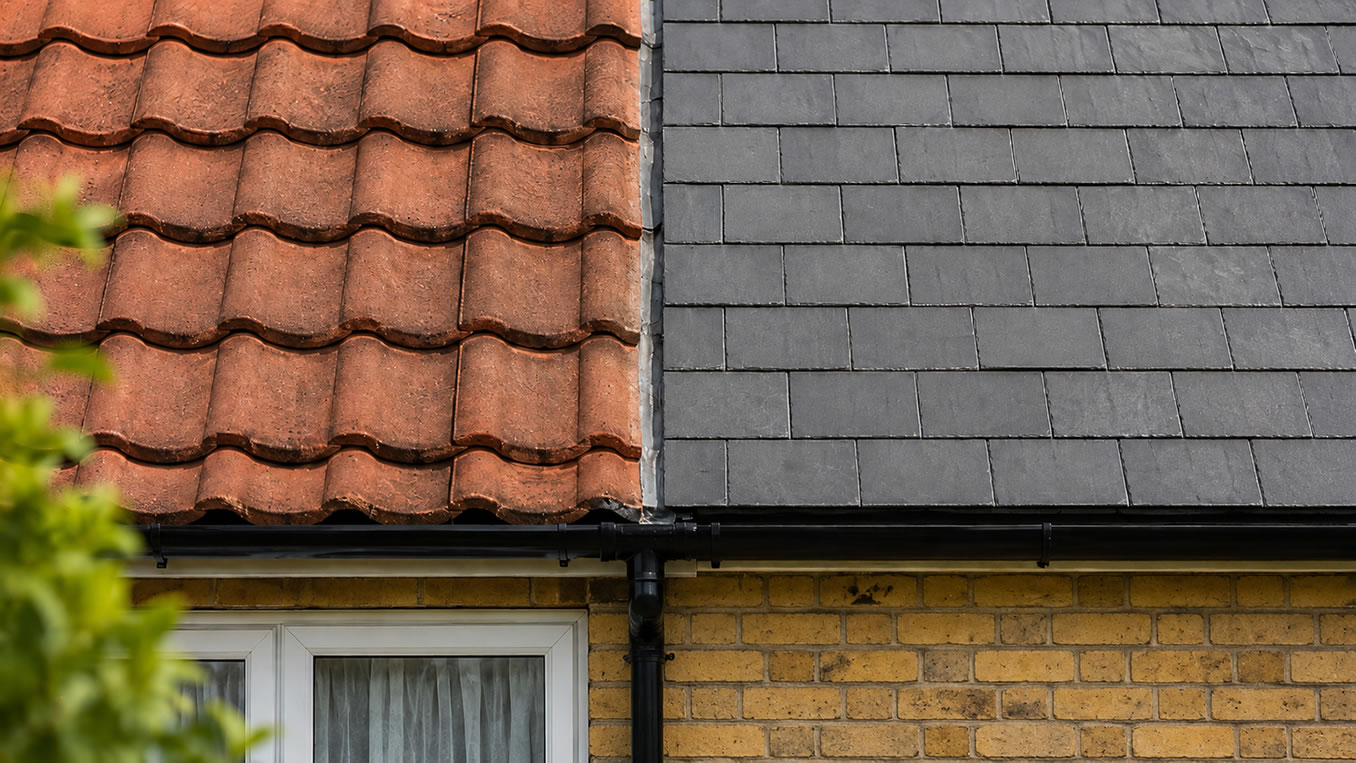
Slate and tiled roofs can both last for decades, but they do not always cost the same to maintain. Natural slate generally lasts longer than most roof tiles, yet individual slate repairs can cost more because the work is more specialist. Concrete tiles, meanwhile, are usually cheaper and easier to replace, while clay tiles tend to sit somewhere between the two.
For homeowners, the important question is not simply which roof costs less to repair today. It is also worth considering how often repairs may be needed, how easy matching materials are to find and whether routine maintenance can extend the life of the existing roof.
As a broad guide, small-area natural slate roof repairs currently cost around £150 to £220 per m², compared with approximately £90 to £120 per m² for concrete tiles and £110 to £160 per m² for clay tiles. However, access, scaffolding and the type of fault can make a much bigger difference to the final bill than the material alone.
This guide compares slate and tile roof maintenance and repair costs, including slipped slates, broken tiles, moss removal, ridge work, flashing, valleys and the point where replacement may offer better value.
Slate and tile roof repair costs at a glance
The table below gives a useful starting point for comparing common UK repair costs.
| Repair or Maintenance Job | Slate Roof | Tiled Roof |
|---|---|---|
| Small-area roof repair | £150–£220 per m² | £90–£160 per m² |
| Replace a few slipped or broken units | Often £150–£400+ | Often £120–£350+ |
| Ridge tile repair | Similar where ridge construction is the same | £225–£550 typical |
| Lead flashing repair | £250–£700+ | £250–£700+ |
| Roof valley repair | £300–£900+ | £300–£900+ |
| Moss removal / roof cleaning | £8–£16 per m² | £8–£16 per m² |
| Gutter clearing during maintenance | £60–£180+ | £60–£180+ |
| Major localised repair | Often £500–£1,500+ | Often £400–£1,200+ |
These figures are broad guide prices. A roofer will normally price the actual job after considering roof height, pitch, access, material type and the extent of the damage.
Is slate more expensive to repair than tiles?
Usually, yes.
Natural slate tends to cost more to repair because:
- slate itself can cost more
- matching old slate may take time
- the roofer needs more specialist skills
- removing surrounding slates without damaging them takes care
- replacement slates may need cutting or grading
- traditional fixing methods may require more labour
By comparison, common concrete roof tiles are widely available and often easier to replace individually.
That does not mean a slate roof is necessarily more expensive over its whole life. Natural slate can last considerably longer than many manufactured roof coverings. Therefore, a higher repair cost can still make sense if the remaining roof has many decades of service left.
Concrete tile roof repair costs
Concrete tiles are among the most common roofing materials on UK homes.
They are popular partly because repairs are usually straightforward. Roofers can often source matching or compatible tiles, especially on relatively modern roofs.
Common concrete tile repairs include:
- replacing cracked tiles
- refixing slipped tiles
- changing damaged ridge or hip tiles
- repairing valleys
- replacing flashing
- renewing small sections of underlay
- replacing damaged battens
For small-area repairs, concrete tiles currently tend to sit around £90 to £120 per m², excluding extras such as difficult access and scaffolding.
A small job involving only a handful of tiles may instead attract a minimum call-out or half-day charge.
Clay tile roof repair costs
Clay roof tiles generally cost more than standard concrete tiles, particularly when the property uses traditional plain tiles or an unusual profile.
Small-area clay tile repairs commonly sit at around £110 to £160 per m².
However, the actual cost varies greatly.
Old clay tiles may be:
- handmade
- weathered to a particular colour
- no longer manufactured
- unusual in size
- fixed using older roofing methods
In those situations, sourcing suitable reclaimed tiles may increase the price.
Nevertheless, good-quality clay tiles can last for many decades, so repairing an older clay roof often remains worthwhile.
Natural slate roof repair costs
Natural slate generally sits at the higher end of pitched-roof repair pricing.
Small-area natural slate repairs can cost around £150 to £220 per m².
The higher figure reflects both material cost and labour.
For example, replacing one slipped slate may sound simple. However, the roofer may need to:
- reach the damaged area safely
- remove or work around surrounding slates
- identify a suitable replacement
- cut or dress the new slate
- fix it securely
- avoid damaging the neighbouring roof covering
As a result, access and labour can cost far more than the replacement slate itself.
Cost of replacing slipped or broken slates
A handful of slipped slates may cost around £150 to £400 or more to repair.
A roofer may use:
- slate hooks
- copper nails
- replacement natural slate
- reclaimed matching slate
- repair clips or specialist fixings
The price often depends more on access than on the number of slates.
For instance, replacing two slates on a bungalow may prove inexpensive. Replacing the same two slates on a three-storey townhouse may require scaffold or specialist roof access.
Cost of replacing broken roof tiles
Replacing a few broken concrete or clay tiles is often cheaper.
A typical small repair might cost around £120 to £350, depending on:
- tile type
- quantity
- height
- access
- availability
- whether adjacent tiles also need attention
If the roofer already has access for other work, adding a few tile replacements may cost relatively little.
Maintenance costs: slate vs tile
Routine maintenance costs are often more similar than repair costs because many tasks apply to both roof types.
These include:
- checking flashings
- clearing valleys
- inspecting ridge and hip details
- removing excessive moss
- checking gutters
- inspecting the roof after storms
- replacing isolated damaged units
| Maintenance Job | Slate Roof | Tile Roof |
| Visual inspection | Similar cost | Similar cost |
| Gutter cleaning | Similar cost | Similar cost |
| Moss removal | Often needs gentler approach | Depends on tile type |
| Flashing checks | Similar cost | Similar cost |
| Ridge inspection | Similar | Similar |
| Individual unit replacement | Usually higher | Usually lower |
Therefore, the main difference appears when actual roof-covering repairs become necessary.
Roof cleaning costs
Roof cleaning currently costs broadly £8.50 to £14 per m² for common methods, although the method and roof condition matter.
Typical approaches include:
- manual moss scraping
- biocide treatment
- soft washing
- steam cleaning
- carefully controlled pressure washing on suitable roofs
Older slate and clay roofs usually need a gentler approach.
Aggressive pressure washing can:
- loosen slates
- damage tile surfaces
- force water beneath the covering
- disturb mortar
- expose weak fixings
For that reason, manual moss removal followed by a suitable treatment often makes more sense on older roofs.
Does moss damage slate and tile roofs?
Moss does not automatically mean the roof needs repair.
However, heavy growth can cause problems because it:
- holds moisture
- blocks valleys and gutters
- lifts lightweight or already loose roof coverings
- hides cracked tiles
- creates debris that washes into drainage systems
The effect depends on the condition of the roof.
A strong modern tiled roof may tolerate light moss for years. On the other hand, heavy moss on a fragile slate roof can make inspection and repair more difficult.
Ridge tile repair costs
Both slate and tile roofs often use ridge tiles, so the cost may be similar regardless of the main roof covering.
Typical current prices include:
| Ridge Repair | Typical Cost |
| 1–3 ridge tiles | £225–£275 |
| 4–6 ridge tiles | £325–£400 |
| 7–10 ridge tiles | £425–£550 |
| Repointing around 10 metres | £200–£300 |
| Full ridge on typical semi | £500–£700 |
Older roofs may use mortar-bedded ridge tiles, while newer roofs may use dry-ridge systems.
If the existing mortar keeps failing, upgrading to a dry-ridge system may offer better long-term value than repeated repointing.
Lead flashing repair costs
Lead flashing protects vulnerable roof junctions such as:
- chimneys
- walls
- valleys
- dormers
- roof windows
Flashing repair costs do not change dramatically simply because the main roof is slate rather than tile.
Typical flashing repairs may cost approximately £250 to £700 or more.
However, slate can make access around the flashing more labour-intensive because the roofer must remove surrounding pieces carefully.
Roof valley repair costs
Valleys carry large amounts of rainwater, so problems here need attention quickly.
Typical roof valley repair prices may fall around £300 to £900, depending on:
- valley length
- lead or GRP construction
- surrounding slate or tiles
- damaged underlay
- rotten valley boards
- access
A full replacement may cost more if the roofer needs to strip a long section of roof covering on both sides.
Again, a slate valley can be more labour-intensive because the roofer may need to preserve and relay individual natural slates.
Underlay and batten repairs
Sometimes the visible slate or tile is not the real problem.
A leak may result from:
- torn underlay
- rotten battens
- failed fixings
- damaged timber
- incorrect detailing
The roofer may need to lift a section of roof covering to reach the fault.
This can make slate repairs more expensive because lifting and relaying natural slate usually takes more time than dealing with larger interlocking concrete tiles.
However, if the old natural slate remains sound, reusing it can save substantial material costs compared with a full new covering.
Why do old slate roofs suffer from slipped slates?
Many old slate roofs develop slipped slates because of fixing failure rather than defective stone.
On traditional roofs, the original nails can corrode after decades of exposure. Roofers sometimes refer to widespread fixing deterioration as nail sickness.
Warning signs include:
- several slates slipping each year
- slates appearing intact when they fall
- repeated repairs across different roof areas
- widespread loose fixings
One or two slips may justify local repair.
However, repeated slipping across the entire roof can indicate that stripping and relaying the slate over new battens and fixings would offer better value.
Why do roof tiles break?
Concrete and clay tiles can fail because of:
- impact damage
- frost
- foot traffic
- storm movement
- ageing
- weak previous repairs
- movement in battens
- fixing failure
One or two cracked tiles rarely justify replacing the whole roof.
However, widespread cracking, surface deterioration or continual failures can indicate that the roof covering is reaching the end of its useful life.
Which roof is cheapest to maintain?
For ordinary maintenance, there may be little difference.
Gutter cleaning, visual inspections and flashing checks cost roughly the same.
However, concrete tile roofs usually have the lowest individual repair costs because the materials are readily available and relatively quick to fit.
Clay tiles tend to cost slightly more.
Natural slate normally costs the most per repair, especially when:
- access is difficult
- matching slate is hard to find
- several slates need replacing
- traditional detailing is involved
Which roof is cheaper over its lifetime?
This is where the comparison becomes less straightforward.
Natural slate costs more to repair, yet it may last well over 100 years.
Concrete tiles often cost less to repair but may need full replacement sooner.
Therefore, a theoretical long-term comparison may look like this:
| Factor | Natural Slate | Clay Tile | Concrete Tile |
| Individual repair cost | High | Medium | Low |
| Routine maintenance | Low–medium | Low | Low |
| Typical material lifespan | Very long | Long | Long |
| Ease of matching | Can be difficult | Sometimes difficult | Usually easier |
| Reuse potential | Excellent | Good | Moderate |
| Specialist labour | More likely | Sometimes | Less often |
| Long-term value | Excellent on suitable properties | Very good | Very good |
Slate can therefore cost more each time something needs attention while still providing excellent value across the full life of the roof.
Should you repair an old slate roof?
Repair usually makes sense when:
- most slates remain sound
- failures are localised
- only a few slates have slipped
- flashing needs attention
- the roof structure remains sound
- matching slate is available
A complete replacement or strip-and-relay may make more sense when:
- slates slip frequently across the roof
- fixing failure is widespread
- battens have deteriorated
- underlay needs full renewal
- previous repairs have become extensive
- roof timbers need major work
The key point is that old age alone does not mean natural slate has failed.
Should you repair an old tiled roof?
Repair usually remains sensible when:
- damage affects only a few tiles
- the roof is otherwise watertight
- replacement tiles remain available
- the underlay is still serviceable
- ridge and valley details remain sound
Replacement may offer better value when:
- tiles fail repeatedly
- the roof leaks in several places
- the underlay has deteriorated widely
- battens or timbers need extensive work
- matching tiles are no longer available
- repairs cover a large percentage of the roof
Repairing versus replacing: a simple cost example
Imagine two roofs each need six damaged roofing units replaced.
Concrete tiled roof
The replacement tiles themselves may cost relatively little. Therefore, labour and access make up most of the repair price.
A straightforward repair might cost a few hundred pounds.
Natural slate roof
The roofer may need to source matching slate, work more carefully around neighbouring pieces and use specialist fixing methods.
The same number of damaged units could therefore cost more.
However, if the surrounding slate still has another 40 or 50 years of useful life, paying slightly more for the repair can still make financial sense.
How access changes both slate and tile repair costs
Access often matters more than the material.
A roofer may be able to complete a small repair using safe ladder or tower access. However, difficult jobs may need:
- scaffolding
- scaffold towers
- roof ladders
- edge protection
- specialist access systems
This means a £20 replacement tile could form part of a £300 repair because reaching it safely is the expensive part.
The same applies to slate.
Is DIY roof maintenance cheaper?
Some basic maintenance can be done from ground level.
Homeowners can:
- inspect the roof using binoculars
- look for missing slates or tiles
- check the loft after heavy rain
- monitor ceilings for staining
- keep nearby trees maintained
- check gutter flow during rain
However, climbing onto a pitched roof is very different.
Tiles and slates can break under foot, while falls from roofs can cause serious injuries.
In most cases, roof-level repairs are better left to an experienced roofer.
How often should slate and tile roofs be inspected?
There is no need to pay for a full professional roof survey every year when the roof shows no problems.
However, it makes sense to check the roof:
- after major storms
- when buying a property
- after nearby building work
- if tiles or slate appear on the ground
- when leaks appear
- when the chimney or gutters need work
- before installing solar panels
Older roofs may benefit from more frequent professional checks.
How to reduce future roof repair costs
Deal with slipped slates and tiles early
One missing piece can allow rainwater onto the underlay and battens.
Keep gutters clear
Blocked gutters can cause water to overflow against fascia boards and roof edges.
Maintain valleys
Leaves and moss can trap moisture and slow water flow.
Look after flashing
Small flashing problems around chimneys can become expensive leaks.
Avoid unnecessary roof walking
Walking across slate or tiles can crack them.
Use matching replacement materials
Poorly fitting replacement units can lead to future leaks.
Keep records of repairs
Knowing which parts of the roof have already received attention makes future diagnosis easier.
Slate vs tile roof repair: which wins?
If the question is purely which costs less to repair, concrete tiles usually win.
If the question is which offers the longest potential roof life, natural slate normally wins.
Clay tiles sit somewhere between the two, offering long life and a traditional finish without usually reaching the same repair cost as premium natural slate.
For many homeowners, the most sensible choice is to maintain whichever good-quality material the house already has rather than replacing an otherwise serviceable roof simply to switch materials.
Get slate or tile roof repair quotes
If your roof has slipped slates, cracked tiles, leaking flashing or other signs of damage, getting several quotations can help you understand whether a small repair is enough.
Ask each roofer to explain:
- what has failed
- which materials need replacing
- whether the rest of the roof remains sound
- whether scaffolding is included
- whether matching slates or tiles are available
- whether repair or replacement offers better value
Use the quotation form on this page to compare slate and tile roof maintenance and repair quotes from local roofing specialists.
Frequently Asked Questions
Is a slate roof more expensive to repair than a tiled roof?
Usually, yes. Natural slate repairs often cost more because the material and labour are more specialist. Concrete tile repairs tend to be the cheapest, while clay usually sits between concrete and slate.
How much does slate roof repair cost?
Small-area natural slate repairs can cost roughly £150 to £220 per m². Small individual repair jobs may instead be priced by labour, access and the number of slates involved.
How much does tile roof repair cost?
Small-area concrete tile repairs can cost around £90 to £120 per m², while clay tile repairs may cost roughly £110 to £160 per m².
Is it worth repairing a 100-year-old slate roof?
It can be. Natural slate may remain sound after 100 years. If the problem affects fixings, flashing or only a few slates, repair or stripping and relaying the existing slate may make more sense than replacing it with another material.
Which roof is cheaper to maintain, slate or tile?
Routine maintenance costs are fairly similar. However, individual repairs generally cost less on concrete tile roofs because replacement tiles are widely available and quicker to fit.
How much does roof cleaning cost?
Typical roof cleaning prices currently sit around £8.50 to £14 per m², although the cost depends on roof size, access, cleaning method and the amount of moss.
Should slate roofs be pressure washed?
Generally, older slate roofs benefit from gentler cleaning methods. Aggressive pressure washing can loosen slates, disturb weak fixings and force water beneath the roof covering.
How much do ridge tile repairs cost?
Small ridge tile repairs commonly cost around £225 to £275, while larger repairs involving several ridge tiles can cost £425 to £550 or more.
When should I stop repairing an old roof?
Replacement may make more sense when faults become widespread, leaks keep returning, underlay and battens have deteriorated or repeated repairs are becoming expensive.
Does access affect slate and tile repair costs?
Yes. Access can have a major effect on both. Scaffolding, towers and specialist safety equipment can cost more than the actual replacement slate or tiles.