
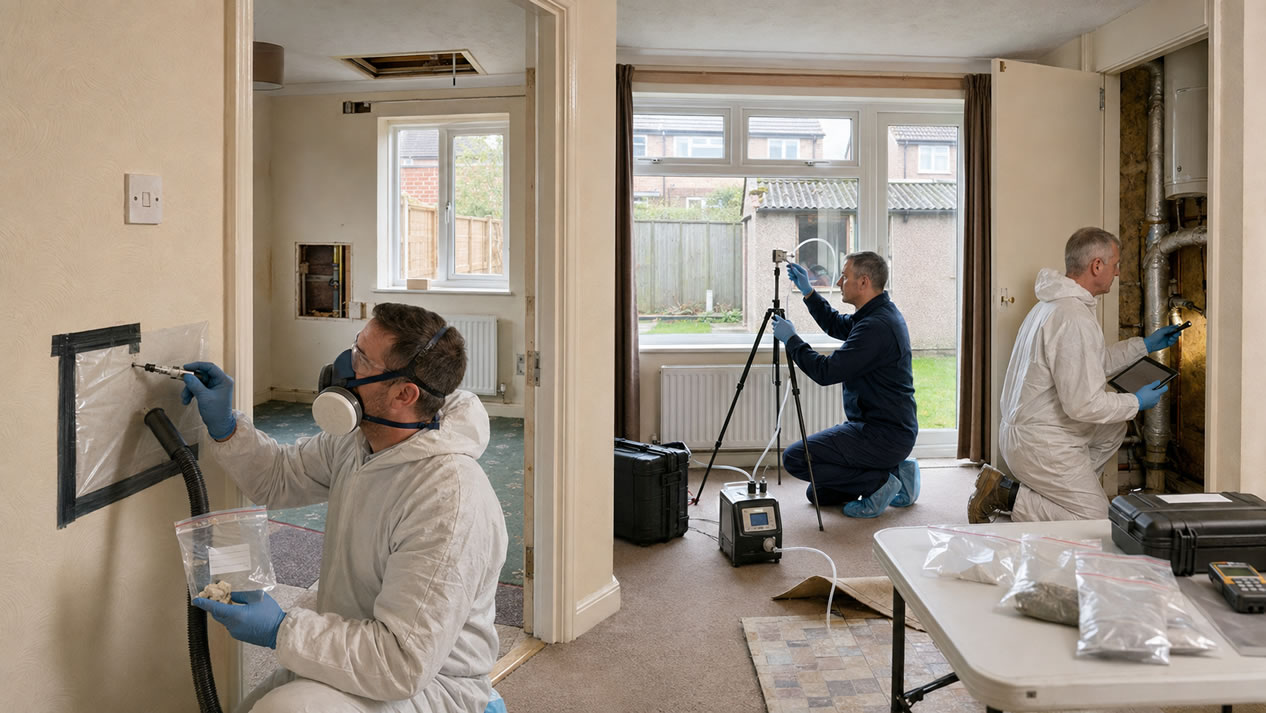
If you own, manage or are planning work on an older property, you may come across several different asbestos testing and survey services.
The names can sound similar, but they are not interchangeable.
For example, an asbestos sample can tell you whether one specific material contains asbestos. An asbestos management survey looks more broadly at materials that could be disturbed during normal use and maintenance. Meanwhile, a demolition survey is much more intrusive because it needs to identify asbestos that could be hidden inside the structure before major work begins.
Air testing is different again. Instead of testing a piece of building material, it measures airborne fibre concentrations in a particular area.
The four services homeowners, landlords and property managers are most likely to encounter are:
- Asbestos sampling
- Asbestos air testing
- Asbestos demolition survey
- Asbestos management survey
Understanding the difference can help you order the right service and avoid paying for a survey that does not actually answer the question you need answered.
The Four Main Asbestos Services at a Glance
| Service | What It Checks | Typical Reason for Using It |
|---|---|---|
| Asbestos sampling | One or more suspect materials | Confirm whether a material contains asbestos |
| Asbestos air testing | Fibres in the air | Check airborne fibre levels or support clearance work |
| Demolition/refurbishment survey | Hidden and visible asbestos in areas affected by major work | Before substantial refurbishment or demolition |
| Management survey | Accessible asbestos that could be disturbed during normal use | Ongoing management of occupied buildings |
Why the Correct Type of Asbestos Survey Matters
Choosing the wrong service can leave important areas unchecked.
For example, imagine an older house has:
- Textured ceilings
- Vinyl floor tiles
- Asbestos-cement garage roof
- Old boiler cupboard
- Suspicious partition boards
If the homeowner only sends one ceiling sample for laboratory testing, that result tells them about that sample.
It does not confirm whether the rest of the property is asbestos-free.
Similarly, a normal management survey is not intended to uncover every concealed asbestos-containing material hidden behind walls, under floors or above ceilings before major demolition work.
That is why the scope of the planned work should determine which asbestos survey or test is appropriate.
1. Asbestos Sampling
Asbestos sampling is the simplest of the four services.
A small piece of a suspect material is carefully collected and sent to a laboratory for analysis.
The purpose is to answer a fairly straightforward question:
Does this particular material contain asbestos?
When Asbestos Sampling Is Useful
Sampling can make sense where you have identified one or several specific materials that need confirming.
Examples include:
- Textured ceiling coating
- Old floor tile
- Garage roof sheet
- Soffit board
- Roof undercloak
- Wall panel
- Flue pipe
- Boiler cupboard board
- Pipe insulation
- Cement panel
It can be particularly useful before a small home-improvement job.
For example, if a roofer needs to remove an old verge board and suspects it may contain asbestos, sampling can provide a clearer answer before work begins.
What Happens During Asbestos Sampling?
The exact process depends on the material, but a surveyor will normally:
- Inspect the suspect material.
- Choose an appropriate sampling point.
- Minimise disturbance.
- Take a small representative sample.
- Seal or make safe the sampling location where appropriate.
- Package and label the sample.
- Send it to a laboratory for analysis.
- Provide the result.
HSE’s current analytical guidance, HSG248, sets out the recognised analytical procedures used in Great Britain for asbestos sample analysis and air monitoring.
What Does the Laboratory Look For?
A laboratory can identify asbestos fibres within the material and determine whether asbestos is present.
Common asbestos types historically used in UK buildings include:
- Chrysotile
- Amosite
- Crocidolite
Homeowners do not normally need to determine the asbestos type visually.
Laboratory analysis should provide the identification.
Can You Identify Asbestos Just by Looking at It?
Not reliably.
Some asbestos-containing materials look almost identical to non-asbestos products.
For example:
- Modern fibre cement can resemble asbestos cement
- Plasterboard can resemble asbestos insulating board
- Modern textured coating can resemble older asbestos-containing coating
Sampling removes much of that uncertainty.
Is One Sample Enough?
Sometimes, but not always.
A single sample only represents the material sampled.
A ceiling in one room may contain asbestos while a visually similar ceiling installed during a later refurbishment does not.
Different areas may therefore need separate samples.
HSE guidance says sampling during surveys should be sufficient to establish whether asbestos is present in the particular materials being assessed.
Sampling Is Not the Same as an Asbestos Survey
This distinction is important.
If you ask for:
“an asbestos test”
you may receive only sampling of one suspected material.
A survey normally includes:
- Systematic inspection
- Locations checked
- Material condition
- Sample results where applicable
- Areas not accessed
- Recommendations
Sampling is usually much more limited.
Typical Asbestos Sampling Costs
Broad UK budgeting ranges might be:
| Service | Typical Cost |
| One asbestos sample | £50–£120 |
| Two to three samples | £100–£250 |
| Several samples and site visit | £150–£350+ |
Location, travel and laboratory turnaround time can affect the price.
When Sampling May Be All You Need
A sample may be sufficient where:
- One material is in question
- You know exactly what needs disturbing
- The rest of the property is outside the work area
For example, testing one old garage roof before replacing it may be enough if no other part of the building will be affected.
2. Asbestos Air Testing
Air testing is fundamentally different from material sampling.
Instead of removing a piece of building material, an analyst draws a measured amount of air through a filter.
The filter is then examined to estimate airborne fibre concentrations.
HSE describes both personal and static air sampling in its analysts’ guidance. Static monitoring can be used to assess potential fibre spread, test the effectiveness of containment and support clearance procedures after asbestos removal work.
When Asbestos Air Testing Is Used
Air monitoring may be used:
- During asbestos removal
- After certain asbestos removal work
- To investigate suspected fibre release
- To assess containment
- For reassurance after an incident
- As part of formal clearance procedures
- For worker exposure monitoring
Air Testing Does Not Tell You Where Asbestos Is
This is another important distinction.
An air test does not locate asbestos-containing materials throughout a property.
It tells you about airborne fibre concentration at the:
- Location
- Time
- Conditions
under which the test was carried out.
If there are asbestos materials hidden elsewhere in the building but no fibres are airborne during the test, air monitoring will not identify them.
Static Air Testing
Static air monitoring uses equipment positioned at a fixed location.
It may be used:
- Outside an asbestos enclosure
- In an adjacent room
- After disturbance
- During controlled asbestos work
The test provides information about airborne fibres within that particular environment.
Personal Air Monitoring
Personal monitoring places the sampling equipment close to the worker’s breathing zone.
HSE says personal sampling may be used to check workers’ exposure, assess control measures and support exposure records and risk assessment.
For a typical homeowner, static or clearance-related testing is more likely to be encountered than occupational personal monitoring.
Reassurance Air Testing
Reassurance testing may be considered after an incident.
For example:
- Suspect board accidentally broken
- Asbestos material disturbed during refurbishment
- Concern following removal work
However, the surrounding circumstances matter.
The analyst needs to know:
- What material was disturbed
- When it happened
- Whether cleaning has taken place
- Whether the room has been ventilated
- Whether the area remains contaminated
A single air test should not be treated as a substitute for properly assessing contaminated dust or materials.
Clearance Air Testing
Air monitoring can form part of the formal clearance process after licensed asbestos removal.
HSE’s guidance identifies static sampling as a fundamental component of clearance procedures following licensed asbestos work.
This is more involved than simply running an air pump for reassurance.
The Four-Stage Clearance Process
After certain licensed asbestos work, an independent analyst may carry out a formal clearance procedure.
This can involve:
- Preliminary checks of the site and enclosure.
- Thorough visual inspection.
- Clearance air monitoring.
- Final assessment after the enclosure is removed.
Successful completion can lead to certification for reoccupation.
HSE’s current regulatory material describes the four-stage clearance role as involving visual inspection, clearance air testing and certification for reoccupation.
When Air Testing Might Be Appropriate in a Home
Examples could include:
Accidental Damage
A builder unknowingly drills or breaks asbestos-containing material.
Following Specialist Removal
Air monitoring may be part of the clearance arrangements depending on the type of work.
Concern About Fibre Spread
An analyst may assess whether asbestos work has affected surrounding spaces.
What Air Testing Cannot Prove
A good result does not automatically mean:
- Property contains no asbestos
- Every surface is free from contamination
- Hidden asbestos is absent
- Future disturbance is safe
Air testing answers a different question.
Typical Asbestos Air Testing Costs
Broad figures may be around:
| Service | Typical Cost |
| Basic reassurance air test | £200–£400 |
| Multiple air monitoring points | £300–£600+ |
| Formal clearance testing | £300–£700+ |
| Complex multi-area monitoring | £500–£1,000+ |
Prices can vary significantly according to travel, number of samples and complexity.
3. Asbestos Demolition Survey
Homeowners often use the phrase asbestos demolition survey, although current HSE terminology generally refers to a refurbishment and demolition survey.
This is the survey you need to understand when building fabric is going to be substantially disturbed.
It can apply before:
- Demolition
- Major renovation
- Structural alteration
- Wall removal
- Ceiling removal
- Large-scale refurbishment
- Significant services replacement
What Is a Refurbishment and Demolition Survey?
It is a more intrusive survey intended to locate asbestos within the specific areas where refurbishment or demolition will take place.
HSE’s survey guidance distinguishes this from a management survey because refurbishment and demolition work can expose materials that are normally hidden and inaccessible.
Why Is It More Intrusive?
The surveyor may need to inspect behind:
- Wall panels
- Ceilings
- Floor coverings
- Boxing
- Service risers
- Cladding
- Fixed equipment
This can involve destructive inspection because the building fabric is going to be disturbed anyway.
Typical Domestic Projects Where It Can Be Relevant
Full Bathroom Renovation
Especially where walls, ceilings or flooring are stripped back.
Possible suspect materials include:
- Floor tiles
- Textured ceilings
- Pipe boxing
- Insulating board
Kitchen Refurbishment
Potential asbestos can be hidden in:
- Flooring
- Ceiling coatings
- Boiler cupboards
- Heat-resistant panels
Loft Conversion
Possible materials include:
- Pipe lagging
- Flues
- Asbestos cement tanks
- Boards
Garage Demolition
Older garages may contain:
- Asbestos cement roofing
- Wall sheets
- AIB ceiling panels
- Cement fascia boards
Internal Wall Removal
Some older partitioning may contain asbestos insulating board.
Does the Whole House Need Surveying?
Not necessarily.
A refurbishment survey should normally cover the areas that will be affected by the planned work.
For example, if only a bathroom is being stripped back, it may not be necessary to conduct destructive investigation throughout every bedroom.
However, the scope needs to be agreed clearly.
Why a Normal Management Survey May Not Be Enough Before Demolition
A management survey is designed around normal occupation and foreseeable maintenance.
It is not necessarily destructive enough to identify asbestos hidden:
- Behind walls
- Beneath floors
- Inside ducts
- Above inaccessible ceilings
A demolition or refurbishment survey has a different purpose.
HSE Enforcement and Refurbishment Surveys
HSE enforcement records repeatedly show the risk of starting refurbishment or demolition work without adequate asbestos assessment where the building could contain asbestos.
For example, HSE notices have been issued where asbestos contractors began intrusive building work without suitable refurbishment and demolition survey information.
What Should the Report Include?
Depending on the survey scope, expect information such as:
- Areas inspected
- Materials sampled
- Asbestos identified
- Material locations
- Areas not accessed
- Laboratory results
- Photographs
- Survey limitations
Because the affected areas may later be demolished, the focus differs from long-term management.
When Should the Survey Take Place?
Before contractors begin intrusive work.
Ideally, it should happen early enough that:
- Asbestos removal can be priced
- Project schedule can be adjusted
- Correct contractors can be selected
- Unexpected delays are avoided
Discovering asbestos halfway through a renovation is often much more disruptive.
Typical Refurbishment or Demolition Survey Costs
Broad UK estimates might include:
| Property/Project | Typical Cost |
| Single room refurbishment survey | £200–£400 |
| Small domestic renovation survey | £300–£500 |
| Whole-house refurbishment survey | £400–£700+ |
| Larger demolition survey | £500–£1,000+ |
Very complex buildings can cost considerably more.
4. Asbestos Management Survey
A management survey is the standard survey used to help manage asbestos during normal occupation and routine maintenance.
HSE describes its purpose as locating, as far as reasonably practicable, suspect asbestos-containing materials that could be disturbed during normal occupancy, including foreseeable maintenance and installation work, while also assessing their condition.
Who Normally Needs a Management Survey?
Management surveys are particularly relevant to:
- Commercial properties
- Offices
- Shops
- Schools
- Warehouses
- Communal areas of residential buildings
- Landlords responsible for common parts
- Property managers
Domestic homeowners can also commission similar surveys where they want to understand asbestos within an older property.
What Does a Management Survey Look For?
The surveyor may inspect:
- Ceilings
- Walls
- Floors
- Service cupboards
- Plant rooms
- Roof spaces
- Pipework
- External cladding
- Soffits
- Outbuildings
The survey concentrates on materials that could reasonably be disturbed during ordinary use and maintenance.
Does a Management Survey Include Sampling?
Often, yes.
HSE says management surveys will usually involve sampling and analysis to confirm whether suspect materials contain asbestos, although some materials may instead be presumed to contain asbestos.
What Does “Presumed Asbestos” Mean?
Sometimes a surveyor may not sample a suspect material.
Instead, they may record it as presumed asbestos.
That means it should be managed as though it contains asbestos until testing proves otherwise.
This might happen where:
- Area is difficult to access
- Sampling would cause unnecessary disturbance
- Material can reasonably be presumed to contain asbestos
Why Condition Matters in a Management Survey
The survey is not just asking whether asbestos exists.
It also considers its condition.
For example:
Sound Asbestos Cement Panel
May need monitoring rather than immediate removal.
Damaged Insulating Board
May require much more urgent attention.
Material condition helps determine management priorities.
What Is an Asbestos Register?
Information from a management survey can be used to create an asbestos register.
The register may record:
- Material location
- Material type
- Condition
- Sample result
- Recommended action
In premises covered by the duty to manage asbestos, this information needs to remain current and be made available to people who could disturb the material.
Does Asbestos Found in a Management Survey Have to Be Removed?
No.
Asbestos does not automatically require removal simply because it exists.
Possible recommendations may include:
- Leave in place
- Monitor
- Label
- Encapsulate
- Repair
- Restrict access
- Remove
The appropriate action depends on condition and likelihood of disturbance.
Management Survey vs Refurbishment Survey
This is one of the most important comparisons.
| Feature | Management Survey | Refurbishment/Demolition Survey |
| Normal occupation | Yes | No |
| Routine maintenance | Yes | Not primary purpose |
| Major refurbishment | Not sufficient by itself | Yes |
| Demolition | No | Yes |
| Intrusive investigation | Limited/minor | Extensive where required |
| Material condition assessed | Yes | Different emphasis |
| Hidden areas investigated | Limited | Much more extensively |
| Building normally occupied during survey | Often yes | Affected area should normally be vacant |
Sampling vs Management Survey
| Question | Sampling | Management Survey |
| Is this particular material asbestos? | Yes | Yes, where sampled |
| Where else might asbestos exist? | No | Yes, within survey scope |
| Condition assessed? | Limited | Yes |
| Provides asbestos register information? | No | Yes |
| Suitable for ongoing building management? | No | Yes |
Air Testing vs Material Sampling
These two are commonly confused.
Material Sampling
Tests:
What is this material made from?
Air Testing
Tests:
What fibre concentration is present in the air during this particular sampling period?
They answer completely different questions.
Which Asbestos Test Do You Need?
A simple way to decide is:
“I have one suspicious ceiling and want to know if it contains asbestos.”
Consider:
Asbestos sampling
“Someone damaged asbestos and I am worried about fibres in the room.”
Consider professional advice, potentially including:
Air testing and contamination assessment
“I am stripping out an old house.”
Consider:
Refurbishment and demolition survey
“I manage an older occupied building and need to know where asbestos is.”
Consider:
Management survey
Asbestos Survey Decision Table
| Situation | Likely Service |
| Test textured ceiling | Sampling |
| Test garage roof | Sampling |
| Test old floor tile | Sampling |
| Suspected airborne contamination | Air testing/assessment |
| Following licensed removal | Clearance air testing where required |
| Bathroom strip-out | Refurbishment survey |
| Kitchen demolition | Refurbishment survey |
| Loft conversion | Refurbishment survey |
| Garage demolition | Refurbishment/demolition survey |
| Office building management | Management survey |
| Communal residential areas | Management survey |
| Routine maintenance programme | Management survey |
What About a Home Buyer Asbestos Survey?
A standard building survey may mention materials that appear likely to contain asbestos.
However, it usually does not involve extensive sampling or intrusive investigation.
If asbestos is a significant concern, a buyer can commission a dedicated asbestos survey.
The appropriate scope depends on whether the aim is:
- General awareness
- Planned refurbishment
- Specific material testing
Properties Built Before 2000
HSE guidance commonly treats buildings constructed or refurbished before 2000 as potentially containing asbestos.
That does not mean every building from that period contains asbestos.
It simply means age should form part of the risk assessment before disturbing unfamiliar materials.
Common Places Surveys May Find Asbestos
Typical locations include:
- Garage roofs
- Shed roofs
- Soffits
- Roof undercloak
- Textured ceilings
- Floor tiles
- Boiler cupboards
- Pipe insulation
- Flue pipes
- Asbestos insulating board
- Electrical panels
- Water tanks
- Wall panels
- Fire-resistant boards
What Information Should You Give the Surveyor?
The quality of the survey partly depends on how clearly you explain what you need.
Provide:
- Property address
- Approximate age
- Previous refurbishment history
- Areas of concern
- Planned building work
- Drawings if available
- Access restrictions
- Known asbestos records
For a refurbishment survey, provide detailed plans of what contractors intend to disturb.
Choosing an Asbestos Surveyor
Look for evidence of:
- Relevant asbestos surveying competence
- Appropriate insurance
- Professional experience
- Clear survey scope
- Suitable laboratory arrangements
- Detailed reporting
For analytical testing, HSE’s guidance identifies UKAS accreditation as an important part of the asbestos testing framework.
What Should an Asbestos Survey Quote Include?
| Item | Why It Matters |
| Type of survey | Confirms correct service |
| Areas included | Prevents gaps |
| Number of samples | Affects price |
| Laboratory testing | Confirms analysis included |
| Photographs | Helps locate materials |
| Floor plans | Useful for larger surveys |
| Material condition assessment | Important for management |
| Access limitations | Identifies unchecked areas |
| Report | Confirms what you receive |
| VAT | Shows final price |
Questions to Ask an Asbestos Surveyor
- Which survey do I actually need?
- Is sampling included?
- How many samples are allowed for?
- Which areas will you inspect?
- Will hidden areas be opened up?
- Does the property need to be vacant?
- Is laboratory analysis included?
- Is the laboratory appropriately accredited?
- Will photographs be included?
- Will inaccessible areas be listed?
- Will the report state material condition?
- How quickly will results be available?
- Is VAT included?
Typical UK Asbestos Testing and Survey Costs
Broad budgeting figures could look like:
| Service | Typical Cost |
| Single material sample | £50–£120 |
| Several samples | £100–£300 |
| Air testing | £200–£400+ |
| Management survey | £250–£500+ |
| Single-area refurbishment survey | £200–£400 |
| Whole-house refurbishment survey | £400–£700+ |
| Larger demolition survey | £500–£1,000+ |
These figures vary significantly according to property size, access, location and sample numbers.
Why the Cheapest Asbestos Survey Is Not Always Best
Two surveys described using the same name may have very different scopes.
For example, one £250 survey may include:
- Four rooms
- Three samples
while another includes:
- Entire house
- Garage
- Loft
- More samples
- Floor plans
- Detailed photographs
Always compare the work included rather than price alone.
Common Mistakes When Ordering Asbestos Testing
Asking for “an asbestos test” Without Explaining the Project
Tell the surveyor whether you are renovating, demolishing or simply investigating one material.
Assuming One Negative Sample Covers the Whole House
It does not.
Using a Management Survey for Major Refurbishment
It may not inspect deeply enough.
Assuming Air Testing Finds Hidden Asbestos
It does not.
Starting Demolition Before Survey Results Arrive
The asbestos assessment should inform how the work is carried out.
Assuming Every Asbestos Material Must Be Removed
Some sound materials can be safely managed in place.
Asbestos Testing Checklist
| Question | Answer |
| Property built/refurbished before 2000? | |
| Specific suspect material? | |
| Renovation planned? | |
| Demolition planned? | |
| Building occupied? | |
| Airborne contamination suspected? | |
| Previous asbestos records available? | |
| Survey scope agreed? | |
| Sampling included? | |
| Laboratory analysis included? | |
| Inaccessible areas listed? | |
| Written report included? |
Frequently Asked Questions
What are the main types of asbestos testing and surveys?
Common services include asbestos material sampling, asbestos air testing, asbestos management surveys and refurbishment and demolition surveys.
What is asbestos sampling?
Asbestos sampling involves removing a small representative piece of a suspect material and sending it for laboratory analysis.
What is asbestos air testing?
Air testing measures airborne fibre concentrations by drawing a measured volume of air through a filter which is then examined.
Does an air test tell me whether my house contains asbestos?
No. Air testing measures fibres present during the sampling period. It does not systematically locate asbestos-containing materials in the building.
What is an asbestos demolition survey?
The commonly used term usually refers to a refurbishment and demolition survey, an intrusive survey intended to find asbestos that could be disturbed during major refurbishment or demolition.
When do I need a refurbishment and demolition survey?
It should be considered before intrusive work to an older building where asbestos may be disturbed, including substantial strip-out, structural alterations and demolition.
What is an asbestos management survey?
A management survey identifies asbestos-containing materials that could be disturbed during normal occupancy, foreseeable maintenance and routine installation work, and assesses their condition.
Does a management survey involve sampling?
Usually it can. Suspect materials may be sampled and analysed, although some may be presumed to contain asbestos.
Is a management survey enough before demolition?
No. Major refurbishment and demolition generally require a more intrusive survey designed specifically around the proposed work.
Does asbestos sampling cover the whole property?
No. The result applies to the sampled material. Other suspect materials may require separate investigation.
What is reassurance air testing?
Reassurance testing measures airborne fibres after a concern or incident to help assess conditions in the area at the time of testing.
What is clearance air testing?
Clearance testing forms part of the process used after certain asbestos removal work before an area is returned to normal use.
How much does asbestos sampling cost?
A single sample may broadly cost around £50–£120, depending on travel, sampling and laboratory charges.
How much does an asbestos survey cost?
A small domestic survey might cost a few hundred pounds, while intrusive whole-house or demolition surveys may cost £400–£1,000 or more.
Should I get asbestos testing before renovating an old house?
If renovation will disturb materials in a property built or refurbished during the period when asbestos may have been used, appropriate asbestos assessment before work starts can prevent accidental disturbance and unexpected delays.