31 Oct
Soffits and Fascias
Holyhead - LL65
Enquiry from: David/Wendy S
Start Date: Immediate
Soffits and Fascias enquiry



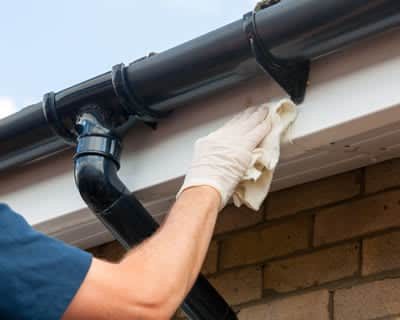
Fascias and soffits are a critical component of the majority of guttering systems. Not only do they provide support for the guttering itself, they enhance the aesthetics of your property by producing a clean and neat finish to the roofline. Fascias or fascia boards are horizontal boards that sit on the edge of the rafters of your roof, closing the end of the roof and creating the support that the guttering is fixed to. Soffits run underneath the fascia boards, closing the gap and protecting the underside of the rafter ends. Soffits are commonly ventilated to help the roofing timbers to breathe and also to prevent any moisture accumulation. Box ends are used where the horizontal fascia meets the diagonal barge board that runs up the edge of the roof profile, providing a neat finish to an otherwise ugly join.
Fascias and soffits are typically produced from either wood or UPVC. Timber fascias and soffits are common on older properties and continue to be popular. However, timber fascias and soffits can rot over time and expose the rest of the guttering to problems or leaks. Recently, UPVC fascias and soffits have been increasingly popular as they offer a robust substitute that won't rot. UPVC fascias and soffits are available in a wide range of colours to accommodate any building, although white is very popular as it has a traditional aesthetic. Fascias are additionally available in ogee moulded designs, where feature grooves are integrated. These can have a striking effect.
In Wales, a typical job costs about £3,100, with prices from around £500 for small jobs to £5,000 for bigger ones. Too few tradespeople covering Holyhead have set their prices yet, so these figures are for Wales.
| Avg. price low | Avg. price low |
|---|---|
| Avg. price | Avg. price |
| Avg. price high | Avg. price high |
£5100
£3825
£2550
£1275
£0
Searches that showed one of our pages for Holyhead, all services
Searches that showed our Soffits and Fascias page for Gwynedd
Searches that showed our page for Caernarfon
Searches that showed our page for Menai Bridge
Searches that showed our page for Rhyl
Holyhead is the largest town in the county of Isle of Anglesey in Wales. Holyhead is located on Holy Island, which had a population of 13,659 at the 2011 census. The town centre is designed around St. Cybi's Church, which is developed inside among Europe's few three-walled Roman forts (the 4th limit being the sea, which used to come up to the fort). The Port of Holyhead has a bustling ferry port. Stena Line, Northern Europe's biggest ferryboat provider, runs from the port, as do Irish Ferries. Holyhead Port is a significant employer, the majority of the jobs being connected to the ferryboat services to the Republic of Ireland run by Stena and Irish Ferries. Other considerable industrial/transport sector employers in Holyhead feature Holyhead Boatyard, Gwynedd Shipping, and Eaton Electrical. New retail developments recently have actually been a huge source of brand-new job creation. Holyhead's arts centre, the Ucheldre Centre, lies in the chapel of an old convent belonging to the order of the Bon Sauveur. It holds regular arts shows, events, workshops and movie screenings. The Holyhead Maritime Museum is housed in what is believed to be Wales's first lifeboat house. According to the Census of 2001, 47% of the residents in the town can speak Welsh. The highest portion of speakers is the 15-year-old age group, of whom 66% can speak the language. In accordance with the 2011 Census, of those in the area who were born in Wales, just 52.2% of the population could speak Welsh. Holyhead is the home of one of the original churches of the Jedi Faith, started by brothers Daniel and Barney Jones early in 2008. Holyhead High School (formerly County Secondary school) was the very first comprehensive school in the UK. For all your home renovations, be sure to identify trusted professionals in Holyhead to make certain of quality.
1 enquiry from Holyhead in the last 12 months, the latest on 31 October 2025.
Holyhead - LL65
Enquiry from: David/Wendy S
Start Date: Immediate
Soffits and Fascias enquiry
Llanfairpwllgwyngyll - LL61
Enquiry from: Sandra Helen J
Start Date: Immediate
Soffits and Fascias enquiry
Answer a few quick questions, so we can match you with local gutter installers who can help.
Get free, no-obligation local soffits and fascias quotes from 4 verified gutter installers working in Holyhead.
Compare customer reviews, services and prices, and choose the right tradesperson for you.


Very excellent service and tracesmen Very excellent service and recomended excelled tradesmen
Very good service.
Very quick Received a call with an offer to give me a quote very quickly. Very happy
Every year, various parts of your roof may need to be changed at one point or the other. Due to the fact that this event can occur at any time in a year, there’s the need to be fully ready. When it comes that being ready, you simply can’t overlook the importance of soffit and fascia boards in protecting your roof space and helping it maintain its clean and unique visual appeal. As a result, when your soffit and fascia boards need to be changed, you best do so as quickly as possible.
This task can be completed by anyone with basic DIY knowledge and experience, but if you lack the confidence to pull off then it’ll be advisable to hire a professional who can guarantee the best results for help.
✓ Remove the old existing boards. In order to install the new soffit and fascia boards, you’d have to remove the existing ones first. If necessary, you can make use of a Stanley knife to make the process much easier.
✓ Fixing soffit boards. Several soffit boards are made using uPVC. The boards are to fixed to the underside of your timber rafter ends. Make sure to use timber to close any gaps between soffit boards and also make sure that your soffit boards’ back are resting against the wall’s top.
✓ Fixing fascia boards. Many fascia boards are also made from uPVC and are usually installed in a similar way to soffit boards. Use a minimum of two nails to make sure they’re secure enough to hold weight of any roof tiles and also to prevent any buckling.
✓ Guttering and felt. To start the guttering, you’d have to screw any brackets into the facia board. You can use a spirit levelto make sure the alignment is perfect to enable the floe of water directly through your guttering system. Once done, you should also check for any rotting roof felt at the edges closest to the gutterin. If there is a rot, make use of eaves felt trays and tuck under existing felt and overlap into the guttering
It may be shocking a whole lot of people would not be able to point out fascias and soffits on a building despite the fact that they’re an essential part of the roof. To give you an idea, they’re simply used to cover the roof beams’ ends that comes out of the wall from underneath of the roof. The board that runs vertically just below the roofline is the fascia board, which is also the long length of UPVC. Therefore if you look at the gutters located in the front of house, the board behind is called the fascia board. However, soffits runs horizontally from behind the gutters to the wall of a building, so if you walk close to a house and look up, you’ll identify the soffits. They’re done to cover the gaps between the wall house and the gutters. The main function of both soffit and fascia is to divert water away from your roof as well as walls.
Fascias and soffits were usually made of wood before UPVC came along. And as a result, they only require little maintenance, no more warping, painting or cracks unlike the wooden ones. However they also can’t last an eternity, so when the time comes and you need to replace your soffit and fascia, you’ll probably want to know just how much it’s going to cost.
Unfortunately, there’s no way to calculate an accurate cost for fascias and soffits as there are too many variables to put into consideration. These includes the type of fascia and soffit you choose as well as the size of your property. However the average cost to replace a three bed semi-detached house’s fascias and soffits is within the range of £1200 to £1500 or even more if you’re staying in London or in a larger detached building.
Soffits are constructed by homeowners on their properties for several purposes. Not only are they incorporated to hide away the unsightly features of a home, but they can also be used to add decorative architectural detail. Soffits construction, on the other hand, is a project that can be done by any DIY person with the knowledge and experience. However, if you lack the confidence to pull this off, then we’d strongly recommend you get in touch with a reliable professional who can guarantee the best results, the first time. In this guide, we’re are going to take you through the soffit construction process.
✓ Measure and mark. The first step is to take an accurate measurement of the size of your propose soffit and use a pencil to mark it out on both the wall and ceiling. The size of your soffits is mainly determined by your needs or preferences.
✓ Cut and Install Wall & Ceiling Plates. Proceed to cut the wall as well as ceiling plates once the dimensions have been marked. Make use of 2x4 lumber, you can cut to size with the help of a table saw or mitre. Once done, you can then attach it to the wall as well as ceiling studs with a framing nail gun.
✓ Build the box frame. Develop a box-frame from 2x4 lumber, using your measurements as guide.
✓ Fit the box frame. Hold the box frame in place with some slide clamps and then attach it to the ceiling and wall plates with drywall screws.
✓ Mark the studs. Make use of a pencil to mark out the studs location on your soffit box frame.
✓ Cut and hang the drywall. Cut the drywall with a utility knife uing your measurement as a guide. Once done, attach the drywall to the framework with the help of drywall screws.
✓ Add finishing touches. This includes installing the corner beads, finishing off with the common drywall work of taping, spackling and sanding. Once the spackle is dry, you can the complete it by painting the soffit.
The soffit and fascia is the outdoor underside region of your roof which would need to be repaired or replaced when it’s in a critical condition. Your soffit and fascia may actually require more frequent replacement or repair depending on the material that the soffit or fascia uses. If you notice your soffit and fascia needs to be replaced, then you’d probably also like to know how much it going to cost. Well, you’ve come to the right place! The price to replace a soffit and fascia can vary significantly which can be a bit annoying when you’re trying to calculate the overall cost you’ll be expected to pay.
The price of a soffit and fascia is based on the following variables:
✓ The materials you wish to use for the new fascia, soffit and guttering
✓ The type of the property. For instance, semi detached houses may come at a lower price due to the less roof space they require when compared to their counterparts, which can reduce the cost of replacement.
✓ If you’re going to also replace the gutter at the same time will also increase the cost of replacement.
✓ The current overall condition of the roof. For example, if you also have broken or slipping roof tiles, the soffits and fascias can be more difficult to replace, hence, increasing the cost of the project.
Generally, the average cost of fitting soffits and fascias as replacement options for your homes will range between £1200 - £3,000. What’s more? Soffits and fascias normally have a per metre cost. The average price of soffits and fascias per metre can range between £100 to £130 when you opt for a white uPVC option.
We can help you get more soffits and fascias work with our qualified job leads and boost your business.
Join today