UK Fascias Limited
Based in Bridgwater, TA7 · 25 miles awayLatest review
Anthony G., TA9
July 2021
Gutter replacement in Highbridge
Very positive , Helpful , Friendly .



Guttering is a vital aspect of the roofing of your house. It offers aesthetic benefits as well as ensuring that rainwater that runs off your roof is effectively channeled from the edge of the building and into drains. The key to choosing the right guttering for your property is understanding the needs of your pre-existing roof. For instance, steeper or larger sized roofs will demand guttering able to channel an increased flow of water. It could be tempting to simply exchange like for like, but a professional guttering company will be able to survey your property to understand your needs, and advise you on the best guttering for your roof. Guttering is available in a range of types and materials. For materials, PVC is the most popular. PVC guttering is very inexpensive while still being durable. It's available in an array of colours and styles. However, guttering is also manufactured from metal, typically either steel, aluminium or cast iron. While these materials are normally more expensive than PVC, they also last longer and are suitable for period properties as they have a more traditional appearance. Different moulds of guttering will also affect the flow of the water. Half round and square guttering are standard and suit many buildings, while deep flow or ogee guttering are well suited for use on properties that demand increased water flow. Ogee guttering also has a unique mould which has an impressive appearance. Guttering is also available in a variety of colorings, from traditional black or white to brown and grey. In addition, some PVC guttering comes in a cast iron effect.
In the South West, a typical job costs about £610, with prices from around £200 for small jobs to £1,000 for bigger ones. Too few tradespeople covering Honiton have set their prices yet, so these figures are for the South West.
| Avg. price low | Avg. price low |
|---|---|
| Avg. price | Avg. price |
| Avg. price high | Avg. price high |
£1100
£825
£550
£275
£0
Searches that showed one of our pages for Honiton, all services
Searches that showed our page for Tiverton
Searches that showed our page for Barnstaple
Searches that showed our page for Ilfracombe
Searches that showed our page for Sidmouth
Searches that showed our page for Colyton
Honiton is a market town and civil parish in East Devon. It is set near to the River Otter, and is roughly 17 miles (27 kilometres) north east of Exeter in the county of Devon. Honiton is at the junction of the A35, the A30 and the A373 roads. Honiton railway station is on the West of England Main Line that runs from London Waterloo to Exeter. Honiton has a population approximated at 11822. The town grew along the line of the Fosse Way, the ancient Roman roadway connecting Exeter to Lincoln, on which it was an important stopping point. The location is detailed in the Domesday Book of 1086 as Honetone, meaning 'Huna's tun' or 'farm'. It came to be an essential market town, known for its lace making that was introduced by Flemish immigrants in the Elizabethan era. In the 17th century, countless people produced lace by hand in their homes, and later on in the 19th century, Queen Victoria had her wedding dress made from Honiton lace, though the dress itself was made in the fishing village of Beer. The town also came to be known for its pottery. Honiton is host to the annual Honiton Agricultural Show, a traditional gathering dating back to 1890. The Hot Pennies ceremony occurs every year on the first Tuesday after 19 July in the High Street of the town, and go back to the reign of King Stephen. The ceremony has its roots in the practice of the landed gentry taking satisfaction in throwing hot pennies from windows to local peasants, a relatively philanthropic gesture causing burns. The custom additionally had the purpose of encouraging people to go to the town from the surrounding area to participate in a subsequent fair. For all of your home refurbishments, make sure to identify trustworthy contractors in Honiton to make certain of quality.
3 rated pros are based within 25 miles of Honiton. Pros with a recent written review are shown first, nearest and best rated first.
Very positive , Helpful , Friendly .

Hello my name is Terry from TPS roofing and maintenance I’ve been in business now for 15 years I do PVC facias soffits gutters and downpipes roof repairs new roofs fencing All types I do good quality work for a fair price look forward to meeting...
Terry and Alan were very respectful. Turned up on time. Completed the work to a high standard. And disposed of all the o...
Taunton - TA1
Enquiry from: Razaq W
Start Date: Immediate
Need gutters and fascia repair
Seaton - EX12
Enquiry from: Wendy C
Start Date: 1 to 3 months
Water leaking from a 90 degree turn in front guttering. bungalow
Material: upvc · Property: detached · When: 1-3 months · Bedrooms: 1-2
Budleigh Salterton - EX9
Enquiry from: Jan S
Start Date: Immediate
Repair to section of guttering on end of house
Answer a few quick questions, so we can match you with local gutter installers who can help.
Get free, no-obligation local gutter replacement quotes from 4 verified gutter installers working in Honiton.
Compare customer reviews, services and prices, and choose the right tradesperson for you.


Happy in Lewisham I was contacted by a number of builders via the service. The builder I choose was the first to arrive and he gave me a written quote. He was polite and reasonable. I liked the fact t ...
Repair to downpipe I posted the job, replacing a down pipe from our bungalow back roof draining into a water butt with a downpipe draining into the main drains and received 3 contacts same day. The fi ...
Makes it easy to get quotes Really easy to place a listing for quotes and we were contacted by firms within the hour and had our issue fixed the very next morning. It was so simple to do.
If you live in an average home with an average amount of guttering and you’re used to a bit of DIY, it’s relatively easy to replace gutters. But if you have a home that’s more than two-storey or you have guttering that’s more complicated, it’s best left to the professionals.
Lots of homes these days have uPVC guttering. uPVC is a hard-wearing plastic that will last a long time without much maintenance except your usual gutter clearing. It’s relatively light, so lots of people think it’s easy to replace uPVC gutters. If you live in a bungalow, you may be able to just use a ladder to take down your old guttering and replace it with new uPVC gutters, but if you live in a two-storey home it can be a bit more complicated. If you do attempt to replace your gutters yourself, make sure you’ve got a sturdy ladder that will comfortably reach the right height, and never rest it on the fascia or the guttering itself.
If you have cast iron or copper guttering, this is much heavier and bulkier than uPVC. Certainly don’t try to replace these on your own – make sure you have another competent DIYer to help you. Reputable roofline specialists will use scaffold towers to make it easier to handle heavy gutters and they will always work in pairs on this type of guttering, so make sure you have the right tools and equipment to work with.
Just because it’s easy to replace gutters, it doesn’t mean you should. It’s better to ask a reliable roofline company to help you, since they have the skills to fit guttering properly and have experience with working at height.
A gutter is part of the system that takes rainwater away from a building. Every home will have some form of guttering system to stop water from dripping off the roof and into the walls. It’s important to keep your gutters clear because if water starts to seep into your home’s walls, you’re likely to get damp.
A guttering system consists of half pipes, troughs, bends and downpipes. They’re usually cylindrical in shape but they may be square on some homes and in countries outside of the UK. Technically, the gutter is the part that you’ll see across your roof that collects rainwater. The water will then feed into a downpipe from your roof’s edge to the base of your home, where you can collect it in something like a water butt, or it will be discharged to a surface water drain or soakaway.
In early times, gutters used to be made from lined wood or stone. Lead was often used as the liner to stop rainwater from seeping through the material, but you won’t see it used much anymore. These days, most homes have uPVC guttering as it’s a hardwearing plastic that should last a long time. But you’ll also see gutters made from aluminium, cast iron and copper, especially on period homes or those in a conservation area.
Every home needs a guttering system to ensure that rainwater doesn’t affect the foundations of the property. It’s also important to keep the gutters clear of debris like fallen leaves, as this will cause them to overflow, potentially causing water to soak into the walls and causing damp.
In the UK, gutters are normally made from uPVC. It’s a hardy plastic that won’t rot, warp or tarnish very easily, which is why it’s so popular. It’s the same material that’s used for most homes’ windows these days; they don’t have to be the standard white as they can be made into a range of colours. Expect to pay an average of £500 for the supply and installation of uPVC guttering, and more if you require scaffolding.
Other materials that are popular for gutters include copper, aluminium and cast iron. These are much more expensive – you might be looking at around £1500 or more for the supply and installation – but they give a more polished look and are often used on period properties or those in a conservation area. If you're considering these types of gutters, make sure you get a few quotes from different roofline companies so you can compare the different materials.
In the past, gutters were made from wood, asbestos concrete or stone. They were often lined with lead to stop the water from seeping through. When it was discovered that asbestos was seriously harmful, it of course stopped being used. Wood was prone to rotting, even with lead lining, and stone is heavy and expensive. So when uPVC came along, it became an affordable and easy material to use for gutters so homeowners could be confident that rainwater will be kept away from the foundations of their properties. It’s important to keep gutters clear from leaves and debris, because if they become blocked, they can make water to fall against your property’s walls, causing damp.
You don’t always need scaffolding to replace guttering. If your home is a bungalow, the tradespeople might only need a ladder to replace your guttering. It’s when your home is two storeys or more that scaffolding is more necessary.
You might not need full scaffolding for a simple two-storey home. Guttering specialists use scaffold towers, which are the platforms you see underneath the scaffolding, where the installation is relatively straightforward. You might need scaffolding to replace guttering when there are obstructions to towers being used – for example, if you have a conservatory or the ground is very uneven. It's more likely that specialist roofline companies will use scaffold towers when necessary. Sole traders that replace guttering as part of their services may be comfortable using sturdy ladders.
There’s no legal requirement to say that you must have scaffolding when fitting guttering, but it is a good idea when working on homes rather than bungalows. If you’re unsure whether you need full scaffolding for your gutter replacement project, get a few quotes from reputable businesses of different sizes. If you’ve been quoted by one company that you need full scaffolding whereas everyone else says that only towers are needed, it’s likely that the job is perfectly safe to carry out with just towers.
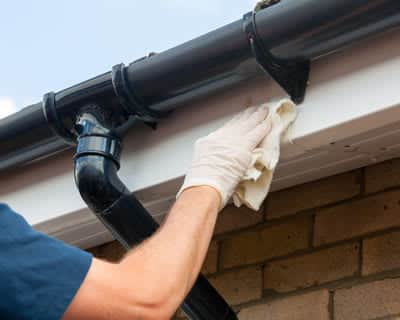
We can help you get more gutter replacement work with our qualified job leads and boost your business.
Join today