31 Oct
Plastering
Antrim - BT41
Enquiry from: Ian W
Start Date: Immediate
Leak fixed in bedroom ceiling where chimney joins ceiling
Property: detached



Do you need a plasterer within Antrim and would like to find the best prices? Then review quotes from reliable contractors with our quick and simple service available to you for free.
Plastering is quite popular in British homes because it's a fast and effective way to restore walls so they're ideal for wallpaper, tiling or painting. It's this ease of decoration afterwards that makes plastering a must.
How often have you removed wallpaper to find the walls underneath are rough or there's damage that needs restoring. Plastering will take only a few hours and as soon as it has dried you could start redecorating.
If you would like the house replastered then make use of our free online service and get up to four prices to compare and contrast within Antrim.
The regular cost of Plastering is £750. Costs fluctuate based on the materials and the firm hired. The upper price range can be as high as £862.5. The material costs are typically about £187.5
| Avg. price low | Avg. price low |
|---|---|
| Avg. price | Avg. price |
| Avg. price high | Avg. price high |
£1000
£750
£500
£250
£0
| Labour cost | £525 | |
| Material cost | £188 | |
| Waste removal | £38 |
Searches that showed our Plastering page for Antrim
Searches that showed one of our pages for Antrim, all services
Searches that showed our page for Carrickfergus
Searches that showed our page for Londonderry
Searches that showed our page for Portstewart
Searches that showed our page for Portrush
Searches that showed our page for Limavady
Translated as 'lone ridge', Antrim is a town and civil parish within County Antrim in the northeast of Northern Ireland. It's located on the banks of the Six Mile Water, which is half a mile from Lough Neagh. It is the county town of County Antrim and was previously the administrative home of Antrim Borough Council. There are lots of divisions and suburbs of Antrim, some of which are Ballycraigy, Carnbeg, Caulside, Dublin Road, Greenvale, Greystone, Islandbawn, Meadowlands, Muckamore, Newpark, Niblock, as well as the Folly. Boasting a population of 20001, Antrim is categorised as being a large town by the Northern Ireland Statistics and Research Agency. Within this population, 23.1 percent were under 16 years old and 15.7 percent were older than 60. 48.6 percent of the population were male and 51.4 percent were female. Many buildings inside the town are historically significant, particularly near the High Street. This consists of the courthouse, a 19th-century smithy on Bridge Street, which has a unique horseshoe entrance, Shane's Castle and Antrim Castle, the Castle Grounds, and the Springfarm Rath. Renovations on Antrim Market House, a 2-storey building which is 9 bays long, 3 deep, built in 1726, are currently being undertaken. This will contain Antrim Information Centre, moving it from its place on the High Street, plus a multi-functional auditorium in order to supply an area for a lot of functions, such as theatre and music productions. Because the town is on the banks of a river, the linen industry came to prominence in Antrim, though this was affected by the decline in the industry during the 20th century. It has been replaced by Northern Ireland's Technology Park. For all your house improvement projects, ensure that that you employ reliable pros in Antrim to ensure that you get the best quality.
Antrim - BT41
Enquiry from: Ian W
Start Date: Immediate
Leak fixed in bedroom ceiling where chimney joins ceiling
Property: detached
Answer a few quick questions, so we can match you with local plasterers who can help.
Get free, no-obligation local plastering quotes from 4 verified plasterers working in Antrim.
Compare customer reviews, services and prices, and choose the right tradesperson for you.

It's always difficult finding a tradesman that comes recommended so having a recommendation service solves this problem
good service
this is the first time I have used this service and found it easy and cost effective
Plastering is suitable to cover most Artex. If it’s shallow Artex, it may be covered by skimming plaster on top. If the pattern of the Artex is too deep, you may need to use plasterboard to cover it or if you want to remove it entirely, you will need to use a wallpaper steamer.
Can You Plaster Over Artex?
The short and simple answer to this question is yes, you can plaster over Artex. However, you must also note that plastering over Artex may not be the best choice as Artex is porous and as such, you’d have to detach the stripping so as to get a smooth and even coating. In the event whereby your ceilings or walls have Artex on them, you’ll have to smooth the Artex in order to obtain a plaster of solid coat.
✓ Preparing Artex for plastering. First and foremost, you’ll have to detach any bumps before you can plaster over the Artex. Do note that you don’t have to completely remove the Artex, all that’s needed is just enough to get a coat of plaster. Make use of a scraper to get rid of the bumps on various Artex designs like swirl and bark. Once you’re through getting rid of as much bumps as possible, there’s the need to seal the Artex due to the fact that it can absorb the moisture out of the plaster which will cut the time to get a good finish to little or nothing. You can use a PVA and water mix to do the job!
✓ The PVA mix. This is done to seal off the porous Artex in order to stop it from absorbing moisture from your plaster which can make it start to crack and crumble. To do this, simply mix half PVA and half water, then use a brush to paint the mixture over the plastering area. Once done, you can give the plastering surface about two to three coats and wait for the solution to dry off within a hour or two.
Plastering over Artex is not as hard as it seems, but if you lack the confidence to complete the task, simply contact a professional for help.
How Much To Plaster A Room?
Generally, the standard of plastering in older houses leaves a lot to be desired. Having settled for so many years, there is a lot of tendency that anything brittle will break or crumble with the movement. And this is exactly where plasters fall.
Plaster provides a wide range of functions in your home and as a result, has grown to become very popular amongst several homeowners. So if you want to plaster a room, you might just wish to estimate the cost so you can set a budget and start to plan. However, there’s no short and simple answer to this as the cost of plastering is based on a number of factors. These factors include the dimensions of the room, the accessibility of the surface, the condition of the existing plaster as well as the size of the company.
So if you want to paster your room, you can either remove the old plaster or skim a 3mm plaster coat over the existing one. In respect to the two options, the prices will also vary. However, several plastering experts will charge either on the average room size or a daily rate. This is due to the fact that they know approximately the number of area they can cover in a day’s work. You can, however, request a quotation which specifies the costs per square metre in order to allow you compare with other contractors. In reality, several plastering professionals use either small, medium or large sized room as the yard stick for providing a quote.
Generally, for a small sized room, you’ll have to pay about £600 to £700, a medium sized will cost within the range of £650 to £1000, while a large sized room will cost between the range of £1000 to £1500.
How To Plaster A Wall
In order to plaster your wall successfully, you’ll firstly need to get the appropriate tools and materials for the job in place. The tools you’ll need to have includes a trowel and bucket trowel, plasterer’s float, corner trowel, hawk board, two buckets, mixing stick or a paddle, adequate plaster, PVA , dust sheets, clean water, sandpaper, stilts or step ladder as well as a dust mask.
✓ Prepare the wall. You’d have to make sure that you lay down a dust sheet so as to protect your floor and also gather any possible spillage or debris of plaster, before you start working on the walls. Get rid of all the dirt, dust and debris as this is very important for the success of your project if you’re going to be plastering on a worn out and old wall. Also, cover the holes and cracks in the walls with a screen tape
✓ Apply PVA to the wall. This will help ensure the layer you’re using will not dry out at the same time.
✓ Mix the paster. Mix the plaster according to the instructions given in the manufacturer’s manual.
✓ Apply the plaster onto the wall. Upon cleaning of the walls and successful mixture of the plaster, the next step is to apply the mixture to the wall using the hawk board, trowels and a floating tool.
✓ Skim and smooth. After the the first coat has dried after waiting for about 30 minutes, the next step will be to wipe out the bumps and lumps using a trowel to smooth over the surface. Once this is done you can then scrape the wall with a devilling float.
✓ Apply the second coat of plaster
✓ Apply the finishing touches. This includes polishing your work by adding some water to the surface with a spray gun and using the trowel to further smoothen out the surface.
✓ Painting and wallpapering.
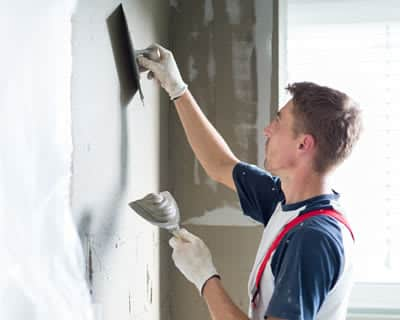
We can help you get more plastering work with our qualified job leads and boost your business.
Join today