
Foster & Newman
Based: in Horfield, BS7 0HULatest review
G., BS37
Plastering in Bristol
awaiting insurance go ahead, but service goodfrom foster & newman v.



Trying to find plasterers in Caerphilly? Our plastering firms in Caerphilly have the ability to provide you the ideal quotations for having plastering finished in your household.
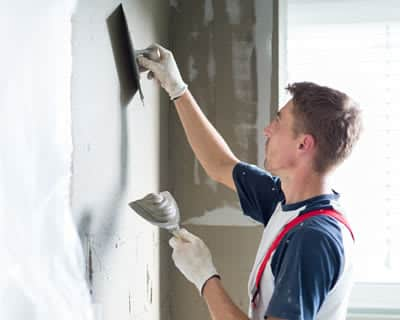
Plastering a wall or ceiling is definitely an efficient way of changing the appearance to guarantee a smooth and attractive finish. Once the plaster has dried out, the wall may then be painted, wallpapered or tiled easily.
One of the significant benefits to plastering walls is the ease of decoration afterwards. Frequently after removing older wallpaper, the surface beneath might be rough and lumpy. Merely painting or wallpapering over this can have a undesirable visual impact.
We are able to provide around 4 plastering companies close to you, who will provide quotations for the work you want completed. You'll be given a property visit from professionals in Caerphilly who'll complete the plastering for a good price.
Plastering in your home can take a few hours to a few days. It'll all rely upon how big and how many rooms you are wanting to plaster. Have a very smooth finish to your internal walls with reliable plasterers and get the best costs today.
The regular cost of Plastering is £750. Costs fluctuate based on the materials and the firm hired. The upper price range can be as high as £862.5. The material costs are typically about £187.5
| Avg. price low | Avg. price low |
|---|---|
| Avg. price | Avg. price |
| Avg. price high | Avg. price high |
£1000
£750
£500
£250
£0
| Labour cost | £525 | |
| Material cost | £188 | |
| Waste removal | £38 |
Searches that showed one of our pages for Caerphilly, all services
Caerphilly is a town in the county borough of Caerphilly, in South Wales. It comes with a populace of 30,388 and is also known as a commuter town for the cities of both Cardiff and Newport. It's traditionally situated in the region of Glamorgan and close to the English edge. For property upgrades within Caerphilly, contrast quotations from vetted experts in the area and get the top cost for work you want completed.
awaiting insurance go ahead, but service goodfrom foster & newman v.
Newport - NP19
Enquiry from: Mehmet Y
Start Date: Immediate
Skimming one bedroom walls only no ceiling
Newport - NP19
Enquiry from: Tracey M
Start Date: Immediate
Hallway and ceiling plastered
Mountain Ash - CF45
Enquiry from: Nichola M
Start Date: Immediate

Repair to cracked brickwork above front door due to guttering erosion
Property: semi detached
Merthyr Tydfil - CF47
Enquiry from: Mollie G
Start Date: Immediate
Price quote for artex removal
Ferndale - CF43
Enquiry from: Daya G
Start Date: Less than one month
Property: terrace
Cardiff - CF15
Enquiry from: Peter D
Start Date: Immediate
Plastering round VELOX WINDOW & SOME WALLS & SMALL CELING
Pontypool - NP4
Enquiry from: Martin M
Start Date: Immediate
To dry line out a 9m x 3.5m extension. ideally tape and jointed ready to be decorated. do you require a door(s): none
Property: detached · When: immediate
Cardiff - CF14
Enquiry from: Adil M
Start Date: Immediate
Plastering calling and 2 wall
Cardiff - CF24
Enquiry from: Zipho Z
Start Date: Immediate
Wall/ plasterboard is crumbling where a hand rail has been installed on top of the stairs. It doesn't look like someone did a proper inspection before installing hand rail
Cardiff - CF14
Enquiry from: Claudiu B
Start Date: Immediate
Plastering my living room ceiling. ground floor, easy access to the room and to water etc. it used to have wallpaper stuck to it. i m removing it and it needs to be made straight/smooth. i will remove
Answer a few quick questions, so we can match you with local plasterers who can help.
Get free, no-obligation local plastering quotes from 4 verified plasterers working in Caerphilly.
Compare customer reviews, services and prices, and choose the right tradesperson for you.

It's always difficult finding a tradesman that comes recommended so having a recommendation service solves this problem
good service
this is the first time I have used this service and found it easy and cost effective
Can You Plaster Over Artex?
The short and simple answer to this question is yes, you can plaster over Artex. However, you must also note that plastering over Artex may not be the best choice as Artex is porous and as such, you’d have to detach the stripping so as to get a smooth and even coating. In the event whereby your ceilings or walls have Artex on them, you’ll have to smooth the Artex in order to obtain a plaster of solid coat.
✓ Preparing Artex for plastering. First and foremost, you’ll have to detach any bumps before you can plaster over the Artex. Do note that you don’t have to completely remove the Artex, all that’s needed is just enough to get a coat of plaster. Make use of a scraper to get rid of the bumps on various Artex designs like swirl and bark. Once you’re through getting rid of as much bumps as possible, there’s the need to seal the Artex due to the fact that it can absorb the moisture out of the plaster which will cut the time to get a good finish to little or nothing. You can use a PVA and water mix to do the job!
✓ The PVA mix. This is done to seal off the porous Artex in order to stop it from absorbing moisture from your plaster which can make it start to crack and crumble. To do this, simply mix half PVA and half water, then use a brush to paint the mixture over the plastering area. Once done, you can give the plastering surface about two to three coats and wait for the solution to dry off within a hour or two.
Plastering over Artex is not as hard as it seems, but if you lack the confidence to complete the task, simply contact a professional for help.
How To Plaster A Ceiling
Generally, plastering is a very tricky and time consuming job which usually require lots of efforts and practice to get right - with that in mind it gets even a lot trickier when it comes to ceiling plastering.
However, when you’re able to acquire the right know-how as well as tools, ceiling plastering can be completed by any confident DIYer enthusiast without the need to call in a professional. However, if you lack the needed confidence to pull off this task, then we’d recommend you get in touch with a trustworthy professional who can guarantee the best results for help. In this guide, we’ll take you through the ceiling plastering process.
You’ll need the following materials to get started: plaster, mixing bucket and paddle, plasterer’s float, plasterer’s towel, bucket trowel, protective gear, bucket of clean water and wide brush.
✓ Prepare the area. When it comes to plastering a ceiling it’s almost unavoidable to leave a mess around and no matter how you do it, your plaster will drop on the floor. Therefore you have put drop sheets on the floor, cover the furniture and put thing you don’t want to get dirty out of the way.
✓ Prepare the ceiling to be plastered. Sand down the uneven patches on the ceiling. Once done, wash the ceiling with a sponge and warm soapy water while also removing all cobwebs as well. Leave the surface to dry once completed.
✓ Mix the plaster or buy a premix plaster. To mix the plaster, simply use equal parts of plaster and water for mixing the plaster,
✓ Plaster the ceiling. Apply a little quantity of plaster to the edge of your trowel and try to spread it in rows to do the job without much hassle. Ensure that the thickness of the coat is thin and even throughout the application. The rough edge of the trowel should be used for the spreading as it’ll help you create scrapes or scratches in the plaster.
✓ Sand the surface
Can You Plaster Over Tiles?
Yes, it’s absolutely possible to plaster over tiles but just because is possible doesn’t mean you should. Plastering over tiles is an option but it’s not recommended by experts due to several reasons. A good example is the fact that a tiled environment is in no way a suitable environment that can serve as a good bonding surface for a plaster. For the success of a plastering project, there’s the need for the surface to be able to bond to the PVA base coat. Due to fact that most tiles are slippery in nature and also lack of the ability to be able to absorb moisture, the PVA base coat layer will not be able to bond to the tiled surface, which will ultimately make for a weak surface upon the application of the plaster. Consequently, the plaster will easily flake and fall from the wall.
The inability to drill into the tiled wall surface after plastering is one of the major disadvantages that also arises when you decide to plaster over tiled surfaces. Most tiled surfaces are found in kitchens and bathrooms which are going to need appliances such as sinks, lavatories, kitchen counters and lots more. These appliances are designed to be installed on solid surfaces which would not be an easy task to carry out on tiles knowing there would definitely be great cracks or damages.
The best tip you’ll get if you’re considering to plaster on a tiled surface, is that detaching tiles from a surface can easily be done with a hammer and chisel, and that would save you a host of problems later in the future. However, if you still wish to plaster on your tiled walls, then you best bet would be to get a Blue Grit bonding agent. It works better than PVA and only needs one coat.
What Is Plaster Made Of?
Plaster is one of the most commonly used materials when it comes to building construction. It’s a crucial component that’s incorporated in coating walls, ceilings as well as partitions and it hardens on drying. Plastering is one of the most ancient building materials which has taken over mud to plaster reed or sapling huts so as to serve as a protection against the elements. Here, we’re going to take a look at the multiple compositions of plaster. These components are very important due to the fact that they form a protective coating on whatever they are used on. They work to protect surfaces such as ceiling and underlying walls from scratches or any form of damage.
Plaster comprises a few materials which includes gypsum, lime or cement and all operates in a similar way. Gypsum is made of calcium sulfate dihydrate and it’s the main component of main forms of plaster, sidewalk chalk, blackboard, drywall and more. Meanwhile, lime plaster is made up of sand, water and lime ( mostly non hydraulic hydrated lime). And lastly, cement which is a mix of suitable plaster, portland cement, sand as well as water.
The plaster is usually produced as a dry powder which is mixed thoroughly with water to create a stiff but also a paste that’s workable immediately before it’s applied to the wall or ceiling.
It’s quite easy to confuse a drywall with a plaster but there are some differences. Not only is plaster a much older style of wall construction than dry wall, but it’s also a lot more expensive than installing a drywall. Plaster walls are also able to provide you with a more durable finish when compared to a drywall and it makes for a better quality finish.
We can help you get more plastering work with our qualified job leads and boost your business.
Join today