
Aspull Plastering Limited
Based: in Wigan, WN2 1XDLatest review
Janet C., WA5
Plastering in Westbrook
we booked this company to complete the work and they never turned up and then failed to reply to our phone call and text...



Searching for plasterers in Skelmersdale? Our plastering businesses in Skelmersdale can provide you the best quotes for having plastering carried out in your house.
Plastering a wall or ceiling is an extremely effective way of modifying the look to guarantee a smooth and attractive finish. Once the plaster has dried, the wall could then be painted, wallpapered or tiled quickly.
One of several important benefits to plastering walls is the ease of decoration after. Frequently after getting rid of old wallpaper, the surface underneath is often rough and lumpy. Merely painting or wallpapering over this can have a very poor visual result.
We can give you up to four plastering firms locally, who will give quotations for the work you would like undertaken. You'll get a household visit from specialists in Skelmersdale who will carry out the plastering for a great price.
Plastering in your own home will take an hour or two to a few days. It'll all depend on how large and how many rooms you want to plaster. Have a smooth finish to your internal walls with trustworthy plasterers to get the best costs today.
The regular cost of Plastering is £750. Costs fluctuate based on the materials and the firm hired. The upper price range can be as high as £862.5. The material costs are typically about £187.5
| Avg. price low | Avg. price low |
|---|---|
| Avg. price | Avg. price |
| Avg. price high | Avg. price high |
£1000
£750
£500
£250
£0
| Labour cost | £525 | |
| Material cost | £188 | |
| Waste removal | £38 |
Searches that showed one of our pages for Skelmersdale, all services
Searches that showed our page for Leigh
The West Lancashire town of Skelmersdale is situated on the high grounds of the River Tawd and was designated as being a new town in 1961. Skelmersdale boasts a population of 38,813, that's down from 41,000 in 2004. A £20 million plan was introduced in 2012 to create a flourishing town centre and five hundred fixed jobs. Reap the benefits of this upcoming town by comparing and contrasting quotations and having the ideal price for your house upgrades.
we booked this company to complete the work and they never turned up and then failed to reply to our phone call and text...

The company were messy when he said he was clean the protection was not put on th floor until I asked and he took 2 of m...
Bolton - BL6
Enquiry from: Sharon P
Start Date: Immediate
Need artexed removing and plastering
Bolton - BL3
Enquiry from: HELEN T
Start Date: 1 to 3 months
Property: semi detached
Wigan - WN1
Enquiry from: Lee W
Start Date: Immediate
Have taken down a chimney in the bedroom from the loft and need a small area of ceiling and wall plastering where the chimney has been taken out
Southport - PR9
Enquiry from: Lesley R
Start Date: Immediate
A ceiling repaired after rain damage
Bootle - L30
Enquiry from: David S
Start Date: Immediate
Plaster over an artex ceiling approx 10mx3n
Liverpool - L37
Enquiry from: David S
Start Date: Immediate
Repair of a plaster ceiling
Answer a few quick questions, so we can match you with local plasterers who can help.
Get free, no-obligation local plastering quotes from 4 verified plasterers working in Skelmersdale.
Compare customer reviews, services and prices, and choose the right tradesperson for you.

It's always difficult finding a tradesman that comes recommended so having a recommendation service solves this problem
good service
this is the first time I have used this service and found it easy and cost effective
There are several different kinds of plastering. ‘Dot and dab’ refers to a base layer of plasterboard which is attached to a wall using ‘dabs’ of adhesive. ‘Floating’ is a technique where a backing or undercoat plaster is applied to walls. ‘Skimming’ or ‘reskimming’ refers to the very thin final decorative layer of plaster.
How To Plaster A Wall
In order to plaster your wall successfully, you’ll firstly need to get the appropriate tools and materials for the job in place. The tools you’ll need to have includes a trowel and bucket trowel, plasterer’s float, corner trowel, hawk board, two buckets, mixing stick or a paddle, adequate plaster, PVA , dust sheets, clean water, sandpaper, stilts or step ladder as well as a dust mask.
✓ Prepare the wall. You’d have to make sure that you lay down a dust sheet so as to protect your floor and also gather any possible spillage or debris of plaster, before you start working on the walls. Get rid of all the dirt, dust and debris as this is very important for the success of your project if you’re going to be plastering on a worn out and old wall. Also, cover the holes and cracks in the walls with a screen tape
✓ Apply PVA to the wall. This will help ensure the layer you’re using will not dry out at the same time.
✓ Mix the paster. Mix the plaster according to the instructions given in the manufacturer’s manual.
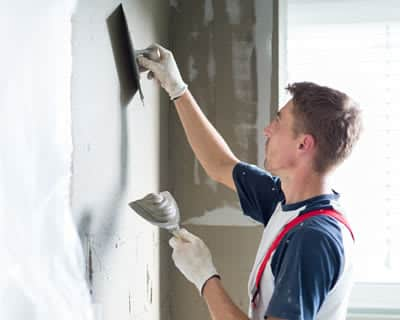
✓ Apply the plaster onto the wall. Upon cleaning of the walls and successful mixture of the plaster, the next step is to apply the mixture to the wall using the hawk board, trowels and a floating tool.
✓ Skim and smooth. After the the first coat has dried after waiting for about 30 minutes, the next step will be to wipe out the bumps and lumps using a trowel to smooth over the surface. Once this is done you can then scrape the wall with a devilling float.
✓ Apply the second coat of plaster
✓ Apply the finishing touches. This includes polishing your work by adding some water to the surface with a spray gun and using the trowel to further smoothen out the surface.
✓ Painting and wallpapering.
Can You Plaster Over Tiles?
Yes, it’s absolutely possible to plaster over tiles but just because is possible doesn’t mean you should. Plastering over tiles is an option but it’s not recommended by experts due to several reasons. A good example is the fact that a tiled environment is in no way a suitable environment that can serve as a good bonding surface for a plaster. For the success of a plastering project, there’s the need for the surface to be able to bond to the PVA base coat. Due to fact that most tiles are slippery in nature and also lack of the ability to be able to absorb moisture, the PVA base coat layer will not be able to bond to the tiled surface, which will ultimately make for a weak surface upon the application of the plaster. Consequently, the plaster will easily flake and fall from the wall.
The inability to drill into the tiled wall surface after plastering is one of the major disadvantages that also arises when you decide to plaster over tiled surfaces. Most tiled surfaces are found in kitchens and bathrooms which are going to need appliances such as sinks, lavatories, kitchen counters and lots more. These appliances are designed to be installed on solid surfaces which would not be an easy task to carry out on tiles knowing there would definitely be great cracks or damages.
The best tip you’ll get if you’re considering to plaster on a tiled surface, is that detaching tiles from a surface can easily be done with a hammer and chisel, and that would save you a host of problems later in the future. However, if you still wish to plaster on your tiled walls, then you best bet would be to get a Blue Grit bonding agent. It works better than PVA and only needs one coat.
Can You Plaster Over WallPaper?
If you have wallpaper installed on your wall surface and you’re considering plastering the wall, when you put into consideration the stress involved in removing a wallpaper you may want to consider plastering directly over the wallpaper. This is quite understandable as removing a wallpaper can be quite time consuming and tedious, but plastering directly over wallpaper is a mistake that should never be made. Plastering over wallpaper is in no way a viable option due to the fact that it can only turn out disastrous after a couple of weeks or even days in some cases as the plaster will crack and crumble. As a result, you’ll have to firstly scrape off the wallpaper in order to assist the plaster get to be firmly secured to the wall behind.
When you plaster over a wallpaper, this will make the wallpaper wet and it’ll absorb the moisture. And once the plaster does not have moisture, the only result is for it to crack and start to crumble. Hence, plaster and wallpaper is never a good combination.
Asides from cracking and crumbling, anther issue is that the wallpaper will bubble. You can actually key the wallpaper with the help of a knife and it might look secured for some time, however it’ll eventually crumble and you’d have to scrape off the plaster complete to start all over again. The wallpaper will bubble as the plaster can’t be keyed into a wallpaper and the wallpaper will only work as a barrier between the plaster and the wall.
Overall, plaster always needs to slowly dry off as well as a good and proper surface to grip to. No matter the amount of PVA mix you spread on the wallpaper, it will always remain a barrier. So you’d have to remove the wallpaper completely to get a great result.
We can help you get more plastering work with our qualified job leads and boost your business.
Join today