30 May
Pool enclosures
Southsea - PO5
Enquiry from: Ruhana A
Start Date: Immediate
UPVC Supply and install



On typical, you can expect to spend about £6,500 on a new standard conservatory. There are lots of different factors that can have an impact on price, including how straightforward it is to dig the foundations, the height and width of the conservatory and extras such as brick, dwarf walls and windows/doors. The type of conservatory you want to install will also have an impact on the cost.
| Avg. price low | Avg. price low |
|---|---|
| Avg. price | Avg. price |
| Avg. price high | Avg. price high |
£9700
£7275
£4850
£2425
£0
| Labour cost | £5,600 | |
| Material cost | £2,000 | |
| Waste removal | £400 |
Searches that showed one of our pages for Shanklin, all services
Southsea - PO5
Enquiry from: Ruhana A
Start Date: Immediate
UPVC Supply and install
Lee-on-the-Solent - PO13
Enquiry from: Sherine S
Start Date: Immediate
UPVC Supply and install
East Cowes - PO32
Enquiry from: Lea M
Start Date: Immediate
UPVC Supply and install
Ryde - PO33
Enquiry from: John A
Start Date: Immediate
UPVC Supply and install
Newport - PO30
Enquiry from: Tincy T
Start Date: Immediate
Property: detached
Shanklin - PO37
Enquiry from: Tess T
Start Date: Immediate
Are you the home owner of that property? - -. Are you replacing an existing conservatory or is this a new build? - -. Do you know which style of conservatory you want? - -. What material do you requir
Ryde - PO33
Enquiry from: Owen K
Start Date: Immediate
7400 x 5500 lean to pool enclosure
Answer a few quick questions, so we can match you with local conservatory installers who can help.
Get free, no-obligation local pool enclosures quotes from 4 verified conservatory installers working in Shanklin.
Compare customer reviews, services and prices, and choose the right tradesperson for you.


saved me searching around unknown companies
Very quickly helped to find supplier
Great service. Within minutes of there information about potential installers for my new boiler I had received a phone call from one and booked a survey from a great company.
Do You Need Planning Permission For A Conservatory?
Adding a conservatory to your home or property comes with a whole lot of benefits. It provides you with the much needed additional living space within your property, add value to your home and creates a link between your home and garden. As advantageous as it is, one of the major reasons why some homeowners decide against constructing a new conservatory is because of planning permission. If you don’t know what you’re doing the entire process can be very tedious and you definitely do not want to go through the stress of completing your remarkable new conservatory, only to be instructed to have it removed again.
Therefore, as a homeowner, you have the responsibility to seek planning permission before you undergo such construction project and that’s more than enough to make some people reconsider the whole project. In this article, we’ll let you know whether you’ll need to apply for a planning permission.
Generally, conservatories falls into the category of permitted development rights which allows you to complete home building projects without having to apply for a planning permission. However, there are some circumstances where you’ll require a planning permission. These includes:
✓ If the conservatory covers more than 50 percent of the land around the main house.
✓ If the conservatory will be placed on the side of the house that faces the road.
✓ If the conservatory will be higher than the highest point of the main building’s roof.
✓ If the main building is lower than the height of the eaves and ridge.
✓ If the conservatory will be constructed to the side of the house and more than a single storey or it goes higher than 4 metres.
✓ If the conservatory will be wider than the width of the main building, if it’s to be built beside it.
✓ If the conservatory will be constructed at the rear and higher than 4 metres.
How Long Do UPVC Conservation Last?
UPVC conservatories are common features on residences across the UK for a good reason. Not only do they give you the extra living space you so much desire within your home or property, but they also go a long way to add value to your property. So if you’re also thinking about constructing a UPVC conservation within your home, you’re probably not alone! One of the several benefits of the structure is also its longevity, however this is dependent on a number of factors. Let’s take a closer look!
Modern UPVC windows will normally last between 20 to 25 years, however some are able to last much longer provided they’re properly maintained and top quality materials are used. And thanks to improvements in colour technology, the finish on UPVC tends to last much longer too.
Some of the factors that can go a long way to determine the longevity of your UPVC conservation includes the type of roofing materials used, how well it’s being maintained, the location or placement of the structure, replacement of individual conservatory parts, as well as insulation.
The type of roofing material for a UPVC conservation can either be glass, polycarbonate or tiles. The glass and polycarbonate roofs usually lasts for a minimum of 20 years when it’s properly installed and provided with the necessary upkeep. Meanwhile, tiled UPVC conservation roof are generally expected to last up to 50 years which is significantly longer than the counterparts - glass and polycarbonate. Interestingly, they require little to no maintenance and are also very unlikely to get damaged during the upkeep.
It’s also very important to make use of a reliable and reputable company to have your UPVC conservatory installed. This is because your structure can only be as good as the company responsible for its installation. So if you require a structures that will last for decades, you should pay great attention to the company you’ll hire.
Whilst uPVC is the UK’s favourite because it’s cheap to manufacture and has a number of qualities, there are also options available including aluminium and hardwood. Both are popular for various reasons.Aluminium, as a metal, is the strongest and most durable material available for conservatories. On top of this it won’t rust, warp or crack. Hardwood offers a more traditional appeal and whilst it requires high maintenance levels, is perfect for conservation areas and listed buildings.
What Is The Difference Between A Conservatory And An Orangery?
If you’re looking to build an extension for your home, one of the first things that comes to mind is the type of structure that would best suit your property. When it comes to glass extensions there are two major varieties which includes the traditional conservatory and the orangery, but there are usually a lot of confusion over the differences of these two varieties. With the growth in popularity of glazed extensions, the differences between the two structures are becoming more and more thin. However, the main difference between a conservatory and an orangery is the number of glass incorporated. Conservatories are fully glazed structures featuring a low brick base wall, meanwhile orangeries are grand brick structures with with glazed roofs. But as a result of innovations of over the years in glazing, the difference has changed a bit.
Here are some of the major differences between a conservatory and an orangery.
✓ Orangeries are generally best suited to traditional-styled homes or with older property making use of matching stone or brick in construction. Meanwhile for a more recent or modern property, a conservatory will be the better option to add the flair to your property.
✓ Conservatories tend to be larger than orangeries, therefore if you want a smaller extension, an orangery would be your best bet.
✓ Orangeries are typically rectangular in shape and is traditionally a more regular building meanwhile a conservatory can be shaped to suit your needs. With an conservatory, you can get a T-shaped, L-shaped, curved, double ended and lean-to extensions to suit your preference.
✓ An orangery usually possess a flat roof at the edges with a glazed lantern section right at the centre. You can also find more luxurious orangeries having two or more lantern sections. However, when it comes to the roofing, conservatories generally have more options. Some are gabled or pitched, others are lean-to with a plethora of choice to finish off the roof.
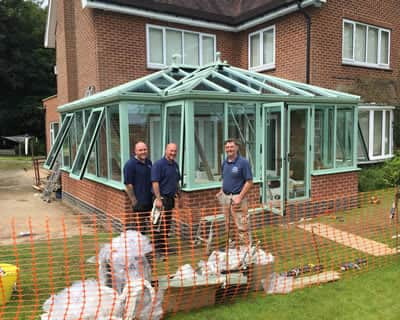
We can help you get more pool enclosures work with our qualified job leads and boost your business.
Join today