29 Jun
Soffits and Fascias
Haverfordwest - SA61
Enquiry from: Maurice B
Start Date: Immediate
Replace soffit and fascia and gutters,down-pipes



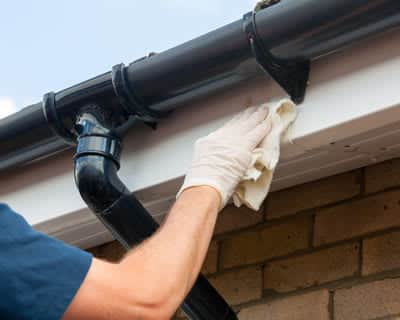
Fascias and soffits are a vital part of many guttering systems. Not only do they provide support for the guttering itself, they improve the design of your house by creating a clean and neat finish to the roofline. Fascias or fascia boards are horizontal planks that sit on the edge of the rafters of your roofing, closing the end of the roof and providing the support that the guttering is fixed to. Soffits run beneath the fascia boards, closing the gap and protecting the underside of the rafter ends. Soffits are often ventilated to enable the roof timbers to breathe and to prevent any moisture buildup. Box ends are used where the horizontal fascia meets the diagonal barge board that runs up the edge of the roof profile, offering a neat finish to an otherwise ugly join.
Fascias and soffits are normally constructed from either timber or UPVC. Wood fascias and soffits are common on older properties and remain popular. However, timber fascias and soffits can rot with time and expose the rest of the guttering to issues or leaks. Recently, UPVC fascias and soffits have been increasingly popular as they give you a robust alternative that won't rot. UPVC fascias and soffits can be purchased in numerous colours to complement any property, although white is extremely popular as it offers a traditional appearance. Fascias are additionally available in ogee moulded designs, where feature grooves are integrated. These can have an impressive effect.
In Wales, a typical job costs about £3,100, with prices from around £500 for small jobs to £5,000 for bigger ones. Too few tradespeople covering Fishguard have set their prices yet, so these figures are for Wales.
| Avg. price low | Avg. price low |
|---|---|
| Avg. price | Avg. price |
| Avg. price high | Avg. price high |
£5100
£3825
£2550
£1275
£0
Searches that showed one of our pages for Fishguard, all services
Searches that showed our page for Carmarthen
Searches that showed our page for Haverfordwest
Searches that showed our page for Pembroke
Searches that showed our page for Pembroke Dock
Searches that showed our page for Narberth
Fishguard is a coastal town in Pembrokeshire, Wales, with a population of 3,419 in 2011; the community of Fishguard and also Goodwick had a population of 5,407. Modern Fishguard includes 2 components, Lower Fishguard and the "Main Town". Fishguard and Goodwick are twin towns with a joint Community Council. Lower Fishguard is thought to be the site of the original community where contemporary Fishguard has grown. It is in a deep valley where the River Gwaun fulfills the sea, for this reason the Welsh name for Fishguard. It is a regular fishing village with a short tidal quay. The negotiation extends along the north incline of the valley. The main town contains the parish church, the High Street as well as the majority of the modern development, as well as lies upon the hill to the south of Lower Fishguard, to which it is signed up with by a steep and also winding roadway. The part of the town that encounters Goodwick expanded in the initial decade of the 20th century with the development of Fishguard Harbour.
Haverfordwest - SA61
Enquiry from: Maurice B
Start Date: Immediate
Replace soffit and fascia and gutters,down-pipes
Haverfordwest - SA61
Enquiry from: Anand V
Start Date: Immediate
Material: upvc · Roofline: gutters, fascias · Property: semi detached
Answer a few quick questions, so we can match you with local gutter installers who can help.
Get free, no-obligation local soffits and fascias quotes from 4 verified gutter installers working in Fishguard.
Compare customer reviews, services and prices, and choose the right tradesperson for you.


Very excellent service and tracesmen Very excellent service and recomended excelled tradesmen
Very good service.
Very quick Received a call with an offer to give me a quote very quickly. Very happy
You can paint your soffits and fascias if they’re made of wood. In fact, it’s a good idea to do this every few years, as it can help to preserve them and keep them looking smart.
You can choose what you paint your soffits and fascias with by deciding what kind of look you want to achieve. You can stain them if you want to maintain a natural wood look, or use an exterior gloss or satin paint if you want to change their colour.
Soffits are constructed by homeowners on their properties for several purposes. Not only are they incorporated to hide away the unsightly features of a home, but they can also be used to add decorative architectural detail. Soffits construction, on the other hand, is a project that can be done by any DIY person with the knowledge and experience. However, if you lack the confidence to pull this off, then we’d strongly recommend you get in touch with a reliable professional who can guarantee the best results, the first time. In this guide, we’re are going to take you through the soffit construction process.
✓ Measure and mark. The first step is to take an accurate measurement of the size of your propose soffit and use a pencil to mark it out on both the wall and ceiling. The size of your soffits is mainly determined by your needs or preferences.
✓ Cut and Install Wall & Ceiling Plates. Proceed to cut the wall as well as ceiling plates once the dimensions have been marked. Make use of 2x4 lumber, you can cut to size with the help of a table saw or mitre. Once done, you can then attach it to the wall as well as ceiling studs with a framing nail gun.
✓ Build the box frame. Develop a box-frame from 2x4 lumber, using your measurements as guide.
✓ Fit the box frame. Hold the box frame in place with some slide clamps and then attach it to the ceiling and wall plates with drywall screws.
✓ Mark the studs. Make use of a pencil to mark out the studs location on your soffit box frame.
✓ Cut and hang the drywall. Cut the drywall with a utility knife uing your measurement as a guide. Once done, attach the drywall to the framework with the help of drywall screws.
✓ Add finishing touches. This includes installing the corner beads, finishing off with the common drywall work of taping, spackling and sanding. Once the spackle is dry, you can the complete it by painting the soffit.
Fascias and Soffits, just like any other components of a home, do not last forever. They can become tired and worn out over time which implies that you’ll have to replace them to prevent further damage. Getting this project completed can be quite costly, but it doesn’t have to be. Fitting soffits and fascias is very simple task which will leave you with both a modern and contemporary styling which requires little maintenance and also more savings. What’s more? You don’t have to worry about repainting the fascias and soffits on an annual basis, all you need to do is a gentle wipe down of the features with a damp cloth to have them look good.
If you’re a competent DIYer and confident enough to pull off this task, then all the better. However, if otherwise, we’d strongly recommend you hire the services of a reliable contractor who can guarantee the best results for help. Here are the steps you can follow to fit your fascias and soffits.
Fascias ( a 18mm fascia board)
✓ This is designed for a direct fix without a need for a timber substrate. Simply secure them directly to the rafters with the help of 2 x 65mm a4 stainless steel fixing nails per rafter.
✓ Ensure that the rafters are level.
✓ Cut the boards back 5mm per edge to enable expansion where any white corner trims, joint trims or angle trims is needed.
✓ Secure the guttering to all third rafter.
Soffit ( 9mm soffit board)
✓ Ensure that the preservative treatment to the structural timber has dried out.
✓ Fix all utility boards of about 100mm to 605mm in width at a maximum of 60mm centres.
✓ If ventilation is needed, there are some soffits that are available in 150mm to 605mm widths and also provides the 10mm air gap needed for roof with a pitch above 15 degrees
Having ventilation in the roof void is a requirement for building regulations approval. Fitting ventilated soffits is the typical way that this roof ventilation is achieved. If you do not have roof ventilation, you may find that your roof void has problems with condensation or overheating.
We can help you get more soffits and fascias work with our qualified job leads and boost your business.
Join today