16 Oct
Floor tiling
Nottingham - NG16
Enquiry from: Christopher S
Start Date: Immediate
Kitchen floor tiles have been fitted and require re grouting, dont think ever done correctly, also need 2 x replacing as cracked



Floor tiling is a well-known product for houses throughout the UK, so contrast and comparison prices from firms within Ilkeston with our complimentary online solution.
No matter which space you're decorating or redesigning, the flooring plays an indispensable part in the finished appearance. Certainly, the material utilized will require to connect the remainder of the area's attributes. At your home you'll possibly use carpet lots. It's conveniently the widely approved material for convenience as well as design as well as appropriate in much of our main areas including the bedroom as well as lounge. Obviously, this would not be appropriate within the shower room or kitchen area however. Which is where tiling will can be found in. For these two parts of the house it's much much better to have something long lasting as well as long lasting, whilst being water-proof also. Floor tiling meets much of these specs and it is available in a number of styles and designs also.
What are the Pros and Cons of having floor tiles?
Tiles are an extraordinary flooring option for any kind of space. They make your space look clean sophisticated while additionally being simple to maintain and also rather long lasting. If you're aiming to floor tiles laid in your house, after that you 'd probably would like to know all the sides to it. Although floor tile floor covering comes with a myriad of advantages, but much like every product, there are likewise some constraints to it. As a result, before you decide on which sort of floor covering to go with, you might just want to go through the typical advantages and disadvantages of floor tile floor covering. In this blog post, we're mosting likely to give you a great understanding right into this to help you make the best possible notified decision. Allow's have a look!
Pros
Sturdy. Porcelain, ceramic and also mosaic ceramic tiles are moisture immune while also having the ability to manage fantastic amounts of foot web traffic that makes them extremely resilient.
Temperature level and also chemical resistant. Ceramic tiles are unsusceptible harsh temperatures and do not deteriorate when subjected to chemical agents.
Easy to maintain. There are some tile floor coverings which are coated with liquid glass which protects them from spots while also making them a lot easier to clean.
Varied and cost effective. Tile floor covering come in a huge array of dimensions, colours, appearances, styles as well as styles to match any person's preference.
Disadvantages
Destructively hard. Ceramic tiles are typically really tough which makes them tend to cause common damage when items fall on them.
Grout lines are hard to preserve. This happens when a cement sealant is not integrated. Cement lines require more interest as they have a tendency to get tarnished easily. This can be cleaned up using water as well as small quantity of vinegar.
Should you lay floor tiles yourself?
With increasingly more home as well as homeowner in the UK capturing the floor tiling wave, it's little surprise the price of getting floor tiling professionally done is on a stable boost. Flooring floor tiles, when done properly, produces a huge selection of advantages which can be delighted in for a multitude of years. Not only does it include in the visual charm of a home, yet it's additionally moisture immune that makes it a great deal long lasting as well as best for homes. If you're questioning whether you can still obtain all these benefits if you decide to floor tile your floor on your own, the short answer is, it depends.
Floor tiling, as simple appear as it might seem from the beginning, must never ever be taken with levity. It's most definitely not the most convenient of jobs and also a simple mistake can make the entire project a terrible one. Being a massive investment in your area, you 'd certainly would intend to get this right the very first time. Consequently, if you lack the experience or confidence to pull this off, after that it's strongly recommended to obtain your flooring tiling job done by a reputable specialist that can ensure the most effective end result while also assisting you stay clear of some unneeded expenses. Below are several of the reasons that you must hire a specialist for your floor tiling project.
Experience and also skill. With a specialist, what you get is experience, understanding and also skills on your task. They have the ability to carry out their jobs quickly, nicely and effectively.
Comfort. With a floor tiling professional, you can be rest assured your project is in the best feasible hands. The hassle, anxiety and unpredictabilities that includes taking care of the tiling task by yourself is entirely taken out.
Get Floor tiling supply as well as fitting prices
By utilizing our quick on-line solution we can offer you up to 4 free quotations from floor tiling business in Ilkeston You'll obtain a free residential property visit, so that your flooring area can be computed and also a selection of styles provided to you.
The typical cost of Floor tiling is £1,500 including the supply of the tiles and fitting them. Costs differ based upon the materials and the organisation chosen. The upper price range can be as high as £1,725. The material costs are commonly about £375.
| Avg. price low | Avg. price low |
|---|---|
| Avg. price | Avg. price |
| Avg. price high | Avg. price high |
£1900
£1425
£950
£475
£0
| Labour cost | £1,050 | |
| Material cost | £375 | |
| Waste removal | £75 |
Searches that showed one of our pages for Ilkeston, all services
The Derbyshire town of Ilkeston is on the River Erewash in the borough of identical name. The town is close to both Derby and Nottingham with a populace of 37,550. Its key sectors traditionally included coal mining and iron working. For all the household developments you require, be sure to assess quotations from reputable professionals in the region for the best price.
Nottingham - NG16
Enquiry from: Christopher S
Start Date: Immediate
Kitchen floor tiles have been fitted and require re grouting, dont think ever done correctly, also need 2 x replacing as cracked
Answer a few quick questions, so we can match you with local tilers who can help.
Get free, no-obligation local floor tiling quotes from 4 verified tilers working in Ilkeston.
Compare customer reviews, services and prices, and choose the right tradesperson for you.

wide variety of range to choose trademen

Easy to use. Excellent suggestions. Trustworthy advice.
FOUND A VERY GOOD COMPANY TO FIT A BOILER VERY EFFICIENT AND GOOD PRICE
How To Remove Tile Floor
Removing old tile can be a very tricky process which require lots of skills and experience to get right, the first time. Here, you’ll learn the best approach to removing your old tile by yourself. During the removal process, be sure to incorporate the necessary tools while also protecting yourself by putting on the recommended safety requirements. These includes a floor scraper, paint scraper, dust mask, handheld chisel, safety glasses, drop sheet as well as leather gloves or top quality riggers.
Tile Removal Process
lBreak The First Tile
• Use a hammer to break the first tile (target the centre of the tile with the hammer).
• To protect yourself from the sharp edges of the broken tile, use a drop sheet to cover the surfaces.
lRemove The First Tile
• With a chisel, remove the broken tile that’s still bonded on the floor.
• Position the chisel on the grout line at the tile’s edge to remove the broken but glued tile.
lBreak Up The Remaining Tiles
• Break up several tiles at once and use the floor scrapper to remove it.
• Ensure that the bonding agent used is pliable to make the job a soft work. If the bonding agent is a bit more permanent in nature, then you might want to consider a dynamite to dislodge the flooring.
lRemove The Mortar
• Hit the mortar with a hammer on a 2 to 3 foot square section to remove it from the underlayment.
• Scrape off the mortar’s broken pieces using a floor scraper
• In the event whereby most of the mortar is not removed, your best bet would be to change the underlayment.
• Bonding agent (adhesive) removal is not the easiest of tasks. To make it a bit simpler, you can softening the adhesive with a heat gun before scraping with the help a wide putty knife.
Tile removal is not only a tedious task, but can also be harmful if adequate care is not taken. If you’re inexperienced or not well trained, we’d recommend you hire the services of a professional to avoid making mistakes and incurring extra costs.
How To Tile A Floor
Are you interested in having a tiled floor in your residential or commercial space? There are so many benefits that comes with installing tiles and that’s why so many home or property owners are considering it. Not only do they increase the visual appeal of the property, but they’re also resistant to moisture helping to increase the durability of the house, whether it’s wall or floor tiles. So if you wish to lay tiles for your house, this guide will help put you in the right direction, ensuring you get it right, the first time.
Floor Tiles Installation Procedures
lFloor Preparation
• The first step is to prepare the floor by moving all objects like mortar, adhesives and more.
• Use concrete patching compound to fill ill low spots and cracks, until the floor is levelled.
• Ensure the floor is dry and clean.
lPattern Layout
• Take the measurement of each wall’s length while also taking into account the room’s diagonals.
• To help place the tiles in an orderly manner, make use of a chalk to mark down lines on the levelled surface in question and ensure it’s parallel to the walls.
lAdhesive Preparation
• Mix the appropriate amount of water with the adhesive (bonding agent).
• The mixture should be toothpaste-like thick to ensure the durability of the tiles.
lTiles Placement
• Depending on the tile’s size, evenly spread the mortar on the floor using a notched trowel.
• Lay the first tile on the bonding agent (adhesive or mortar) and apply a gentle and little pressure on the tile.
• Repeat the technique for other tiles using plastic spacers to ensure the edges and corners are properly aligned.
lTiles Cutting
• Cut the tiles (if necessary) with the help of a wet saw or scoring cutter featuring a diamond-tripped blade.
lGrout Application
• Filling of the tiles’ gap is done using the grout. It can be applied to the joints with a rubber float.
• After application, allow the grout to set up for some minutes.
• Use sponge and a bucket of water to clear out any adhesive leftover.
lGrout Sealing
• Use a foam brush or applicator bottle for the sealants’ application.
• Clean out excess sealer within 10 minutes.
Floor tiling can be a very tricky activity that can end up being disastrous, especially when done by a novice. Unless you have prior experience or well-trained, it would be advisable to employ the services of a seasoned professional - it’ll save you lots of time, money and guarantee a top quality job is done.
Removing floor tile is always a simple task until you get started. Then, you’d realize not only is it a tedious and time consuming task, but also one with multiple hidden challenges that’s only revealed once the project is underway. If you have no experience or perhaps you lack the confidence required to pull this off, we’d highly recommend you call in a professional who can guarantee the best outcome and save you some unnecessary spending. However, if you wish to tackle this yourself, this guide would be your perfect partner to ensure a successful outcome.
To get started, you’ll need the following tools; hammer, chisel, pry bar, scraper, trash can as well as a broom or shop vac.
How To Lay Tiles On Concrete
Installation of tiles on concrete sub-floors can be done with relative ease under adequate guidance. Here is what you have to do.
lPrepare The Concrete Subfloor
• Ensure the concrete is dry, clean and must be at least 6 weeks old.
• If there are dips and humps, level the concrete using a levelling compound.
lSet Out
• Working from the centre outwards, take a measurement of the floor (both length and width) and draw a cross at the centre.
• Lay out the tiles from the cross with a space of 3mm between each tiles. This will allow for movement stresses within the floor and later to be filled with grout upon installation of the tiles and adhesive dried.
lCut The Tiles
• Due to the particularly had nature of some floor tiles such as natural stone and porceclain, high quality tools are usually required to produce a clean cut through the tiles. With the help of an electric wet cutter alongside a slide cutter and nippers, your job would be made a lot easier.
• For a better result during intricate cuts, make use of a cardboard template.
lFix The Tiles
• The tiles should be fixed using a cement-based adhesive.
• Ensure to refer to the packaging or product data for the mixing ratios information.
• Stir the mixture till its lump-free
lApply The Mixture
• Spread the mixture onto the concrete sub-floor to create parallel ribs with the help of a floor trowel.
• Push the tiles into the parallel ribs.
• Clear out any excess adhesive from the tiles surface with a damp sponge.
• Do not walk on the tiles for at least 2 hours.
lGrout
• Once the adhesive is dried, wipe out any dust, adhesive or dirt from the tiles’ gaps.
• Mix about 4 to 5 parts of grout powder with 1 part of water and ix together.
• Apply the mixed grout diagonally across the tiles using a soft rubber grout float.
• Wipe out excess grout from the tiles surface and allow the tiles to dry.
• Stubborn residues can be cleaned using any washing up detergent with warm water within 24 hours after grouting.
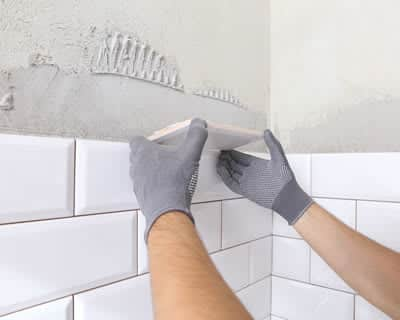
We can help you get more floor tiling work with our qualified job leads and boost your business.
Join today