17 Sep
Tile or slate roofing
Bampton, Burford, Carterton - OX18
Enquiry from: Sue A
Start Date: Immediate
Tile or slate roofing enquiry



In the South West, a typical job costs about £7,500, with prices from around £3,000 for small jobs to £11,800 for bigger ones. Too few tradespeople covering Cricklade have set their prices yet, so these figures are for the South West.
| Avg. price low | Avg. price low |
|---|---|
| Avg. price | Avg. price |
| Avg. price high | Avg. price high |
£12300
£9225
£6150
£3075
£0
Searches that showed one of our pages for Cricklade, all services
Searches that showed our page for Swindon
Searches that showed our page for Pewsey
Searches that showed our page for Malmesbury
Cricklade is a small town and also civil parish on the River Thames in north Wiltshire, England, midway between Swindon and Cirencester. It is the first downstream community on the Thames. The parish population at the 2011 census was 4,227. Cricklade Business Association stands for the neighborhood service neighborhood as well as has close links with other charitable organisations, such as the Rotarians, the Waylands Trust, and also the charity that runs the recreation centre. Cricklade's many hostelries consist of the Vale, the Old Bear, the White Hart, and the Red Lion. Beverages are likewise sold at the White Horse Members' Club as well as the leisure centre. An above-average percentage of the ward population ward was retired at the time of the 2011 census. There is a local museum in Calcutt Street run by the Cricklade Historical Society, housed in a former Baptist church. T. R. Thomson of Costorphine was a veteran local of Cricklade and also a relocating spirit behind the establishment of the society. His publication Materials for a History of Cricklade as well as numerous short articles have boosted the study of local background in the community. Cricklade has been twinned with the French town of Sucé-sur-Erdre considering that 1990. In June 2010 the 20th anniversary was commemorated in Cricklade. Sucé exists simply north of Nantes in the Loire Valley, 30 miles (48 kilometres) from the Atlantic shore. Check outs are exchanged in alternating years. Cricklade Twinning Association likewise holds get-togethers to raise funds towards holding the visits by Sucé to Cricklade.

Bampton, Burford, Carterton - OX18
Enquiry from: Sue A
Start Date: Immediate
Tile or slate roofing enquiry
Swindon - SN3
Enquiry from: Shusan R
Start Date: Immediate
Flat and pitched roof replaced
Swindon - SN3
Enquiry from: Kim B
Start Date: Immediate
New roof tiles and guttering and fascias replaced
Swindon - SN1
Enquiry from: Taha A
Start Date: Immediate
Tile or slate roofing enquiry
Swindon - SN3
Enquiry from: Michelle P
Start Date: Immediate
Tile or slate roofing enquiry
Swindon - SN2
Enquiry from: Anthony R
Start Date: Immediate
Tile or slate roofing enquiry
Swindon - SN3
Enquiry from: Kim B
Start Date: Immediate
Complete new roof and guttering
Swindon - SN25
Enquiry from: Jane S
Start Date: Immediate
Polycarbonate roofing sheets have holes and need replacing. it's a lean to style so hopefully straight forward to replace
Swindon - SN3
Enquiry from: Cliff R
Start Date: Immediate

Roof: pitched · Property: semi detached · Built: 1930-1970 · Height: 1st floor
Swindon - SN2
Enquiry from: Karen S
Start Date: Immediate
Old tiles ,felt batten off . Replace with new . Involves a porch
Swindon - SN1
Enquiry from: Sterry D
Start Date: Immediate
Material: slates · Property: terrace · Height: 1st floor · Bedrooms: 3-4 rooms
Answer a few quick questions, so we can match you with local roofers who can help.
Get free, no-obligation local tile or slate roofing quotes from 4 verified roofers working in Cricklade.
Compare customer reviews, services and prices, and choose the right tradesperson for you.


A good straight company. A good straight company. Used them twice now and both times the price has been good and the work has been carried out on time, to a high standard and no mess left behind. Any ...
Easy to use Easy to use, got us a great roofer that we needed urgently.
Very good Very good, as previously stated I received next day responces
One of the most popular choices for roofing materials are roof slates. There is a number of advantages that a roof slate has, hey can be aesthetically pleasing, they can also increase the potential selling value of the house and many more. Slate is a sturdy and resilient material that delivers waterproofing physical characteristics to a pitched roof. Unlike other roof materials which absorb water slates do not. Therefore, slate is the most resistant towards freezing and water damage.
Find out the pitch of your roof
Before beginning with the fitting procedure, you need to figure out the pitch of your roof. The roof pitch commands how much overlap is essential with each slate. This has been made a lot easier than the early days with the advancement of technology.
Find out the required overlap
Once you’ve found out the exact pitch of your roof accurately, take a look at the slate producer’s description. Each manufacturer will propose the obligatory overlap in order to form a firm and safe slate roof.
Roll out the roof membrane
Firstly, guarantee your joists or trusses are clean of any sheards or old nails that could harm the membrane. You will now have to roll the chosen roofing membrane along the roof trusses. It is always wise to start from one of the bottom corners and keep rolling it along to the other corner.
Secure the roof membrane
Once the membrane has been moved out, use thump nails to protect one edge. You will now have to pull the membrane taut and carefully fix it into position. Do this before adding any nails across the membrane at points of intersection with the trusses for extra stability.
Batten placement
This is done to find the proper assignment of the battens. For this, you will need two full-sized slates along with an under eaves slate. Carefully position the battens on the top of the roof on the top of the overlay. Make sure not to fix them down since it will be easier to move them around and make any adjustments.
An eave is the edge of a roof, which is why they are now and then called roof eaves. On a household's outside, eaves can stick out outside the side of the building, serving both ornamental and applied purposes. The eave of a house has come to mean the lower area of the roof that projects after the external covering, as opposite to a cornice, which is part of the entablature in Classical architecture.
Think of how a roof outspreads outside the covering, and then think about how a hard rain may roll down the roof and, on the ground, away from the structure. Centuries ago, the eavesdrop was that indentation line made around a structure when the rain fell off the edge of the roof onto the ground.
Types of Eaves
A roof can come to a conclusion in essentially three ways. A closed eave is the one which has very little or no overhang at all. An open eave has a visible overhang, projecting beyond the roof brackets. A boxed eave is surrounded with a soffit.
The Use of Eaves?
An eave can defend the siding and substance of a structure. A roof eave bulging beyond the sides permits snow and rain to fall from the roof away from the covering, to the ground. The more the "weather" gets thrown away from the household, the chances of you having a dry basement increases.
In cases of regions with a warmer climate, a large eave can help provide shade to the interior of the house. In rainy environments, the prolonged eaves of Asian architecture deliver shelter from the climate, as well as direction. In the 21st century, an eave may be an inconspicuous site for security cameras and light.
The task of installing a tile roof can be quite a difficult one. Such a project takes a great deal of preparation, well before the actual tile installation is done. It does not matter if you are putting new ones or replacing your old tiles, understanding the proper technique and steps become crucial.
Remove old roofing (if applicable).
This is, on its own, a major job that can take days and require special tools. It takes some time, but be prepared to do it right.
Install battens (if applicable).
Battens may be needed to hold the tiles in place if the roof is having a steep slope. Usually made of metal or wood, battens are generally 1 inch thick and run horizontally along the roof.
You can find several varieties of tiles that has a hook or a lip allowing it to hang on the available battens. Apart from this, you can find several clips in the market which help to attach the tiles on to the batten.
Determining the spacing for battens can be done easily using two tiles. To prevent interlocking, a three inch overlap is required at the minimum, and a smaller amount of overhang should be left over the eaves. Keep this in mind when you determine the locations of the battens.
After you have determined the distance between the first two battens, measure the distance and set battens using that spacing up, making sure to double-check measurements as you go along.
• Install the tiles.
• You will need to begin with one side first, and then continue to move along the length of the roof.
• Cut tiles to fit tight spots.
• Tiles have to be cut precisely to overcome any obstacle like the chimney.
• Install the ridge tiles.
After completing the broad surfaces of the roof, special ridge tiles are required to cap the top.
A pitched roof is a type of roof that is defined to have a sloping surface that has an angle that is greater than 20 degrees. Pitched roofs offer a more classical appearance. They remain the most communal and effective answer in wet and cold weathers to guarantee all-out protection.
Eaves
In the roof, the lower part of the inclined roof which is prominent outside the external face of the wall. The chief purpose of eaves is to pour the rainwater from the roof straight on the exterior wall. It also provides protection from sunlight. Eaves are sometimes decorated to an architectural beauty.
Gable
The Three-sided higher part of the wall at the end of a ridge roof.
Flashing
A band of impermeable material, typically metal, used to eliminate water from the intersection between a roof covering and another part of the structure. Flashings are provided to stop moisture from inflowing the wall and roof through joints in copings, parapet wall, and other infiltrations through the roof plane.
Hip
The Hip is defined as the exterior angle, which is generally greater than 180 degrees, which is formed at the inclined ridge of the roof slopes.
Ridge
The ridge is defined as the horizontal intersection made by the rising roof surfaces that are inclined in opposite directions.
Purlins
Purlins are the horizontal members which are laid on the principal rafters which help to support the common rafter of a roof. This is usually done when the span is large. Purlins are made from wood or steel. The top surfaces of the purlins intend to be unvarying and plane.
Fascia
This is the wooden board that is fixed to the feet of the common rafter at eaves. The Fascia helps the lowest ends of the roof covering material to rest on it.
Rafter
One of the major structural components of a pitched roof is a rafter. The rafter generally begins for the support of the roof to the ridge or hip. The purlin is supported by equally spaced rafters used side by side.
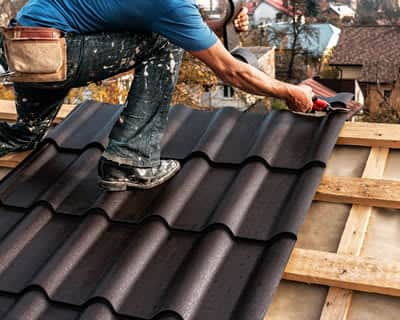
We can help you get more tile or slate roofing work with our qualified job leads and boost your business.
Join today