02 Jan
Bricklayers
Whitland - SA34
Enquiry from: Charles M
Start Date: 1 to 3 months
Property: detached · When: 1-3 months



Extensions will require brickwork of some form, either to infill the existing gaps or even to add insulation to existing brick walls. For most conversions, the garage door is infilled and a solid wall with a couple of windows is put into the front or side of the house.
This brick wall will require foundations or lintel supports which might or might not already be present under the existing door. Usually the window will not be a full width to match the existing garage door, therefore the new brickwork wall should take this into consideration. Depending on the current thickness of the outer brickwork walls, they will likely require additional insulation. This is usually done by adding interior wall insulation like insulated plasterboard, or with the addition of an additional layer of brickwork to create a cavity wall. These options are again determined by the existing garage foundations. Furthermore, if any of the walls are shared with a neighbouring property, the brickwork must adhere to building regulations on sound proofing. With all brickwork on garage conversions, it is important to take into account the existing brickwork of the home.
In contrast to lots of beliefs, a bricklayer actually does greater than laying of blocks. There's even more to being a bricklayer than you can most likely consider. A solitary bricklaying projects needs a large range of abilities. Let's look at these skills!
This is not just an aesthetic choice, as matching existing brickwork could be a condition of planning permission or building regulations in your area. We will provide as much as 4 Bricklayers pros in your area, that will provide quotations for the job you want done. You'll obtain a property visit from specialists in Abergwili that'll assist you to select the right Bricklayers for your home before carrying out the installation. Enter your postal code to begin browsing now.
The common cost of Bricklayers is £400. Costs fluctuate based on the materials and the tradesman chosen. The upper price range can be as high as £460. The material costs are in general around £100
| Avg. price low | Avg. price low |
|---|---|
| Avg. price | Avg. price |
| Avg. price high | Avg. price high |
£600
£450
£300
£150
£0
| Labour cost | £280 | |
| Material cost | £100 | |
| Waste removal | £20 |
Searches that showed one of our pages for Abergwili, all services
Abergwili is a community in Carmarthenshire, Wales. It has a population of 1612 and is also an electoral ward.
Abergwili is famous for its Bishop's Palace, which has been home to the Bishop of St David's since 1542. It was erected between 1283 and 1291, when Thomas Bek was Bishop of St David's. The palace used to be a college of priests, and villagers knew it as a college until it formed with another to form Christ College in Breacon. It still has the chapel added by Archbishop Laud in 1625. Carmarthenshire County Council bought the palace in 1974 to use it as a museum, and they built the bishops a new dwelling in the grounds. Until 1802 there was a river called Towy running past the palace, but it changed course and left an oxbow lake. Now it contains lots of wildlife.
There is a public farm in Abergwili called Merlin's Hill Centre. It sits next to Merlin's Hill, and there is a footpath that goes right to the top. There is an Iron Age hillfort at the peak.
If you require a replacement [product] for your property in Abergwili, ensure you do a comparison of quotations from no less than three trustworthy firms.
Whitland - SA34
Enquiry from: Charles M
Start Date: 1 to 3 months
Property: detached · When: 1-3 months
Answer a few quick questions, so we can match you with local builders who can help.
Get free, no-obligation local bricklayers quotes from 4 verified builders working in Abergwili.
Compare customer reviews, services and prices, and choose the right tradesperson for you.

Quick contact
Left me with the necessary information .

Would highly recommend, they found me a firm which I was happy with a quote they give me and went ahead and had my job done within 2 days of enquiring.
Well, just like many other team work, a bricklayer is only as good as his supporting cast. And a hard-working labourer should be able to keep three bricklayer gangs happy. But even when he gets to serve just one bricklayer, the site conditions and nature of the wall can also play a huge role in determining the number of bricks that can be laid within 24 hours.
With the best possible site condition, hard-working labourer and best scenario with no pillars, no face brick, long straight wall and no wall ties, a well trained bricklayer should be able to lay within a range of 800 to 1100 bricks all day long. However, you rarely get walls like this as there is always going to be some corner or curve somewhere which usually takes some time to get right. Furthermore, once the bricklayer has laid up to 5 feet, there’ll be a need to get some lift. From that point onwards, the job understandably gets slower and tougher - meaning there’ll most definitely be a face brick.
In addition, there are multiple other factors that can affect the number of bricks that can be laid in a day. Sometimes its the complex designs or weather that’ll determine the daily rate.
With the aforementioned factors and more realistically, on a good day and great site, an expert bricklayer should be able to lay about 500 to 800 bricks in a day. This is generally a very good target, but of course you never can tell with the reasons above and other factors that are simply beyond the control of the bricklayer. If you have a project and want it completed as soon as possible, you can pay the bricklayers based on the number of bricks laid to increase their efficiency.
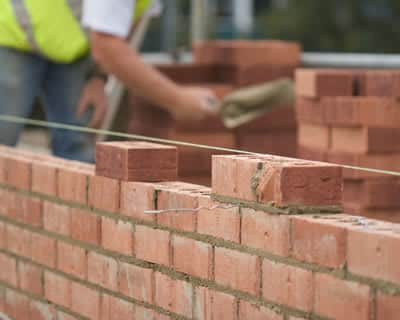
This is an individual who is trained in the art of working with concrete blocks or bricks, clay bricks as well as other kinds of mortar building materials. In a combination of these materials and good bricklaying skills, a bricklayer can build and repair veneer as well as full brick construction, arches, partitions and other structures.
Contrary to many beliefs, a bricklayer actually does more than laying of bricks. There’s more to being a bricklayer than you can probably think of. A single bricklaying projects requires a wide array of skills. Let’s have a look at these skills!
• Using damp resistant materials to seal foundations.
• Spreading mortar between joints and applying them to serve as a thick layer binding the bricks together in rows.
• Reading and working from specifications as well as plans.
• Working with brick-cutting machines.
• Taking charge and caring for cement blocks or bricks, clay bricks and the likes.
• Construction of scaffolding - subject to possession of some licenses in some states.
A bricklayer mostly works outdoors, in the field and may also work at heights. Depending on the job, a bricklayer can work as part of a team or be in contact with the public. They are mostly recruited by building and construction companies and bricklaying sub contractors. However, they can also set up their own private construction firm or become a self employed tradesperson.
A bricklaying qualification is one of just two construction trades which can continue to become a registered builder. And regardless of the form a bricklaying employment takes, there are certain qualities that makes a really good bricklayer. These includes:
• Ability to work at heights and outdoors
• Enjoy practical work
• Technical aptitude
• Good hand-eye coordination
• Independent and yet a team player too
• Top physical fitness
• Attitude and attendance.
Laying of bricks is a skilful trade which requires the bricklayer to fully understand the process involved in the required building material preparation necessary to construct a foundation as well as to mix the concrete or mortar. As a tradesperson, you also need to fully comprehend how to make use of various materials and master the art of shaping, polishing and cutting it. A typical bricklaying endeavour is expected to include different activities such as preparation of the surface, assembly, installation, reinforcement as well as repair.
As a result, every aspect of the job demands an in depth and extensive knowledge, skills and also experience. To get started in this career path, you can also consider getting a bricklaying license as this will stand you out from the lots from your customer’s point of view. However, to obtain a bricklaying license, you’ll need to have some qualifications which includes an industry experience in the field as well as a trade certificate. These formal and nationally recognized qualifications can be gotten through the Recognition of Prior Learning.
It must, however, be said that several states will require either a building practitioner registration or a bricklaying license to enable you practice as a professional bricklayer in order to ensure that the national standards for quality is always met. In other states, a bricklayer must meet some certain registration requirements or possess concrete licenses. Some will necessitate that you register as a building practitioner to take on certain projects but only to a particular level.
Overall, a bricklaying license will help you meet the building commission’s requirements so as to avoid stern punishments like fines and sanctions. It also allows you to sign legal contracts and agreements, market your services and lots more to steer ahead of competition in the industry.
Do you want your house to be built using brick? Or perhaps you just require the professional services of a bricklayer. Regardless of your bricklaying needs, the cost charged depends on each job as every job is unique. Bricklayers generally look at each task individually and charges based on the complexity of each. We’ve put together this guide to give you an idea of the costs charged by bricklayers. Let’s have a look!
Generally, bricklayers charge either based on a daily rate or a fixed price for a particular amount of bricks ( usually a thousand bricks or 10 - 12 metres square). On the average, an experienced bricklayer can charge within a range of £150 to £200 daily rate and if a labour is needed for the job, an additional £60 to £100 may be included to get the job completed in a quick and fast manner. If the quoting is done based on the number of bricks to be incorporated, then a thousand bricks will be quoted in between £350 to £450 which should be completed in a couple of days.
You should however take note that most times, the bricklayer’s cost will depend on the amount of work involved in the project. As a result, a more tedious and challenging project will most definitely cost more than a simpler one. Examples of some difficult projects that’s likely to cost more are hard to reach areas, difficult sites as well as second storeys which are considered to be more challenging than single storey buildings. What’s more? The complexity of the project is also a great cost factor. While some projects are basically direct and straightforward, others involve curves and more complex designs which will ultimately make the cost jump up.
We can help you get more bricklayers work with our qualified job leads and boost your business.
Join today