


Commercial / Industrial Roofing in Kirknewton

Compare Commercial / Industrial Roofing Prices in Kirknewton

Home > Roofing Projects > Commercial roofing > Kirknewton

Commercial / Industrial Roofing in Kirknewton

On the lookout for commercial roofing in Kirknewton? Our commercial roofing professionals in Kirknewton are able to offer the ideal prices for getting commercial roofing installed or replaced.

Commercial roofs may be necessary for a number of reasons, particularly if the existing roof needs repair or it will be placed on a brand new build.

There are plenty of factors which will play a role in the structure and preparing of a new commercial roof structure and the cost will all depend on the size and style you select.

Thermoplastic roofing is especially popular. This kind of roofing is made from a durable material with high temperature tolerance. The material is a favourite for commercial roofs as it's resistant against ultra violet and chemical exposure. The roof covering lasts for over 20 years, having a great resistance for fire, punctures and high wind loads.

You may also look at EPDM roofing. The durability and versatility of EPDM roofing can make it a popular material in the commercial roofing world. These kinds of roofing material have the advantage of being much easier to install, sustain and repair too, leading to their popularity.

If you want to install commercial roofing then make sure to check quotes between vetted experts in Kirknewton. By doing this you will get the very best price and offer available for you within Kirknewton.

Average Commercial roofing cost in Kirknewton

In the UK, a typical job costs about £5,050, with prices from around £500 for small jobs to £10,000 for bigger ones. Too few tradespeople covering Kirknewton have set their prices yet, so these figures are for the UK.

Typical commercial roofing prices in the UK

Avg. price low

Avg. price low
£500

Avg. price

Avg. price
£5,050

Avg. price high

Avg. price high
£10,000

£10500

£7875

£5250

£2625

£0

Based on the price ranges set by 45 tradespeople who cover the UK (the middle values of their lowest and highest prices per job). Your price depends on the size of the job, access and materials.
Time frame: 1-2 weeks
Advertisement

Commercial roofing on Google in Kirknewton

Google searches that showed Local Quotes, 18 July to 15 October 2026

1,394

Searches that showed one of our pages for Kirknewton, all services

Source: Google Search Console, the number of times our pages appeared in Google search results. It counts searches that showed the page, not quote requests.

Commercial roofing searches near Kirknewton, 18 July to 15 October 2026

30

Searches that showed our page for Edinburgh

Kirknewton

Kirknewton is a town previously in the county of Midlothian as well as, given that 1975, in West Lothian, Scotland. The population of the Kirknewton Community Council district is 2200, that includes the village and also surrounding areas. It lies southern of the A71 from Edinburgh to Livingston, and north of the A70, the top-level road that runs along the north side of the Pentland Hills from Edinburgh to Carnwath as well as Lanark. Much of the town stands back from the B7031, which links both primary "A" roads.

Looking for Commercial roofing in Kirknewton?

Get free quotes from local roofers

Get free quotes
Advertisement

Local & reliable roofers near me

Tell us about your commercial roofing project

Answer a few quick questions, so we can match you with local roofers who can help.

Find up to 4 roofers in Kirknewton

Get free, no-obligation local commercial roofing quotes from 4 verified roofers working in Kirknewton.

Hire with confidence

Compare customer reviews, services and prices, and choose the right tradesperson for you.

Our reviews

Average

Quick identification of interested ...

Quick identification of interested local tradesmen

Helpful finding local trader to quo ...

Helpful finding local trader to quote for my work

very effecient

very effecient

FAQs

How to install commercial rubber roofing?

How you install commercial rubber roofing is similar to fitting it on a residential property, except that the area that’s covered is likely to be bigger. With commercial properties, you should always leave any maintenance and repair works to the professionals – whether you own or lease the property, you could invalidate any insurance if you try to install rubber roofing yourself. We’ll outline the steps roofers will take when installing rubber roofing on a commercial property.

Firstly, the installers will remove any existing coverings and clean and dry the surface thoroughly. This is vital in ensuring that the rubber will stick. They will then unwrap the EDPM rubber membrane and leave it to rest until it’s fully expanded. On a warm day this may take around half an hour.

Next, the roofers will work with half a sheet of rubber at a time and adhere it to the roof surface. They may use a water-based adhesive which they will spread onto the roof in sections, then roll the membrane onto the surface before moving onto the next section. If they’re using a bonded adhesive, they will apply it to both the roof and the rubber and leave it to dry until it’s tacky before extending the membrane.

Once the EDPM rubber is rolled out, the installers will brush the surface with a large broom to get rid of bubbles and provide a stronger bond. Then they will work of the edges, applying adhesive to roof and walls edges, sealing corners and creating watertight seals. They’ll also tidy up any excess membrane and seal all the trims.

As long as it’s installed correctly, your commercial rubber roofing should last you decades without any repairs needed. It’s always best to inspect your roof regularly to spot any damage before it becomes a bigger problem.
What is the best commercial roofing material?
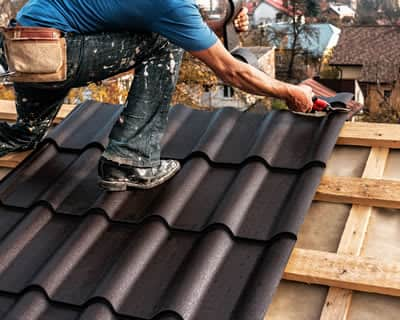
The best commercial roofing material for your building will depend on the size and type of roof you have as well as your budget. A lot of commercial buildings have flat roofs, but some have pitched roofs. These days, flat roofs are almost flat, but are usually built on a small slope so water can drain effectively. Pitched roofs are much steeper and are made using tiles or shingle. Our top choices for commercial flat roofs would be fibreglass or EDPM rubber. Both of these materials will set you back around £80-110 per square metre, making them some of the most expensive flat roof materials, but they’re strong and durable. A fibreglass roof consists of a cut glass fibre mat that is pressed on the roofing frame, then resin is poured and rolled over the roof before a topcoat is applied. An EDPM roof involves laying an EDPM rubber membrane on the roof surface then gluing it down and coating it with a contact adhesive. For pitched commercial roofs, our top material would be concrete tiles or metal. Concrete tiles will set you back anywhere between 40p and £2.90 per tile and they’re long-lasting and fire-resistant. However, they are heavy and can be susceptible to high winds. Metal roofs have been used for over 50 years and today’s modern systems are extremely strong and allow for structural or thermal movement. Aluminium roofs will cost between £40-75 per square metre, plus installation. These days, flat roofs are almost flat, but are usually built on a small slope so water can drain effectively. Pitched roofs are much steeper and are made using tiles or shingle. Our top choices for commercial flat roofs would be fibreglass or EDPM rubber. Both of these materials will set you back around £80-110 per square metre, making them some of the most expensive flat roof materials, but they’re strong and durable. A fibreglass roof consists of a cut glass fibre mat that is pressed on the roofing frame, then resin is poured and rolled over the roof before a topcoat is applied. An EDPM roof involves laying an EDPM rubber membrane on the roof surface then gluing it down and coating it with a contact adhesive. For pitched commercial roofs, our top material would be concrete or clay tiles. Concrete tiles will set you back anywhere between 40p and £2.90 per tile and they’re long-lasting and fire-resistant. However, they are heavy and can be susceptible to high winds. Clay tiles cost as little as 50p to £2 each and can last over 50 years, but they are heavy so if your commercial roof isn’t already, it will need to be reinforced.

Am I liable for a leaking roof in a commercial property?

Whether you’re liable for a leaking roof in a commercial property will depend on your ownership status and any contracts. Of course, if you own a standalone commercial property, it would make it your responsibility to repair to leaking roof. But if you own an office within a building, you should check your paperwork to see whether you are responsible for some or all of a leaking roof.

If you’re a tenant in a commercial property, things get a bit more complicated. Lots of commercial leases are FRI, or Full Repairing and Insuring leases, which means that the tenant is responsible for all external and internal maintenance and insuring the building. It means that it’s vital that you read through your tenancy agreement in full before signing it and seek legal advice if you think you need it. If your lease is an FRI lease, you are liable for a leaking roof in your commercial property.

It’s important to ensure that you have a schedule of condition for the property, which will mean that you only have to restore the commercial property back to the condition that it was in when you took over. It’s also worth getting the roof inspected before you sign the lease, as if there is any damage before you sign the landlord may be responsible.

The best way to avoid having to pay for a leaking roof in a commercial property is prevention. If you are liable for repairs and maintenance, make sure you have the roof inspected regularly by a reputable company to avoid having to pay for costly repairs when disaster strikes.

Why do commercial buildings have flat roofs?

There are a few reasons why commercial buildings often have flat roofs. Lots of people argue that flat roofs aren’t as attractive as pitched roofs, which is why it’s uncommon to see a residential property with an entirely flat roof. Lots of commercial buildings don’t need to look attractive, so go for flat roofs because they’re cheaper.

Flat roofs tend to be less expensive than pitched roofs, especially for large, broad commercial buildings. Some commercial buildings simply couldn’t have a pitched roof because their width would mean that the roof would have to be extremely high. Flat roofs are also cost-effective for commercial buildings because it means that air conditioning and ventilation units can go on the roof, saving space in and around the building.

Commercial buildings also often have flat roofs because they don’t need the loft space that residential properties need. If there’s no need for the space, it doesn’t make sense to spend more money on a pitched roof just to keep the attic space empty. Flat roofs also give the commercial building owner the opportunity to use the space as a smoking area for employees or give access to fire escapes to upper floors.

If you’re having a commercial property build, make sure you speak to the experts about the type of roof that is suitable for you. If you’re planning on having air conditioning or ventilation systems installed within the property, you might be best off with a flat roof – but if you need some extra storage space, a pitched roof might work best for you.

Commercial roofing

Other Top Projects in Kirknewton

Are you a roofer in Kirknewton?

We can help you get more commercial roofing work with our qualified job leads and boost your business.

Join today