Paving & Driveway | Block
Ballymoney - BT54
Enquiry from: Mr W
Start Date: Immediate
Estimate of replacing tarmac driveway with asphalt and insuring that drainage is foolproof.
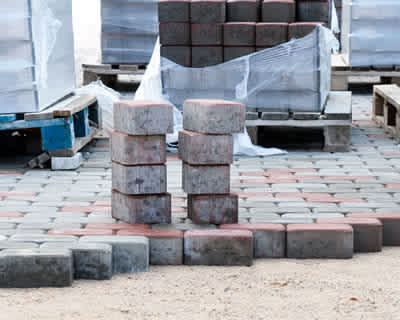
Block paving can look great as a driveway. It really is an elegant and functional answer to your driveway and can give your home great kerb appeal. Whether you want a classic herringbone design or something a bit different, there are many block paving materials and options available to you. The bricks used in block paving are most commonly manufactured from clay, but some are made up of different composite materials. Among the main advantages to block paving is that if a few of the bricks get broken over time, they can easily be replaced. In addition, it means that it's easier to perform work under the surface of the paving without leaving a mark. The most common pattern that driveway companies lay is the herringbone pattern since it has the strongest interlock, rendering it a fantastic choice for driveways. The herringbone pattern is created by the tradesperson by setting the blocks at 45 degrees or 90 degrees to the perpendicular. Both types of herringbone pattern create an elegant and interesting look for your driveway that will make your home look fantastic to potential buyers. Complete our online form to speak to up to 4 driveway companies who can provide you with a quote for a block-paved driveway.
The typical cost for a block paving project is about £4,000. For smaller areas of paving, or if you live in a cheaper area of the country, expect to pay approximately £3,000, but for larger areas or within the London area, costs may be as much as £4,600-£5,000.
| Avg. price low | Avg. price low |
|---|---|
| Avg. price | Avg. price |
| Avg. price high | Avg. price high |
£4700
£3525
£2350
£1175
£0
| Labour cost | £2,800 | |
| Material cost | £1,000 | |
| Waste removal | £200 |
Requests for quotations in Ballycastle in June 2026
Requests for Block paving quotations in Ballycastle in June 2026. 0% change from May 2026.
Requests for Block paving quotations in County Antrim in June 2026. 0% change from May 2026.
Ballymoney - BT54
Enquiry from: Mr W
Start Date: Immediate
Estimate of replacing tarmac driveway with asphalt and insuring that drainage is foolproof.
Ballymoney - BT54
Enquiry from: Michele F
Start Date: Immediate
Driveway asphalted Are you the property owner: Owner of the property Property Type: Detached Do you require: Tarmac What work is required: Driveway Roughly how much area are you looking to have paved:...
Ballymoney - BT53
Enquiry from: Laurence K
Start Date: Immediate
need a patio approx. 10ft x 10ft. with design slabs matching paths surrounded by brick are you the property owner: owner of the property property type: semi detached do you require: block paving loca...
Ballymoney - BT53
Enquiry from: Marina M
Start Date: Immediate
I just need cheap way t do a driveway
Ballymoney - BT53
Enquiry from: Pamela L
Start Date: Immediate
145 m2 grass at present, would like all paving
Ballymoney - BT53
Enquiry from: Rob H
Start Date: 1 to 3 months
Remove gravelled drives and lawn. Replace with block paving. approx. 150 sq metres
Ballymoney - BT53
Enquiry from: M
Start Date: Immediate
Concrete driveway tarmac 10- 40 feet
Answer a few quick questions, so we can match you with local driveway installers who can help.
Get free, no-obligation local block paving quotes from 4 verified driveway installers working in Ballycastle.
Compare customer reviews, services and prices, and choose the right tradesperson for you.
Would highly recommend, they found me a firm which I was happy with a quote they give me and went ahead and had my job done within 2 days of enquiring.
Good easy way to find a selection of trades you need all in one place.
Love Local Quotes it's a big part of my Business I would recommend to anyone
Your contractor should have access to your driveway and a power source. If they have these things, you don’t need to be there while they’re working on your driveway. However, it’s worth being around if you can so you can clarify details and answer any questions.
The most commonly used driveway surfacing materials are gravel, asphalt, concrete and paving - which can be block, slabbed or patten imprinted. Take a look at our product information pages to help you decide which one to use and which one will look best for your driveway.
Are you having weed problems on your carefully picked out block pavings? After spending huge bucks to install the block pavings, the last thing any homeowner would want to discover is weed taking over the prized asset. Fortunately, this is a problem that can be effectively handled in a few simple steps provided in this article.
Basically, sealing of block paving is all about prevention of weed growth in the area by total weed removal, putting of sand between the block paving joints and sealing with a good quality sealant. This is a task that’s best left for a reliable professional to guarantee the best results especially if you lack proper training and experience. This guide will give a good insight into the process.
Here are the equipment you’ll need to get started: pressure washer, weed killer, bin bag, broom, small brush, protective gear, sealing roller, spueegee, jointing sand and sealer and DIY sprayer.
lRemove The Weed
• Put on a protective clothing and gloves
• Get a weed disposal bag to clean while you go.
• Apply the selected weed killer on both areas where weeds are present and the absent ones to prevent any growing.
lPressure Washing
• Angle your pressure washer between the gaps. This is done to remove all weeds and debris that are still lying around as well as removing all possible chemical residues to create a thorough clean between the paving slab.
• Leave the washed area to dry.
l Sand The Joints
• Check the weather forecast to ensure there’s about 24 to 48 hours of dryness as its important for both sand and sealant to do a perfect job.
• Put sand between the gaps and push it down with your small brush until its levelled.
lSeal The Gaps
• The sealing process should be done immediately and sanding.
• Clean up the patio
• Perform a test using a small area
• Apply the sealant
• Apply the second of sealant
• Leave to dry for about 2 to 3 hours.
How To Lay Block Paving
Do you wish to know how to install block paving? We’ve got you covered! Here, you’ll find a useful step by step guide that’ll provide you with all the necessary information to lay a wide range of block paving products available in the market today. You must, however, note that the installation of block paving can be a tricky affair and should not be attempted unless you have undergone a proper training or have a good experience in the field. If otherwise, we’d advise you to leave the task for a reliable block laying professional to guarantee the best results and also avoid making costly mistakes.
lDesign
• Draw up a design to perfectly suits your needs.
• Decide on the type of block as well as colour.
lExcavation
• Use a mini excavator or a JCB ( depending on the size of the job) to excavate the driveway.
• Identify and mark out the area to be excavated.
• Dug out the area until you reach a suitable level
• Ensure that the proposed finish level is 150mm underneath the damp proof course in any of the adjoining building’s brick.
lEdge Restraints
• Build a 100mm depth-thick concrete foundation with the help of a concrete mixer, 1 part cement and 6 parts ballast.
• Position the kerb unit on top of the level with a string line and spirit level.
• Use a trowel and rubber mallet to mortar the kerb unit to the foundation.
• Haunch the back of the kerb units in such a way that the concrete reach half way up the kerb’s rear.
lSubbase
• Put the crushed concrete in the edge restraints and ensure it’s at the desired level of 50mm.
• Use a vibrating plate to compact and level
lScreeding
• Apply a layer of sharp sand (to 50mm depth) and campact it using a vibrating plate.
• Apply second layer of sharp sand (to 20mm depth) on top of the first layer.
• Level the second layer to the correct falls.
lInstallation Of Paving
• Lay the block paving starting from the bottom of a slope.
• Ensure the blocks are placed at about 10mm to 15mm above the required finish level.
• Make sure the blocks used are between 3-5 packs as you proceed with your desired pattern. You may need to cut smaller block pieces to fill smaller gaps.
lFinishing Touches
• Clear out the area to ensure no debris is left on the blocks.
• Put kiln dried sand and brush across the whole of the area, ensuring the sands falls between the blocks’ joints.
• Compact the drive with the vibrating plate.
• Brush more kiln dried sand over the area and compact again
• Repeat the process until the joints are full of sand.
We can help you get more block paving work with our qualified job leads and boost your business.
Join today