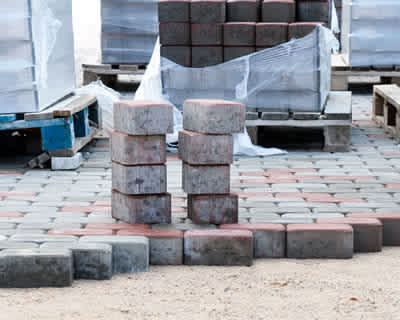
- Prepare the sub-base The driveway company will excavate, or dig, the existing surface down to a depth of around 200mm. They will remove any debris from the area may place it in a skip or arrange for it to be removed in another way. When they dig down to the sub-base of your previous driveway, they will assess how much hardcore they need and arrange for that to be delivered to the site. They will then spread the hardcore across the sub-base to create a level surface to pour the concrete on. Most good contractors will apply a gel to any walls and doors to protect them from concrete splashes. They will also add any gulley tops, manhole covers or shuttering that’s required.
- Installation and imprinting Next, the tradespeople will have the concrete either poured from a large mixer vehicle or barrow it in from a mixer and pour onto the surface. They level it with rakes, then add a colour surface hardener in a colour of your choice. This will give the driveway its permanent colour. They will then wait until the concrete has hardened to the correct consistency for imprinting the pattern, then will use special tools and stencils to make the pattern that you asked for. They will then spread a colour powder called a release agent over the surface, and leave to dry for 1 to 2 days depending on the weather conditions.
- Cleaning When the contractors return, they will add crack control cuts into the concrete. This is important because concrete expands and contracts in the heat, so there needs to be some give to stop any larger cracks from forming. Then everything is power washed clean, and a chemical wash is also used on the concrete to ensure it’s completely dust-free. The installers will ensure all your walls and doors are clean, which will hopefully be an easy job if they used wall gel.
- Sealing The final step is to seal the driveway. There needs to have been at least two dry days before the tradespeople can do it, so you might find it’s best to have your pattern imprinted driveway installed in the summer. The contractors will blow any debris away from the surface and dry any damp areas where necessary. They will then add an anti-slip agent to the sealant and brush it on. It’s best to not walk or drive onto your new concrete driveway for about 4 days after sealing to allow everything to set. But after that, you’re ready to use your new driveway!
Isle Of Benbecula
Benbecula is an island of the Outer Hebrides, in the Atlantic Ocean off the west shore of Scotland. In the 2011 census it had an usually resident population of 1,283, with a sizable percentage of Roman Catholics. It develops part of the area carried out by Comhairle nan Eilean Siar or the Western Isles Council. The island has to do with 12 km from west to eastern and a comparable distance from north to southern. It exists in between the islands of North Uist and also South Uist; it is connected to both by road embankments. Traveling to any of the various other Hebridean islands, or to the British mainland, is by air or sea. Benbecula Airport on the island has daily trips to Glasgow, Stornoway and Barra. A direct service to Inverness was introduced in 2006 however discontinued in May 2007. There are no direct ferry solutions from Benbecula to the landmass, however a service operated by Caledonian MacBrayne from Lochboisdale on South Uist supplies a five-hour crossing to Oban on the landmass, whilst another service from Lochmaddy on North Uist gives a two-hour going across to Uig on the Inner Hebridean island of Skye, as well as therefore to the mainland through the Skye Bridge. Ferry services from the islands of Berneray (linked by causeway to North Uist) as well as Eriskay (connected to South Uist) attach to the various other Outer Hebridean islands of Harris as well as Barra specifically. There is a thick collection of lochs throughout nearly the entire island, and almost all of the island is below 20 metres in altitude.